
Summary
- i96 Soluções Tecnologia e Consultoria is publicly visible as a Recife, Pernambuco micro-enterprise with a live company site, CNPJ 39.559.432/0001-72, and a service pitch around telecom technical support, Linux servers, DNS, monitoring, IP address management, backups and advanced MikroTik, Cisco and Huawei configuration.
- The strongest network-resource evidence does not show i96 as the registrant of five Brazilian autonomous systems. It shows i96, under the Registro.br handle ISTCO17, as administrative and abuse contact across AS265174, AS266962, AS268711, AS269671 and AS271350, which supports a network-operations role for other providers.
- The commercial mechanism is a support contract under cost pressure: local engineering time, field visits, router and fibre gear replacement, upstream connectivity, monitoring software and billing collection all have to be recovered through recurring customer payments, while much of the equipment stack is priced or benchmarked in dollars.
- The weak hinge is licensing and customer-scale proof. i96's public site and CNPJ record prove an active technology-support company, and the RDAP records prove repeated operational responsibility in Brazilian number-resource records, but the current public Anatel provider dataset is not strong proof that i96 itself is a retail broadband access provider.
Established: i96 has a live public website at https://i96.com.br/ describing telecom and technology services; public CNPJ mirrors list I96 SOLUCOES TECNOLOGIA E CONSULTORIA LTDA as an active micro-enterprise in Recife with primary activity "Suporte técnico, manutenção e outros serviços em tecnologia da informação"; Registro.br RDAP records at https://rdap.registro.br/domain/i96.com.br and https://rdap.registro.br/autnum/265174 tie the same i96 name and contact domain to domain administration and to network-resource administration. Reasonable inference: i96's repeat appearance as administrative and abuse contact on five Brazilian ASNs indicates a paid operations, support or consulting role for small providers that need routing, abuse handling, monitoring and escalation coverage. Still missing: audited revenue, customer contracts, direct Anatel service authorization under i96's own CNPJ, headcount, hardware inventory, upstream invoices and any public SLA document that would prove the exact economics of a managed account.
The customer sees one bill, while i96 sees many clocks
Start with the Brazilian customer who has the least patience for infrastructure explanations: a small business with a payment terminal, staff phones, a back-office computer, a Wi-Fi router under the counter, a camera recorder, a cloud accounting system and one person who gets blamed when the connection drops. That customer may not know whether the circuit arrives through fibre, fixed wireless, a local carrier, a reseller or a support contractor. It knows only the monthly amount, the time it takes to get help, and the cost of a bad afternoon when card payments fail or WhatsApp stops receiving orders.
That is where a provider such as i96 is economically interesting. The firm's own website does not present it as a giant access carrier. It presents "i96 Soluções" as a telecom and technology partner and says it provides technical solutions for a sector whose demands keep evolving. The homepage at https://i96.com.br/ lists Linux servers and hypervisors, recursive and authoritative DNS, Zabbix monitoring, PHPIPAM for organizing IP addresses, speed-test environments using Ookla, Minha Conexão and Nperf, backup strategies, advanced equipment configuration, remote access and technical support. The same page says its support is performed inside and outside business hours to keep services available.
For the customer, that reads like convenience. For the contractor, it is a stack of clocks. The router clock starts when a device needs a firmware update, a power supply fails, a customer asks for a guest Wi-Fi change, or a fibre handoff moves from one cabinet to another. The support clock starts when the business calls after closing time. The billing clock starts every month when the customer has to pay before the provider has collected enough cash to replace equipment.
The upstream clock starts before any customer pays, because the network owner or managed customer still needs transit, peering, tower capacity, server hosting, DNS and monitoring to be ready. The replacement clock starts when an imported router or optical module is bought in a currency that is not the customer's salary currency.
This is why the article is not about whether "support" is a soft business. In small broadband and managed-connectivity markets, support is the hard product. The circuit may be resold, the router may come from a global vendor, the switch may be commodity hardware, and the domain may be hosted elsewhere. The value is that somebody knows the topology, holds the passwords, can read the monitoring alert view, can speak to the upstream provider, can distinguish a Wi-Fi issue from a route issue, and can decide whether a site visit is worth sending. The customer buys that judgment as much as it buys bandwidth.
The renewal question is therefore brutal: can a local technical provider raise or defend the monthly price when the customer's own revenue is not rising at the same speed as the provider's input costs? A bakery, small clinic, shop, agency or local ISP customer may accept a support premium after an outage. It may resist the same premium when the service is quiet. The better i96 performs, the less visible its work becomes. That is the paradox of managed connectivity: uptime weakens the customer's memory of why the support contract exists.
The legal identity is a technology micro-enterprise, not a faceless routing label
The first useful public check is identity. The company site footer gives CNPJ 39.559.432/0001-72 and names i96 Soluções as the rights holder. Public CNPJ mirrors, including BrasilAPI at https://brasilapi.com.br/api/cnpj/v1/39559432000172 and CNPJ.ws at https://publica.cnpj.ws/cnpj/39559432000172, list the legal name as I96 SOLUCOES TECNOLOGIA E CONSULTORIA LTDA. They show the company as active, founded on 2020-10-26, classified as a micro-enterprise, located in Recife, Pernambuco, and registered under a main activity for technical support, maintenance and other information-technology services. The same records list secondary activities that matter for the operating thesis: custom software development, web design, customizable software licensing, IT consulting, data processing, application-service provision, internet hosting and professional training.
That profile matters because it keeps the article from treating i96 as a mystery ASN label. It is a small legal company with a technology-support registration, a public website, a domain, a CNPJ and service language aimed at telecom operations. It also sets a ceiling on what can be assumed. A micro-enterprise with R$30,000 of registered capital is not automatically a facilities-based access carrier with its own fibre network, tower estate and direct retail base. It is more plausibly a specialist contractor selling scarce knowledge to customers whose own networks are larger than their internal technical teams.
The Registro.br RDAP domain record at https://rdap.registro.br/domain/i96.com.br adds another identity layer. It shows i96.com.br as active, created in 2019 and expiring in 2027, with HostGator nameservers and i96 Soluções Tecnologia e Consultoria as the administrative contact under the ISTCO17 handle. The domain record also matters because the same contact domain, i96.com.br, appears in the number-resource records. That cross-link is cleaner than a marketing page alone: the website, domain administration and ASN contact trail all point to the same small technical organization.
There is still a caution. The public CNPJ classifications are IT and support categories, not proof of a retail broadband licence. "Provedores de serviços de aplicação e serviços de hospedagem na Internet" appears as a secondary activity, but an activity code is a registration category, not a customer count or network footprint. The firm can be important to broadband economics without being the subscriber-facing carrier. In Brazil's regional-provider market, the person who configures the router, cleans up addressing, fixes DNS and takes the after-hours call may sit between the end customer and the licensed network owner.
That position can be valuable precisely because it is operationally close and legally light.
The five ASNs make i96 look like an operations desk for other networks
The clearest infrastructure evidence comes from Brazilian RDAP records. Registro.br RDAP pages for AS265174, AS266962, AS268711, AS269671 and AS271350 each show a different registrant organization, but each also shows i96 Soluções Tecnologia e Consultoria under handle ISTCO17 in administrative and abuse roles. The direct public URLs are https://rdap.registro.br/autnum/265174, https://rdap.registro.br/autnum/266962, https://rdap.registro.br/autnum/268711, https://rdap.registro.br/autnum/269671 and https://rdap.registro.br/autnum/271350.
That distinction is the core evidence hinge. AS265174 is registered to MENTRIX TELECOM LTDA, not i96. AS266962 is registered to G M DA COSTA INTERNET. AS268711 is registered to ULTRACONECT COMUNICACAO LTDA. AS269671 is registered to MORAIS NET. AS271350 is registered to FSNET PROVEDOR. Yet the routing and abuse contact on each record points to i96's ISTCO17 contact. That does not make i96 the owner of those networks. It does make i96 hard to dismiss as a thin consulting label with no repeatable role in network operations.
The practical meaning of administrative and abuse contact roles is not glamorous. It can include keeping contact data current, receiving complaints, coordinating routing changes, answering registry and security mail, managing who is allowed to speak for the network, and responding when traffic or address reputation becomes a problem. In a small provider, that work can be handled by a founder. In a network that has grown beyond the founder's personal bandwidth, it is often delegated to a consultant or managed-operations partner.
The pattern across five ASNs suggests i96 is trusted by multiple provider owners or operators to sit in that operational path.
The prefixes attached to those records are also evidence, but only as evidence. AS265174 links to 167.249.204.0/22 and 2804:2bc4::/32. AS266962 links to 45.226.124.0/22 and 2804:4604::/32. AS268711 links to 45.171.124.0/22 and 2804:5994::/32. AS269671 links to 45.191.124.0/22 and 2804:6824::/32. AS271350 links to 181.189.64.0/22 and 2804:7a24::/32. Those blocks should not be treated as companies, products or independent actors. They show the size and type of network resources for which the named registrants and their contacts carry responsibility.
The RDAP dates add a timing signal. The i96 ISTCO17 handle was created in 2021 and most of the ASN records show 2024 changes placing or keeping that handle in operational roles. The legal company was founded in late 2020. That sequence fits a young technical consultancy moving from formation into visible network-operations work over the next several years. It does not prove revenue, but it does show a public footprint that is more specific than generic "IT consulting."
The route views turn support into a bandwidth and escalation problem
BGP route views add useful context when they are handled carefully. The bgp.tools page for AS265174 at https://bgp.tools/as/265174 describes MENTRIX TELECOM LTDA as an active Brazilian eyeball network, shows one IPv4 and one IPv6 originated prefix, and identifies VISUAL LINK COMUNICACOES MULTIMIDIA LTDA - ME as the visible upstream. That is a fragile-looking operational picture: if a small network has one visible upstream in a public route view, the support desk has to know whether the resilience plan is commercial, technical or simply absent.
The bgp.tools page for AS266962 at https://bgp.tools/as/266962 looks different. It identifies GILSON NET as an active Brazilian eyeball network, shows multiple originated IPv4 and IPv6 routes, lists four visible upstreams, shows many peers, and records IX.br São Paulo entries with 10 Gbps link speeds on several ports. That does not make i96 the operator of the whole network. It does illustrate the range of problems a support contractor can be pulled into. A customer with one upstream asks for availability. A customer with multiple upstreams, IX ports and peers asks for policy, route filtering, incident diagnosis, peering hygiene and change control.
This is where upstream bandwidth becomes a cost even when the support provider is not reselling every megabit directly. A managed account still needs someone to explain whether congestion is last-mile, upstream, peering, server, DNS, Wi-Fi, customer equipment or application-side. A cheap support retainer that assumes every ticket is a quick remote login will fail when the issue is a BGP policy change, an IX session, an overloaded customer router or a carrier outage. The consultant's price has to include the probability of rare but expensive diagnosis.
The public route views also explain why the customer may not care who legally owns the network. The user sees latency, packet loss and support response. The provider sees upstream invoices, route announcements, address blocks, prefix filters, IX sessions, DNS, monitoring and customer complaints. i96's opportunity is to translate those hidden dependencies into a monthly service that the customer can understand. Its risk is that the customer compares the bill with a commodity fibre plan and ignores the engineering that makes the plan usable.
The local labour margin is the first input to break
The i96 website's most revealing service claim is not the equipment list. It is the promise of support inside and outside business hours. After-hours availability turns a simple consulting engagement into an on-call economics problem. A support person cannot be billed only for the minutes spent on a call if the provider also needs them to be reachable, rested, trained and trusted. A field visit cannot be priced only as fuel if it interrupts a queue of remote issues. A configuration change cannot be priced only as a template if the wrong rule takes a customer offline.
For a Recife-based micro-enterprise, the labour base is local and real-denominated. Technicians, consultants and administrators are paid in reais. Their opportunity cost moves with local wages, competing job offers, transport costs and the stress of on-call work. The customer's willingness to pay is also local and real-denominated. The managed account therefore has a narrower pricing corridor than a dollar-priced SaaS product. If the provider raises prices too fast, the customer may downgrade to a cheaper access plan and ad hoc support.
If the provider holds prices flat, it eats the labour inflation and loses the time needed to make the account reliable.
The service menu makes this tension visible. Linux servers and hypervisors require patching, backup testing, disk and memory monitoring, access control and recovery planning. DNS requires conservative change discipline because a single bad edit can take mail or customer portals offline. Zabbix monitoring requires alert tuning, escalation rules and someone who knows which alarm is noise. PHPIPAM requires hygiene around addresses that otherwise become tribal knowledge. Speed-test environments require correct placement and interpretation, because a test can prove either customer equipment trouble or the provider's own bottleneck.
Advanced MikroTik, Cisco and Huawei configuration requires vendor-specific knowledge and a habit of not treating every site as the same.
That is the support margin. It is not a line item called "labour"; it is the share of the monthly account left after bandwidth, hosting, software, hardware, transport, tax, billing failures and customer service have been covered. The more customized the customer's network, the more labour is locked into memory of that network. The more standardized the provider's scripts and monitoring are, the more accounts one engineer can support. The public record gives evidence that i96 sells the type of work where that standardization matters. It does not show whether i96 has already achieved it.
Imported routers turn the exchange rate into a renewal argument
Hardware is the easiest cost for a customer to misunderstand. A small business sees a black box with blinking lights and assumes it should last until it dies. The provider sees an imported component whose replacement price moves with the dollar, local distributor stock, taxes and urgency. When a router dies during business hours, the customer asks for restoration, not a purchasing lesson. The support contract has to carry that spare-capacity problem before the failure happens.
MikroTik's own product pages make the dollar link explicit. The RB5009UG+S+IN page at https://mikrotik.com/product/rb5009ug_s_in lists a suggested price of $219 and describes a compact router with seven Gigabit Ethernet ports, one 2.5G port and a 10G SFP+ cage. The CCR2004-16G-2S+ page at https://mikrotik.com/product/ccr2004_16g_2splus lists a suggested price of $465 and describes a 1U router with 16 Gigabit ports and two 10G SFP+ cages. Those are not exotic carrier-core machines; they are plausible small-provider and SMB-edge devices. They are also priced in dollars before Brazilian retail markups, tax, freight, availability and warranty handling.
Banco Central's PTAX API gives the currency context. The official endpoint at https://olinda.bcb.gov.br/olinda/servico/PTAX/versao/v1/odata/ reported a dollar sell rate of R$5.1717 on 2026-07-03 for the period queried. A $219 router is therefore already roughly R$1,132 before local channel effects; a $465 router is roughly R$2,405 before local channel effects. For a customer paying a few hundred reais a month for managed connectivity, the replacement of one small router can consume months of gross margin if it was not priced into the contract.
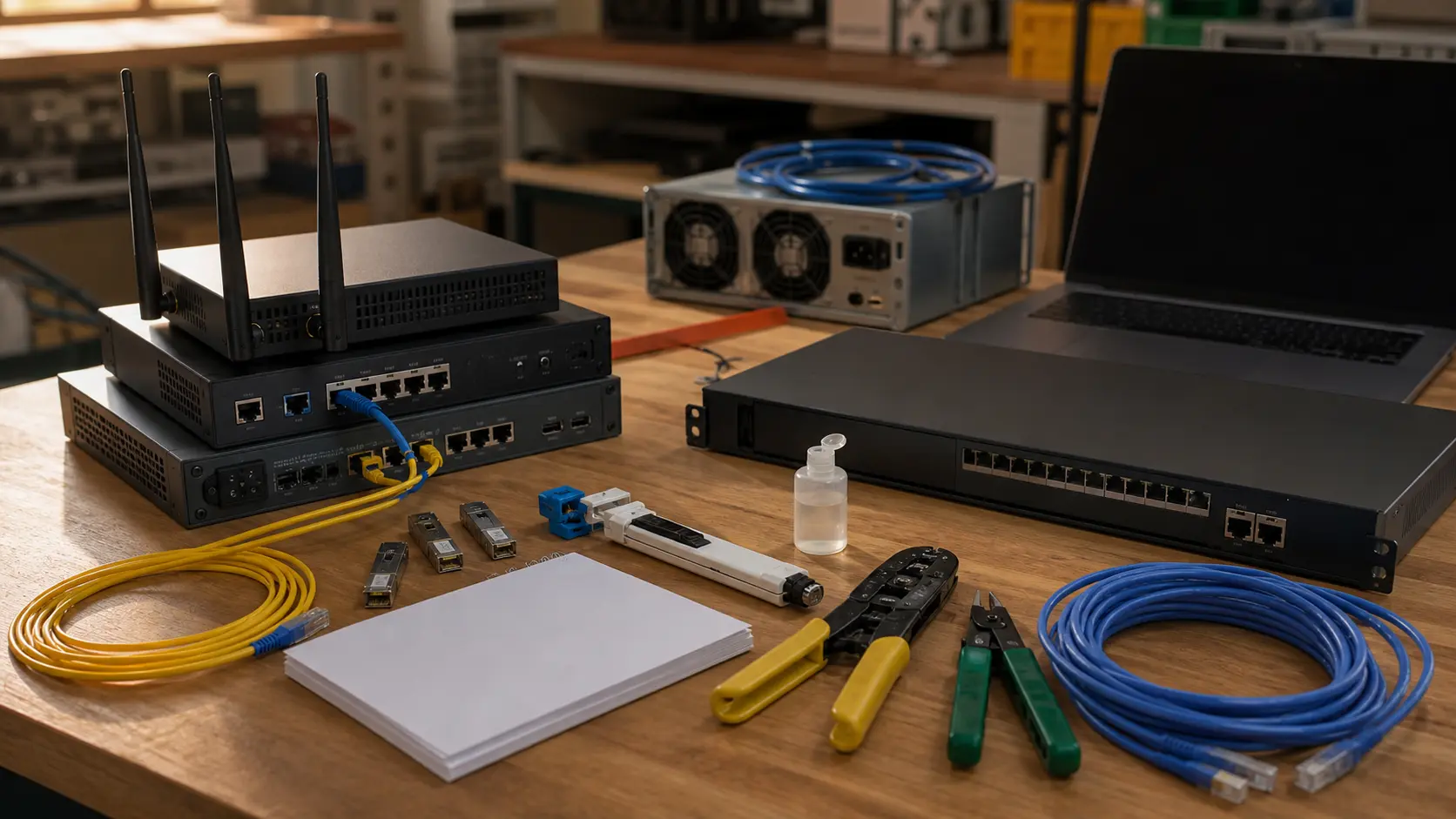
The same logic applies to SFP modules, fibre tools, wireless access gear, UPS batteries, antennas, switches and spare power supplies. The article does not need a single local price quote to prove the currency mismatch. The product pages show dollar-denominated benchmarks; the central bank shows the real-dollar rate; i96's service menu shows the equipment categories it configures and supports. The risk is not that every part is imported on the day of failure. The risk is that the replacement reserve is silently underfunded because customers resist a monthly price that includes future hardware shocks.
This creates a fairness problem in the renewal conversation. The customer may say the provider is charging for equipment it already owns. The provider may know that the old equipment is no longer the relevant cost; the relevant cost is the next equivalent device, the time to configure it, the trip to install it, the temporary workaround, the backup restoration and the lost evening when the outage happens after business hours. A sustainable support contract has to make that reserve visible without turning the proposal into a parts catalogue.
Billing collection is not back office; it is working capital
In small-provider economics, billing is part of network reliability. A customer that pays late does not simply create an accounting nuisance. It makes the provider finance bandwidth, hosting, labour and spare equipment longer than planned. If enough customers pay late, the provider has to choose between stricter collection, lower support quality, deferred maintenance or external credit. That is why recurring managed connectivity is not just a technical service. It is a working-capital loop.
Anatel's access-data panel at https://informacoes.anatel.gov.br/paineis/acessos says the regulator publishes monthly access counts for Brazil's main telecom services and that the data is supplied to Anatel by the providers themselves. This matters because the Brazilian broadband market is subscription heavy and monthly reporting oriented. Even when i96 is supporting another provider rather than billing the final broadband subscriber, the managed-service chain ultimately depends on recurring access revenue. The small business's payment funds the local provider; the local provider funds upstreams, support and replacement reserves; the support contractor gets paid only if that chain keeps moving.
The CNPJ record reinforces the small-company constraint. A micro-enterprise does not have the same balance-sheet tolerance as a national operator. It cannot absorb many months of unpaid support, unpaid equipment replacement or free after-hours work without changing behaviour. It must either enforce collections, price support higher, narrow the service scope, standardize equipment, or accept lower resilience. Each choice changes the customer experience.
This is why the opening customer's renewal decision is so difficult. From the customer's side, the monthly bill is a cost to be minimized. From the provider's side, the same bill is the only pool from which labour, upstream response, monitoring, spare routers, vehicle time, training, taxes and bad debt can be paid. If the customer compares i96-backed support with a raw access plan, it may miss the fact that the raw plan does not include the same escalation memory. If i96 cannot explain the difference in business language, it risks being treated as an optional technician rather than a continuity partner.
Anatel is a check on overclaiming, not a reason to ignore the company
Anatel evidence is important precisely because it prevents overclaiming. The official provider dataset for telecom service providers is available from the Anatel data pages, including the "prestadoras_servicos_telecomunicacoes.zip" file linked through https://www.anatel.gov.br/dadosabertos/paineis_de_dados/outorga_e_licenciamento/prestadoras_servicos_telecomunicacoes.zip. A direct public proof that i96's CNPJ appears there as a licensed retail telecom provider would materially strengthen the "regional ISP" classification. The available public evidence, however, is stronger for technology-support and network-operations responsibility than for direct retail access authorization.
That does not make i96 irrelevant to regional ISP economics. It changes the category of relevance. Brazil's regional broadband market is filled with small licensed providers, resellers, installers, consultants, tower operators, fibre contractors, monitoring specialists and network engineers. The customer experience often depends on the contractor behind the provider as much as on the formal licence holder. The RDAP pattern across five ASNs is exactly the kind of public clue that shows a contractor's operational position even when the contractor is not the subscriber-facing brand.
For readers, the right conclusion is cautious. i96 should not be described as the owner of AS265174, AS266962, AS268711, AS269671 or AS271350. It should not be described as a national broadband carrier. It should be described as a Recife technology and telecom support company whose public records connect it to administrative and abuse responsibilities across several Brazilian network-resource records. That is a meaningful role in a market where many small providers need outsourced technical depth.
The Anatel check also sharpens the investment and risk question. If i96 were a licensed access provider with a visible subscriber base, the main analysis would focus on churn, ARPU, fibre capex and retail competition. If i96 is primarily a support contractor for providers and businesses, the analysis shifts to labour productivity, customer concentration, support scope, tool standardization, customer payment discipline and the ability to pass through hardware shocks. The same network evidence matters, but the economic engine is different.
The supplier stack is global even when the relationship is local
i96's service page names MikroTik, Cisco and Huawei as equipment categories it configures. Those names point to a global supplier stack. The customer relationship may be local and Portuguese-speaking; the hardware road map, security advisories, firmware cadence, distributor availability and replacement pricing are global or at least internationally exposed. A support contractor has to bridge those worlds.
That supplier dependence creates several operational risks. First, firmware and security updates can force labour into accounts that were priced as quiet maintenance. Second, equipment availability can make a standard design suddenly expensive or impossible to repeat. Third, a customer whose network mixes vendors may require broader expertise than the monthly retainer originally assumed. Fourth, support documentation and community knowledge may exist, but turning that into a safe production change still consumes engineer time.
Fifth, a small company that becomes known for solving difficult network problems may attract accounts that are underpriced precisely because they are difficult.
The software side has the same structure. Zabbix is powerful, but monitoring only creates value if alerts are interpreted, thresholds are tuned and false positives are reduced. PHPIPAM can make address management cleaner, but only if the records are maintained when field technicians add equipment. Speed-test infrastructure can help diagnose user complaints, but only if tests are placed and interpreted correctly. Backups are a promise only when restoration is tested. Each tool improves scale if it is disciplined; each tool adds overhead if it is treated as a badge.
The provider's task is therefore to turn global components into a local operating procedure. That is a defensible business if i96 can standardize configurations, maintain templates, build repeatable monitoring packs, keep spare equipment policies, and price after-hours support correctly. It is a fragile business if each account is a custom rescue mission. The public website proves a broad service menu. It does not prove how much of that menu is standardized.
Competitive pressure comes from cheap access, not only rival consultants
The most obvious competitor for i96 is another technician or managed-services company. The more dangerous competitor may be the customer's belief that support should be bundled into a cheaper access plan. Brazilian small businesses can often buy broadband from a local ISP, a regional fibre provider or a national operator and expect some level of router and outage support. The managed provider has to explain why its higher-touch service is different.
The difference is usually not speed alone. A raw 600 Mbps or 1 Gbps access plan can look attractive on a flyer, but the business problem is continuity, response and control. Does the provider know the customer's internal addressing? Can it manage the firewall? Does it know which camera recorder, payment terminal, VoIP handset or guest network must be restored first? Can it talk to the upstream carrier without starting from zero? Can it configure replacement hardware quickly? Can it tell when a speed test is irrelevant because the bottleneck is Wi-Fi? These are the points where a support contractor earns margin.
The problem is that these points are difficult to sell before failure. Customers buy visible speed and visible price. They undervalue configuration memory until something breaks. That makes churn lumpy. A customer may leave after a quiet year, then return after a poor support experience elsewhere. A provider may discount to keep the account, then regret it when a failure consumes a weekend. The recurring contract has to price the average of quiet months and crisis months, while customers remember only the latest bill.
There is also pressure from the providers i96 supports. If the owner of a small ASN grows, it may hire internal network staff. If it shrinks, it may cut consulting. If it sells, the buyer may bring its own operations team. If it consolidates upstreams or outsources to a larger managed network, i96 may lose the technical relationship. The RDAP pattern across multiple ASNs is good evidence of repeatability, but it is also evidence of customer concentration risk if a few provider relationships account for a large share of revenue.
Vehicle time and spare stock are the hidden service level
The support contract also has a physical side that is easy to underprice. Remote access can fix a firewall rule, a DNS error, a queue setting or a monitoring threshold. It cannot replace a failed power supply, clean a fibre connector, reseat an SFP, move a router after a shop renovation, confirm whether an optical level is marginal, or explain why a customer's access point is being drowned by nearby interference. The moment a technician leaves the desk, the account consumes travel time, vehicle cost, parking, customer coordination and the opportunity cost of not solving other tickets.
For a Recife-based support company, that field-time problem is not abstract. A technician may need to cross town for a small business whose monthly payment barely covers the visit. The visit may happen during the same hours when other customers are calling, or after hours when the customer can tolerate downtime. If the contract treats every trip as included, the provider's best customers can subsidize the noisiest sites. If every trip is charged separately, the customer may delay a necessary visit until a small fault becomes a real outage.
A durable managed-connectivity plan has to decide, in advance, what remote support covers, how many field visits are included, what qualifies as emergency response, and who pays when customer premises wiring or power is the actual cause.
Spare stock is the other hidden service level. A provider that keeps a spare router, switch, SFP, power supply, fibre patch cord, wireless access point or small UPS can restore service faster. It also ties cash to equipment that may sit on a shelf for months. A provider that keeps no spare stock protects cash until the day a failure forces a scramble through distributors, couriers or borrowed equipment. The customer experiences this as support quality. The provider experiences it as inventory finance.
This is where wireless and fibre gear change the economics. A managed account is rarely only one router. It can include optical handoffs, patch panels, ONUs or ONTs, PoE injectors, access points, antennas, switch ports, cable runs, power protection and whatever small accessory failed at the worst possible time. A clean configuration file is valuable, but it does not help if the replacement device is unavailable or if the field technician does not have the right connector, cable, module or ladder.
The support promise therefore includes a quiet warehouse question: which parts are common enough to stock, which parts can be obtained locally, and which parts require a longer lead time that the customer has to understand before renewal.
The i96 public service list points directly at this issue because it combines remote tools with hardware configuration. MikroTik, Cisco and Huawei configuration, Zabbix monitoring, IP address management and backup strategy all reduce restoration time only if they are paired with repeatable field practice. If a replacement router arrives, the provider still needs the correct saved configuration, documented port roles, current passwords, a known upstream handoff, and a test method that proves the customer's real application is working. Otherwise, a spare device becomes another troubleshooting step.
The pricing implication is uncomfortable but central. A support provider cannot promise local response at commodity-access prices unless somebody else is paying for the vehicle time and spare stock. That somebody may be the final customer, the network owner, the monthly retainer, a separate emergency fee, or the provider's own margin. If the answer is unclear, the first serious outage becomes a negotiation. The customer thinks it bought support; the provider thinks it sold reasonable effort; both are surprised by the cost of doing the work properly.
A company such as i96 has value when it removes that surprise by writing the operating reality into the service scope before the incident.
The bullish case is operational trust across small networks
The bullish case for i96 is not scale in the national-operator sense. It is trust across small networks that cannot justify a full internal engineering bench. A company that can manage Linux services, DNS, monitoring, IP address records, backups, router configuration and after-hours support for several providers or business accounts can become a quiet infrastructure layer. It can make small networks less fragile without owning the customer relationship outright.
The five ASN records support that case because they show repeated public reliance on the same i96 contact for administrative and abuse roles. A one-off consultant might appear on one record. A repeat operations partner appears across several. The firm also has a coherent public service menu rather than only a domain or social page. Its CNPJ record aligns with the work: technical support, IT consulting, application services, hosting and training. The BGP views for at least two associated networks show real routing environments that need maintenance.
The margin upside is in standardization. If i96 can turn recurring problems into reusable playbooks, it can support more accounts per engineer. Examples include standard MikroTik baseline configurations, backup templates, Zabbix alert packs, DNS change procedures, access-control policies, IPAM hygiene, incident checklists and customer onboarding forms. The more it standardizes, the more a monthly retainer becomes profitable rather than merely busy.
There is also a relationship advantage. Local providers and small businesses often prefer a reachable person over a ticket queue. A Recife-based company with named consultants, a WhatsApp contact path and a Portuguese service site can sell reassurance in a way a distant vendor cannot. That advantage is not permanent, but it matters when the customer is weighing whether to renew after a problem. The closer the provider is to the customer's operating reality, the easier it is to defend support value.
The bearish case is underpriced complexity
The bearish case is equally clear. The service list is broad for a micro-enterprise. Linux, hypervisors, DNS, Zabbix, PHPIPAM, speed tests, backups, MikroTik, Cisco, Huawei, remote access and after-hours technical support can become a trap if priced as simple helpdesk work. A small team can win accounts by saying yes, then lose margin because every customer has a different network, different urgency and different willingness to pay.
The network-resource evidence also cuts both ways. Being administrative and abuse contact on several ASNs may indicate trust. It may also indicate exposure to incidents without ownership economics. If abuse complaints, routing mistakes, upstream outages or customer escalations land on i96, but the registrant controls the budget and final decisions, i96 carries operational stress without full economic control. The consultant has to be paid for accountability, not merely for configuration tasks.
The Anatel provider-data uncertainty is another bearish point. If i96 is not visibly licensed as a retail telecom provider under its own CNPJ, then it may have less direct claim on end-customer recurring access revenue. It may depend on contracts with the actual provider owners. That can be a good business if the contracts are sticky and professional. It can be a weak business if the provider owners treat support as a variable cost to cut during cash pressure.
Currency makes the downside sharper. Dollar-linked equipment costs can rise before local customers accept higher prices. The Banco Central PTAX rate near R$5.17 per dollar on July 3, 2026 shows the scale of that exposure. A spare router that looks affordable in dollars can become a significant local cash need after taxes and channel costs. If the support contract does not include a replacement reserve, the provider either delays replacement, asks the customer for a surprise payment, or absorbs the hit. All three choices can weaken trust.
What would change the judgment
Several facts would materially improve the assessment. The first is direct Anatel authorization under i96's own CNPJ, or a clear public explanation that i96 deliberately operates as a technical support contractor rather than a retail telecom provider. Either outcome would reduce ambiguity. The second is a customer or partner page naming providers or business segments served, without exposing sensitive network details. The third is a published support scope that distinguishes remote support, after-hours coverage, field visits, equipment replacement and monitoring responsibilities.
The fourth is evidence of standardization. A public description of managed monitoring, backup testing, configuration baselines or incident-response procedures would show that i96 is selling a repeatable service rather than only founder expertise. The fifth is stronger route and customer evidence over time: if the same i96 handle remains attached to multiple ASNs, and if more networks add it in operational roles, the repeatability case strengthens. If the handle disappears from those records, the current thesis weakens.
The sixth is pricing evidence. A public managed-support plan, even without exact customer names, would show whether i96 is trying to recover hardware reserve, upstream escalation and after-hours labour. A plan that includes only cheap remote support would suggest underpricing. A plan that separates monitoring, change management, incident response and field service would suggest a more durable commercial model.
For now, the answer to the opening customer is conditional. i96 is worth keeping if the customer is buying more than a line: monitored equipment, configuration memory, after-hours response, upstream escalation and disciplined replacement planning. It is less compelling if the customer only needs commodity access and is willing to tolerate generic support. The public evidence proves a real Recife-based technology-support company with repeated network-resource contact roles. It does not yet prove the revenue scale, licence position or customer concentration needed to call the business structurally safe.
That is why i96 is interesting. It sits in the gap between visible broadband and invisible support. Brazil's small-network market depends on that gap. Customers want local accountability, but they resist paying for the imported equipment, scarce engineering and upstream complexity behind it. i96's public record suggests it sells the skill to make those inputs feel boring. The investment question is whether boring can be billed at a price that survives the next router replacement, the next after-hours outage and the next customer who believes connectivity should only get cheaper.