
Summary
- A Fortinet renewal should be judged as an incident-continuity account, not as a narrow firewall refresh. The buyer pays for FortiGate capacity, FortiGuard security services, FortiCare support, partner labour, audit evidence, and a path for escalation when a breach drill exposes the cost of slow containment.
- Public evidence supports Fortinet's scale and product depth: its 2025 Form 10-K reports $6.80 billion of revenue, including roughly $4.58 billion of service revenue, while its official product pages describe FortiGate, FortiGuard and FortiCare as a combined hardware, cloud-intelligence and support model. That evidence does not prove that any one customer will contain a breach faster.
- The renewal is expensive because it absorbs seven costs at once: appliance capacity, scarce security labour, security-processor and supply-chain investment, compliance reporting, cloud and intelligence dependencies, switching work, and the practical substitute the buyer can choose.
- The final judgement is conditional. Fortinet earns the renewal where it lowers failure cost, keeps patch and support discipline credible, and lets the buyer show usable evidence after a tabletop exercise. It loses the account where the team has better labour coverage, stronger Microsoft or SASE economics, cleaner partner support, or a credible replacement path through Palo Alto Networks, Cisco, Zscaler, Microsoft, a managed provider, open-source controls or delayed renewal.
The Renewal Meeting Starts With A Failed Containment Clock
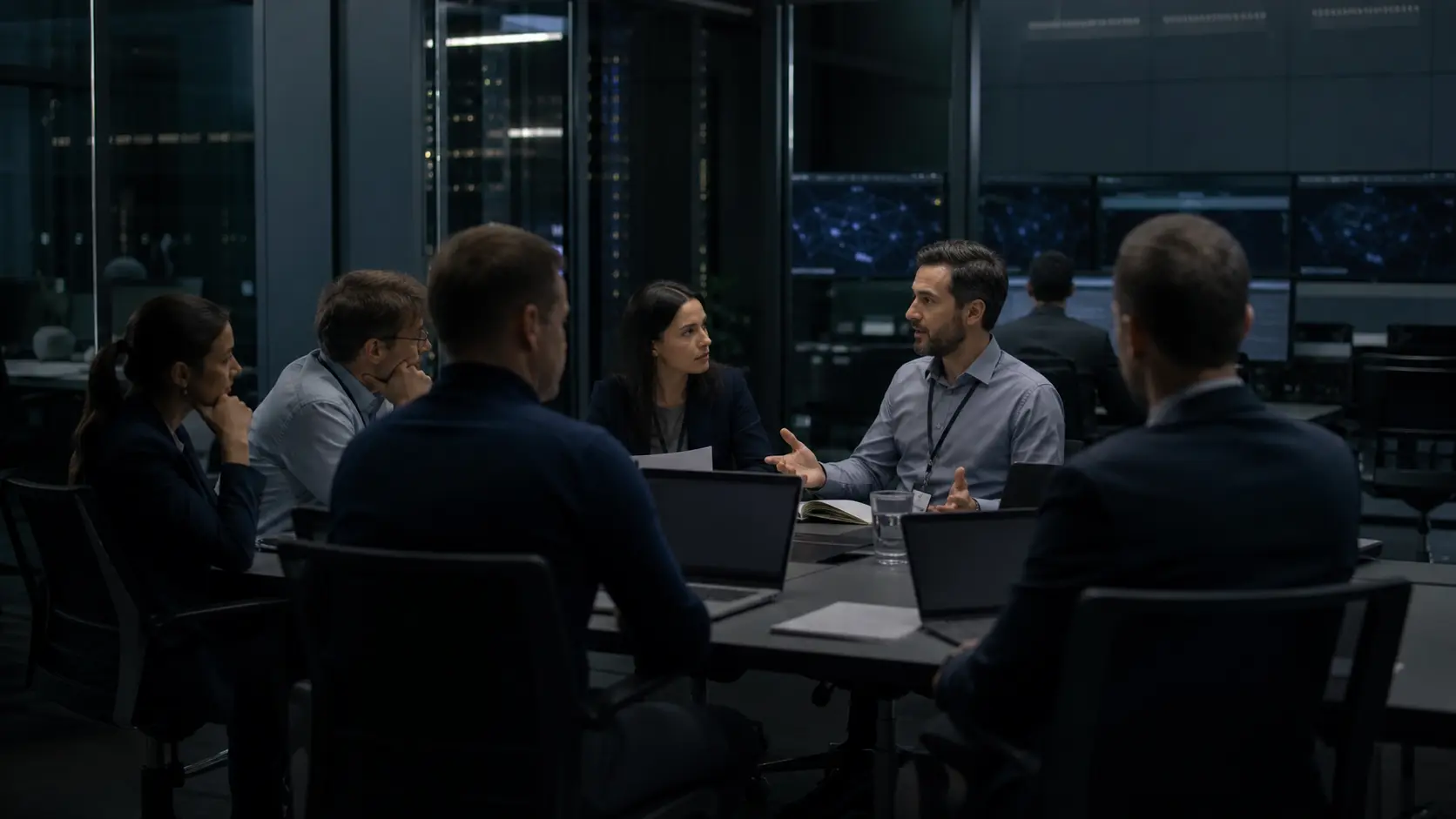
The most revealing Fortinet renewal meeting does not start with a discount table. It starts in the room after a breach drill, when the CISO, procurement lead, network architect and audit owner compare the minutes lost between first alert, policy check, VPN containment, firewall rule change, support escalation and board briefing. The red team did not have to win spectacularly. It only had to show that an expired service bundle, an unsupported operating-system branch, an overworked network engineer or a slow reseller response could turn an intrusion into a disclosure problem. At that point the renewal account has a different shape.
It is not "FortiGate hardware plus licences." It is a pre-paid claim on continuity.
The paid unit is therefore the firewall, security subscription and incident-continuity renewal account. In the first 200 words, that matters because the economic unit defines the proof frame. A buyer pays for throughput and inspection on a physical, virtual or cloud firewall; for FortiGuard feeds and security services that update the controls; for FortiCare support and replacement rights; for partner labour that designs, deploys and troubleshoots; and for the audit trail that lets management say what was monitored, patched and escalated. Fortinet's own next-generation firewall page frames FortiGate as a hybrid-environment control backed by FortiGuard AI-Powered Security Services and purpose-built security processors (https://www.fortinet.com/products/next-generation-firewall). The renewal has to be measured against that combined promise.
The breach drill gives the buyer three questions. First, what is actually being bought? The answer is not simply packets blocked at the perimeter. It is a bundle of security decisions delivered across hardware, operating system, cloud-delivered intelligence, central management, logs, support and local expertise. Second, why is the unit expensive after labour, capital, compliance, risk, time and failure costs are counted? It is expensive because the invoice is only the visible part of the renewal.
The hidden cost is staff time spent maintaining policies, testing upgrades, preserving logs, proving compliance, working with a channel partner, rotating credentials, staging replacement appliances and explaining exceptions to auditors. Third, how far does public evidence show that the account is worth paying for? Public evidence shows Fortinet's scale, product line, support promise, security-advisory process and market adoption. It cannot prove the buyer's own incident outcome.
That gap is not a reason to ignore public evidence. It is the discipline of the renewal. The 2025 Fortinet Form 10-K filed with the U.S. Securities and Exchange Commission says the company generated $6.80 billion of total revenue and $1.85 billion of net income in 2025, and that services were the larger part of the business (https://www.sec.gov/Archives/edgar/data/1262039/000126203926000007/ftnt-20251231.htm). The same filing describes FortiGuard and FortiCare as central services and says the company relies on channel partners for substantially all billings and revenue. The official FortiCare page describes lifecycle services from design to deployment, operation and evolution, with 24x7 global support, regional expertise and hardware replacement options (https://www.fortinet.com/support). The FortiGuard subscriptions page describes more than 20 services integrated across the Fortinet Security Fabric (https://www.fortinet.com/solutions/enterprise-midsize-business/security-as-a-service/fortiguard-subscriptions). These are strong facts about the vendor's model.
The drill then puts those facts under pressure. If the buyer cannot map which devices are protected, which services are active, which FortiOS versions are exposed to known advisories, which partner owns escalation, which logs answer audit questions and which applications still depend on VPN, the renewal is not a comfort purchase. It is a corrective action. That is why a serious procurement team prices the account through failure cost first.
The renewal is defensible when the avoided outage, avoided disclosure scramble, reduced audit labour and reduced security-team load are more valuable than the cash saved by a thinner support tier or a delayed refresh.
What The Customer Actually Buys When The Invoice Says Fortinet
Fortinet sells a broad security platform, but the renewal buyer experiences it as a smaller set of operational promises. The first promise is inspection capacity. FortiGate firewalls sit at branch, campus, data-center, cloud, OT and service-provider edges, depending on the deployment. The buyer expects them to inspect traffic without becoming the choke point that breaks the business during a busy day or an incident. Fortinet emphasizes purpose-built security processors, energy efficiency, SD-WAN, ZTNA and unified management on its firewall page (https://www.fortinet.com/products/next-generation-firewall). That positioning matters commercially because it converts a device refresh into a claim about consolidated network and security operations.
The second promise is current intelligence. A firewall that was excellent on the day it shipped becomes a stale control unless signatures, URL classifications, malware analysis, DNS filtering, intrusion-prevention rules and other security services keep moving. Fortinet's FortiGuard bundle page describes a-la-carte services and bundles, and presents FortiGuard as a real-time, always-on defence layer for FortiGate NGFWs (https://www.fortinet.com/support/support-services/fortiguard-security-subscriptions/fortigate-security-bundles). For the buyer, this is the part of the invoice that funds an external research and update function. It does not remove the need for local tuning, but it reduces the burden on a team that cannot individually research every exploit chain and campaign.
The third promise is support. Security teams do not buy support because they enjoy tickets. They buy it because the incident clock is cruel. If a HA pair behaves oddly during a maintenance window, if a firmware branch has a known issue, if a RMA is required, if a VPN configuration becomes part of a credential-rotation exercise, or if a patch creates unexpected behaviour, the account needs a path beyond community posts. Fortinet's support contact page says critical issues should be taken immediately to customer support, while lower-priority issues can use web tickets or chat, and the page points FortiCare Essential customers to web tickets through the portal (https://www.fortinet.com/support/contact). The Advanced Support page describes account-based services with relationship managers or technical account managers for larger or more critical customers (https://www.fortinet.com/support/advanced-support). Those distinctions turn support tier selection into a continuity decision, not a procurement afterthought.
The fourth promise is management coherence. A buyer with a few branch boxes may tolerate manual policy changes. A buyer with hundreds of sites cannot. Fortinet's product story leans on one operating system, unified policy and central management. In practice, the buyer is buying fewer places for mistakes to hide. That is valuable only if the local team can operate the controls, partner handover is clean, rule ownership is documented and logs can be retained in a form that auditors and incident responders can actually use. The invoice may say FortiGate, FortiGuard, FortiManager, FortiAnalyzer, FortiCare or related bundles.
The account is judged as a system.
The fifth promise is ecosystem continuity. Fortinet's partner program page says partners can engage as integrators, managed security service providers or marketplace participants, and it highlights specializations in secure networking, SASE, OT and security operations (https://www.fortinet.com/partners/partner-program/become-a-fortinet-partner). The partner locator page presents the partner ecosystem as a way for buyers to find implementation and managed-service help (https://www.fortinet.com/partners/partner-locator). For many mid-market buyers, this is not optional. They do not have enough in-house firewall engineers, incident responders or policy architects. The renewal therefore buys access to a labour market around Fortinet, not only Fortinet's own employees.
The sixth promise is board evidence. A breach drill increasingly ends with questions about governance. Who knew? What was patched? What was monitored? What controls were tested? What vendors were depended on? The SEC's cybersecurity disclosure rules for public companies require material incident disclosure and annual information about risk management, strategy and governance (https://www.sec.gov/newsroom/press-releases/2023-139). Even private companies feel the effect through customers, insurers, lenders and procurement questionnaires. A Fortinet renewal must help produce evidence for those audiences. If it only provides a technical control but leaves the buyer unable to show control performance, it is weaker than the invoice suggests.
This is why Fortinet's group revenue is context rather than proof. A large vendor can fund research, support, certifications, channel programs and product breadth. It cannot guarantee that a hospital, regional ISP, manufacturer, school district or SaaS provider has configured the product well. The customer buys a probability shift. The job is to make a breach less likely, a breach drill less chaotic, an audit less labour-intensive and a recovery less improvised. That is useful, but it has to be proven locally.
Seven Costs Sit Behind One Renewal Line
The first cost is operating capacity. A firewall account has to carry normal traffic, peak traffic, encrypted traffic, branch-to-cloud traffic, VPN traffic, management traffic and incident traffic. During a breach drill, capacity is not only throughput. It is the ability to apply new controls without breaking payroll, customer portals, factory lines, call-centre access or executive communications. Fortinet argues that purpose-built security processors accelerate security and networking functions and reduce power consumption (https://www.fortinet.com/products/next-generation-firewall). The buyer has to translate that into its own topology: inspection depth, latency, HA design, east-west visibility, failover, logging volume and maintenance windows.
The second cost is scarce specialist labour. Firewall engineering is not clerical work. Someone has to understand segmentation, NAT, VPN, routing, application control, SSL inspection, identity integration, SD-WAN, cloud tunnels, logging, threat feeds and firmware dependencies. Fortinet's 2025 Form 10-K says the company had 15,109 employees at year-end and explicitly describes a shortage of highly skilled employees for security companies. The buyer's own shortage is often worse. The renewal is expensive because it either buys labour through Fortinet, a partner, an MSSP or a trained in-house team.
If that labour is absent, a cheaper licence can become an expensive outage.
The third cost is capital and infrastructure intensity. Fortinet's business is not a pure software account. The 2025 Form 10-K describes product costs tied to third-party contract manufacturers, materials, shipping, logistics, quality control, inventory, repair and replacement. It also reports inventory purchase commitments of $810.6 million at December 31, 2025, up from $591.1 million one year earlier. Those commitments are not a buyer guarantee, but they show why hardware availability, component prices, tariffs and supply planning matter.
A procurement team that delays renewal too long may save cash while increasing exposure to lead-time, refresh and support-end risks.
The fourth cost is compliance and locality burden. A buyer with U.S. public-company exposure has SEC incident-disclosure duties. A bank, healthcare system, telecom provider, defence supplier, school or critical-infrastructure operator will face additional audits and customer questionnaires. IBM's 2025 Cost of a Data Breach page puts the global average breach cost at $4.4 million and emphasizes that crisis simulations, clear roles, backup testing and fast containment are part of resilience (https://www.ibm.com/reports/data-breach). The precise figure is not a Fortinet-specific price anchor. It is a reminder that the avoided cost is not only ransom or lost sales. It is legal review, incident response, downtime, evidence collection, customer notice, insurance friction and management time.
The fifth cost is upstream supplier dependence. Fortinet depends on component suppliers, contract manufacturers, cloud service providers, colocation providers, threat-intelligence collection and partner channels. Its own 10-K says customers may access products through Fortinet data centers and points of presence, third-party colocations and cloud providers such as Amazon Web Services, Microsoft Azure and Google Cloud. That is normal for a modern security vendor, but it means the renewal account includes dependencies the buyer does not directly control.
The buyer's question is whether those dependencies are better than running more of the burden in-house.
The sixth cost is switching. Firewalls are sticky because they encode years of policy decisions. A buyer that moves from Fortinet to Palo Alto Networks, Cisco, Check Point, Zscaler, Microsoft, an MSSP or open-source controls has to migrate rules, VPNs, logs, HA designs, monitoring, runbooks, training, audit narratives and partner responsibilities. Palo Alto Networks positions its NGFW platform around cloud-delivered security services, PA-Series appliances, VM-Series and Cloud NGFW (https://www.paloaltonetworks.com/network-security/next-generation-firewall). Cisco positions Cisco Firewall around Talos intelligence, unified management, cloud, campus, IoT and branch options (https://www.cisco.com/site/us/en/products/security/firewalls/index.html). These are real alternatives, but they move cost into migration, retraining and proof.
The seventh cost is the practical substitute. Sometimes the substitute is not another firewall. Zscaler's Zero Trust Exchange promises to hide applications, inspect traffic, reduce lateral movement and connect users directly to apps rather than to the network (https://www.zscaler.com/products-and-solutions/zero-trust-exchange-zte). Microsoft Defender offers coordinated defence across endpoint, identity, email, apps and cloud, and Microsoft emphasizes bundled licensing and cross-domain disruption (https://www.microsoft.com/en-us/security/business/microsoft-defender). A managed security provider may absorb operations. Open-source controls may cover a lab, a small environment or a specialist team. Delayed renewal may work for a buyer with low exposure and strong compensating controls. The renewal price is therefore constrained by substitutes, but only after the buyer prices the work those substitutes require.
Public Scale Supports Capacity, Not A Private Outcome
Fortinet's public filings make the first case for the renewal: the company is large enough to fund a serious security platform. Its 2025 Form 10-K reports $6.80 billion of revenue, up from $5.96 billion in 2024. Product revenue increased to about $2.22 billion, while service revenue rose to about $4.58 billion. Service revenue is the more important number for a renewal account because it reflects FortiGuard subscriptions, FortiCare technical support and related services that continue after appliance shipment.
The filing says service revenue increased because of revenue recognized from the deferred revenue balance tied to FortiGuard and other subscriptions, plus SaaS solutions including SASE and SecOps.
Deferred revenue is also economically important. At year-end 2025, Fortinet reported current deferred revenue of about $3.64 billion and non-current deferred revenue of about $3.48 billion. The 2026 first-quarter Form 10-Q later showed total revenue of $1.85 billion for the quarter and remaining performance obligations of about $7.45 billion (https://www.sec.gov/Archives/edgar/data/1262039/000126203926000013/ftnt-20260331.htm). For a customer, those numbers suggest that the business is not a one-time hardware seller. Fortinet has a large book of obligations to deliver security services over time. That can support investment in support infrastructure and updates. It can also create renewal pressure, because the vendor's model depends on customers continuing service subscriptions.
The public scale does not answer the buyer's most painful question: did Fortinet reduce our breach probability enough to justify the renewal? Public revenue cannot show whether a specific organization had a policy error, whether its partner configured SSL inspection correctly, whether its SOC ignored a relevant alert, whether its FortiOS version was current, or whether its incident runbook worked. The evidence is therefore strong at the vendor level and incomplete at the account level. That is why the breach drill is the right frame. A renewal is justified when the buyer can connect vendor scale to local operating evidence.
The 10-K also helps explain Fortinet's incentives. It says the company relies significantly on revenue from FortiGuard and other security subscriptions and FortiCare technical support services, and that a decline or fluctuation in those services could affect operating results. That is a useful warning. The seller wants a larger, longer, more bundled renewal. The buyer wants exactly enough coverage, no unused shelfware and a support path that works. The conversation should not be framed as faith in Fortinet.
It should be framed as coverage: which services are active, which assets they cover, which controls they update, which logs they generate, which support tier applies, which SLA or response expectation is realistic, and who acts during an incident.
Fortinet's official trust page adds another form of evidence. It says Fortinet is U.S.-based, incorporated in Delaware, publicly traded on Nasdaq, regulated by the SEC, headquartered in Sunnyvale, has over half a million customers, and has an integrated portfolio of more than 50 enterprise-grade products (https://www.fortinet.com/trust). The SafeBase-hosted trust resource center lists security, quality, privacy, access-control, network-security, application-security, data-security and cloud-hosting resources (https://trust.fortinet.com/). These pages do not prove product quality by themselves, but they help compliance teams assemble vendor-risk evidence. For regulated buyers, that can reduce audit friction.
Scale also brings concentration and complexity. The 10-K says Fortinet relies on third-party channel partners for substantially all billings and revenue, and that a small number of distributors represents a large percentage of revenue and accounts receivable. That matters because the buyer's support experience may depend on a reseller, distributor, regional service provider or MSSP as much as on Fortinet's global capability. A great vendor with a weak local partner can still create incident friction. A strong partner can make a mid-market buyer much more capable than its headcount suggests.
The right conclusion is neither that Fortinet's scale guarantees safety nor that public filings are irrelevant. Scale funds options. It supports product breadth, threat research, cloud services, certification, training, support centres, replacement depots and partner programs. But the buyer has to turn those options into a tested local system. The breach drill is the only honest way to decide whether that happened.
Support Is Part Of The Product When The Breach Is Real
Support looks like an overhead line until the first incident bridge. Then it becomes part of the control. If a firewall is suspected of misclassifying traffic, if a patch needs emergency validation, if a VPN profile has to be disabled, if a RMA threatens a branch outage, or if a logging gap blocks an investigation, the support path determines whether Fortinet's product can be used under stress. The account is not only about the product doing the right thing automatically. It is about the human and contractual path when it does not.
Fortinet's support page gives the buyer concrete points to test. It describes FortiCare Services as lifecycle support across design, deployment, operation and evolution, including Professional Services, Advanced Support, Priority RMA, Secure RMA and Technical Support (https://www.fortinet.com/support). It lists 24x7 global support, more than 1,800 certified global resources, three regional centres of expertise, 23 support centres, 40 regional depots, more than 200 in-country depots, and four-hour expedited hardware replacement availability. These are not guarantees for every account at every location, but they are the public support promise a buyer can turn into due-diligence questions.
The support contact page is equally useful because it distinguishes critical issues from routine ones. It directs critical Priority 1 or Priority 2 issues to immediate customer-support contact, while Priority 3 or 4 issues can use web tickets or chat. It also says FortiCare Essential customers can open web tickets through the portal (https://www.fortinet.com/support/contact). That matters in a breach drill. If the buyer discovers that its support tier, reseller arrangement or portal registration does not match the severity it expects, the renewal decision changes. The cheapest support option may be rational for a lab. It may be reckless for the edge that protects remote access into a regulated business.
Advanced Support changes the question again. Fortinet describes it as account-based support with high-touch account management, business guidance, service relationship managers and technical account managers for medium, large and global enterprises (https://www.fortinet.com/support/advanced-support). The buyer should not buy that tier because it sounds prestigious. It should buy it when the failure-cost calculation demands a named escalation path, proactive review, continuity planning, upgrade guidance and a small group of people who know the account before the incident.
The most important test is not whether support exists. It is whether support can be used. In many organizations, the people who own procurement do not hold portal credentials. The people who hold portal credentials do not own contract details. The partner knows the topology but cannot approve emergency changes. The SOC sees the alert but cannot change firewall policy. The audit owner needs evidence but does not know which logs are retained. A Fortinet renewal absorbs some of this friction only if the buyer writes the roles down and rehearses them. Fortinet can sell support; it cannot automatically give the buyer a crisis operating model.
The history of edge-device exploitation makes this practical. Fortinet's PSIRT page publicly lists advisories, including FortiOS and FortiProxy issues, severity levels, affected products and remediation material (https://www.fortiguard.com/psirt). CISA's Known Exploited Vulnerabilities feed includes multiple Fortinet vulnerabilities, including FortiOS/FortiProxy authentication bypass and SSL-VPN items, with required remediation actions for federal agencies and other users that follow KEV discipline (https://www.cisa.gov/sites/default/files/feeds/known_exploited_vulnerabilities.json). The presence of Fortinet in KEV is not unusual for a widely deployed edge-security vendor. It is precisely why renewal discipline matters. Devices at the edge attract attackers; support, patch management and credential rotation are part of the product's real economics.
The support-cost question can be answered during the drill. How quickly can the team identify affected devices? How quickly can it confirm active subscriptions? How quickly can it map an advisory to its deployed firmware? Can it reach a human with the right severity? Does the partner know the account? Can the team rotate VPN, LDAP and administrator credentials without breaking the business? Can replacement hardware be staged? Can logs support an investigation? A buyer that cannot answer those questions is not evaluating a renewal; it is discovering a continuity gap.
Compliance Turns Logs Into Board Evidence
The compliance burden attached to a firewall renewal has grown because cyber incidents have become board, investor, insurer and customer events. The SEC's 2023 rules require public-company registrants to disclose material cybersecurity incidents and to provide annual information about risk management, strategy and governance. The Form 8-K disclosure clock generally runs four business days after the company determines an incident is material, and annual reports must describe processes for assessing and managing material cyber risks and board oversight (https://www.sec.gov/newsroom/press-releases/2023-139). A firewall renewal does not create those duties, but it affects the buyer's ability to satisfy them.
The breach drill should therefore ask what evidence the Fortinet account can produce. Can FortiAnalyzer or another logging system show blocked events, allowed exceptions, administrative changes, firmware versions, VPN sessions and policy history? Are logs retained long enough for the relevant legal, insurance and customer deadlines? Can the buyer distinguish a prevented attack from an undetected one? Can it show that known exploited vulnerabilities were reviewed, patched or mitigated? Can it prove which partner or internal team made changes? These questions are not bureaucratic decoration.
They are the path from a technical incident to a credible management statement.
Fortinet's Trust Resource Center helps with vendor-risk documentation by listing resources across quality, privacy, information-security management, access control, endpoint security, network security, application security, data security and cloud hosting locations (https://trust.fortinet.com/). That helps procurement and compliance teams gather the vendor file. But the buyer still needs account-specific evidence. A SOC 2 report or certification does not prove that the buyer's branch firewall has been patched, that the partner did not reuse credentials, or that logs cover the relevant time window.
The audit burden is also locality-specific. A U.S. public company may care about SEC disclosure and investor messaging. A telecom provider may care about service continuity, lawful-access obligations, data retention, national-security reviews and customer commitments. A manufacturer may care about OT segmentation and downtime. A healthcare buyer may care about patient services and protected health information. A school district may care about remote access, web filtering and limited staff. Fortinet's platform can fit many of those environments, but the renewal has to show which compliance load it reduces.
Fortinet's 2025 Form 10-K says supply-chain security management begins with establishing control of a qualified supplier base and references NIST SP 800-161 supply-chain risk-management practices for federal information systems and organizations. It also says research and development is conducted primarily in the United States and Canada and states that Fortinet does not perform source-code development or internal research and development in Russia or China. Those statements are relevant for buyers facing sanctions, federal procurement, supply-chain or geopolitical questionnaires.
They do not eliminate the buyer's own responsibility, but they are part of the vendor evidence file.
The compliance question cuts both ways. A larger Fortinet bundle can reduce audit work by consolidating firewall, web filtering, IPS, SD-WAN, VPN, reporting and support evidence. It can also increase audit work if the buyer activates more modules without ownership, logging, change control or policy review. A bundled control that is not operated well becomes a larger blind spot. That is why the renewal should be tied to a control map: which risks are reduced, which logs prove it, which people review them, which exceptions exist, which evidence goes to audit, and which parts remain outside Fortinet.
The strongest renewal case is not "Fortinet is trusted." The strongest case is "our Fortinet account gives us tested evidence for these risks, under these time limits, with these people responsible." That is how the account survives a breach drill, an audit and a board challenge.
Channel Dependence Shapes Escalation, Price And Blame
Fortinet's commercial model makes the channel central. The company says in its 2025 Form 10-K that it relies on third-party channel partners for substantially all billings and revenue. That is not a weakness by itself. Cybersecurity distribution often works through resellers, system integrators, MSSPs, distributors and marketplaces because buyers need local design, deployment, migration and managed-service labour. But the channel creates a separate renewal risk. When the breach drill exposes a gap, who owns it?
The partner may have sold the original appliance, designed the HA pair, configured SD-WAN, retained administrative access, renewed the service bundle, managed FortiManager, handled FortiAnalyzer, recommended the support tier and negotiated discounts. If an advisory arrives, the buyer may assume the partner is watching. The partner may assume the buyer owns patch approval. Fortinet may publish the advisory and make fixes available. The distributor may control quoting and renewal dates. The CISO may only see the failure when a drill asks for evidence. That is why channel dependence has to be priced explicitly.
Fortinet's partner program page says partners can choose business models including integrator, MSSP and marketplace, and lists specializations such as secure networking firewall, SASE, OT and security operations (https://www.fortinet.com/partners/partner-program/become-a-fortinet-partner). The partner locator says buyers can find partners by engagement type, including system integrators and managed security service providers (https://www.fortinet.com/partners/partner-locator). The buyer should treat those pages as a menu of responsibility models. A project integrator is not the same as a 24x7 MSSP. A reseller that can quote a renewal is not automatically qualified to run breach response. A regional specialist with Fortinet depth may be more valuable than a larger generalist.
Channel dependence also affects price. Fortinet may publish product and support positioning, but the buyer's actual quote is shaped by partner margin, distributor economics, renewal timing, bundle choice, hardware refresh, competitive displacement, co-terming, service tier, and the amount of professional services required. A buyer that only negotiates discount may miss the larger cost: whether the partner will be available during maintenance windows, whether documentation is current, whether handover is clean, whether runbooks exist, and whether emergency work is pre-approved.
The channel can reduce scarce labour cost. For a regional ISP, school, manufacturer or healthcare group, a competent Fortinet partner can supply design patterns, patch discipline, FortiManager expertise, log-retention guidance and migration experience. That is real value. It can also hide dependency. If the buyer cannot operate the environment without the partner, the renewal account includes a partner-retention risk. If the partner changes staff, loses certification, raises rates or becomes slow, Fortinet's product may look worse than it is.
Competitors exploit this point. Palo Alto Networks can argue for high-end policy and cloud-delivered security consistency. Cisco can argue for integration with broader network and Talos-driven security. Zscaler can argue that cloud-delivered zero trust reduces dependence on appliance-heavy branch architectures. Microsoft can argue that bundled endpoint, identity, email and cloud defence reduces the number of specialist point products. An MSSP can argue that buyers should pay for an outcome and let the provider choose controls. Open-source advocates can argue that a capable team should avoid vendor lock-in.
The Fortinet channel has to answer these alternatives with service quality, not only price.
The breach drill should therefore include the partner. Ask the partner to explain the topology, subscriptions, support tier, FortiOS versions, known advisories, patch plan, emergency contact path, RMA process, log-retention posture and substitution risk. If the partner cannot answer, the renewal needs either a new partner, a higher support model, more in-house skill or a different vendor strategy. If the partner answers well, the renewal can be more valuable than the hardware list suggests.
Technical Records Show Public Surface, Not Security Governance
Public technical records add useful evidence, but they must be handled carefully. DNS, RDAP, MX, TXT and routing observations can show public surface, vendor dependencies and domain-control signals. They cannot prove how Fortinet runs its security operations, how it stores customer data, how well any buyer's firewall is configured, or whether a specific incident would be contained. For this renewal, technical records are a small supporting layer, not the main conclusion.
The fortinet.com RDAP record from Verisign shows FORTINET.COM as the domain, with status values including client and server transfer, update and delete prohibitions, registration in February 2001, expiration in February 2032, and Fortinet nameservers including NS-A1.FORTINET.COM, NS-O1.FORTINET.COM, NS3.FORTINET.COM and NS4.FORTINET.COM (https://rdap.verisign.com/com/v1/domain/FORTINET.COM). DNS lookups showed fortinet.com resolving to two Amazon Web Services IP addresses at the time checked, with smtp.fortinet.com as MX and TXT records that include multiple SaaS and verification relationships. Those observations prove a public corporate web and mail surface with third-party cloud and SaaS signals. They do not prove Fortinet product-cloud architecture or customer-data flows.
The technical-record layer still matters in a breach-drill renewal because buyers increasingly need to understand supplier dependencies. Fortinet's own 10-K says customers may access products through Fortinet data centers and points of presence, third-party colocations and cloud providers such as AWS, Microsoft Azure and Google Cloud. Fortinet's Trust Resource Center lists a cloud-services data-hosting-location resource.
A buyer using cloud-managed Fortinet capabilities, FortiSASE, FortiGuard services or cloud logging should ask where data is processed, which regions are used, how outage notices are handled, how service dependencies are disclosed, and how the buyer can continue operating if a management plane is degraded.
The same caution applies to PSIRT and vulnerability records. FortiGuard PSIRT advisories prove Fortinet publishes product-security information and remediation guidance. CISA KEV proves that some Fortinet vulnerabilities have been known to be exploited and require remediation for federal civilian agencies and organizations that follow KEV practice. Neither source proves that Fortinet is unusually weak or unusually safe. Widely deployed edge-security products are high-value targets.
The commercial question is whether the buyer's renewal includes enough patch governance, support, outage planning and compensating controls to operate through that reality.
There is a subtle point here. A firewall vendor's product is supposed to reduce exposure, but the product itself also becomes part of the exposure. FortiOS, FortiProxy, FortiManager, FortiWeb, FortiClient EMS and related products have appeared in public advisory streams over time. Cisco and Palo Alto Networks have similar edge-security realities. The buyer should not pretend that choosing a leading firewall brand removes vulnerability management. It changes its form.
The account must include a calendar for advisory review, a staging environment for patch testing, a policy for emergency updates, monitoring for management-interface exposure, credentials rotation after relevant advisories, and clear exceptions where patching cannot happen.
Technical records also reveal the limits of substitution. A Zscaler or Microsoft-heavy architecture may reduce some appliance exposure but increases reliance on identity, endpoint, cloud policy and SaaS availability. A Palo Alto or Cisco migration changes product-specific advisory streams but does not eliminate edge-device risk. An open-source approach may give transparency and flexibility but can increase labour burden. A delayed renewal may preserve cash while leaving stale controls. Technical evidence therefore supports mechanism analysis. It does not settle the buying decision alone.
The renewal account is strongest when the buyer treats public technical records as prompts for better questions: what are our exposed management interfaces, which cloud services are critical, which vendor domains matter, which advisories map to our versions, which controls continue offline, and which logs prove our actions? That is how a thin record layer becomes useful without overstating what it can show.
Substitutes Are Real, But Each Moves The Burden
Fortinet's renewal is constrained by real substitutes. Palo Alto Networks is the most obvious high-end firewall alternative for buyers that want a different operating model, threat-prevention stack or cloud-management approach. Its NGFW page emphasizes ML-powered firewalls, cloud-delivered security services, hardware and virtual families, Cloud NGFW, Prisma Access and AIOps (https://www.paloaltonetworks.com/network-security/next-generation-firewall). The substitute argument is that a buyer may pay more per unit but gain policy clarity, security efficacy, cloud integration or executive confidence. The counterargument is that migration cost, staff retraining and rule conversion can be substantial.
Cisco is a different substitute because it can bundle firewall decisions into a broader network, campus, data-center, branch and security-cloud estate. Cisco Firewall's official page emphasizes Talos threat intelligence, unified management, hybrid mesh firewall, Secure Access, public-cloud firewall, private-cloud firewall, container firewall and branch devices (https://www.cisco.com/site/us/en/products/security/firewalls/index.html). For a buyer already deep in Cisco routing, switching, identity or observability, Cisco can reduce vendor sprawl. For a buyer that chose Fortinet for price-performance and simpler branch economics, Cisco may feel heavier.
Zscaler is not a like-for-like firewall swap. It is a change in security architecture. Its Zero Trust Exchange page describes hiding applications from the internet, inspecting encrypted traffic, connecting users directly to applications rather than the network, and enforcing per-session policy (https://www.zscaler.com/products-and-solutions/zero-trust-exchange-zte). That can weaken the case for renewing a large remote-access VPN and branch-firewall estate. But Zscaler does not remove every network-control need. Data centers, OT, east-west segmentation, local breakout, sovereign constraints and emergency operations may still require firewalls or complementary controls.
Microsoft is another substitute because many buyers already pay for Microsoft 365, Entra, Defender, Intune, Sentinel or cloud services. Microsoft Defender's page presents cross-domain protection across endpoint, identity, email, apps and cloud, and says Defender products operate as a coordinated system that connects posture, protection, detection and response (https://www.microsoft.com/en-us/security/business/microsoft-defender). A CFO may ask why another security renewal is needed when Microsoft already covers so much. The CISO's answer has to be specific: network choke points, OT, branch inspection, SD-WAN, segmentation, VPN replacement plans and the limits of endpoint-first control.
Managed security providers are a practical substitute for labour. A buyer that cannot hire Fortinet engineers may pay an MSSP to manage FortiGate or to replace it with the provider's preferred stack. This can convert capital and staffing burden into an operating service. The risk is loss of direct control and dependency on service quality. Open-source controls can be credible for a technically strong team that wants transparency and lower licence cost, but they raise the labour test. The cheapest firewall is expensive if only one engineer can operate it and that engineer is unavailable during an incident.
That is why the renewal should leave a written decision record, even when the buyer stays with Fortinet. The record should identify the failure scenario that matters most, the controls Fortinet covers, the controls another supplier covers, the residual gaps that remain, and the trigger that would reopen the architecture. Without that record, the next annual negotiation repeats the same argument with less memory and more pressure.
Delayed renewal is the substitute that rarely appears in vendor comparisons but often appears in budgets. A buyer can extend, co-term later, downgrade support, postpone a refresh or accept an unsupported period. Sometimes that is rational: a site is being closed, architecture is changing, risk is low, or the account is overbought. Sometimes it is false economy. If the breach drill shows an unsupported edge, stale signatures, unavailable replacement hardware, expired support or missing logs, the saving is just a transfer of cost into risk.
Fortinet's defence against substitutes is strongest where it can show consolidated price-performance, broad product coverage, local partner availability, useful support tiers, FortiGuard intelligence, FortiCare continuity and lower operational complexity. It is weakest where the buyer has moved applications behind identity-aware access, uses Microsoft heavily, has a preferred MSSP, needs a different cloud-security architecture, or has lost confidence in firmware stability, partner support or renewal transparency. The renewal decision is not ideological. It is a comparison of where the burden will sit after the invoice is signed.
Market Signals Point To Friction Before Defection
Market signals should be treated as early-warning evidence, not as proof. Public reviews and market articles show what buyers and investors are watching, but they do not prove the experience of any one Fortinet account. The most useful signal is pattern, not anecdote. If buyers repeatedly praise price-performance, SD-WAN, VPN, web filtering and HA, but complain about licence cost, firmware CVEs, management console complexity or support friction, the renewal team knows where to test.
TrustRadius lists FortiGate with an 8.5 out of 10 score and hundreds of reviews, with high marks for high availability, stateful inspection and VPN. The same page summarizes review cons including documentation gaps, firmware stability issues and a history of CVEs; individual 2025 reviews mention Forti-token cost, high licence cost, portal difficulty, FortiOS CVEs, upgrade time and price as a major ROI factor (https://www.trustradius.com/products/fortinet-fortigate/reviews). That is not a statistically perfect sample and some reviews are incentivized. Still, it is useful market chatter. It says the renewal account often wins on practical capability and value, but friction appears around ongoing cost, usability and patch confidence.
Investor signals point to a different friction. Investor's Business Daily reported that Fortinet's Q1 2026 revenue rose 20% to $1.85 billion and billings rose 31% to $2.09 billion, beating expectations (https://www.investors.com/news/technology/fortinet-stock-ftnt-fortinet-earnings-news-q12026/). The same publication's February 2026 coverage of Q4 2025 noted strong billings and product revenue growth but also reported analyst concern that services guidance was below consensus (https://www.investors.com/news/technology/fortinet-stock-fortinet-earnings-cybersecurity-news-q42025/). Investors care about billings because renewal and deferred revenue dynamics foreshadow future revenue. Buyers should care for the mirror reason: a vendor under pressure to grow billings may push bundles, multi-year terms, hardware refresh and service attach.
Security-market chatter also shows that "AI-driven threats" and data-center firewall demand are becoming seller narratives. Barron's reported that Fortinet's May 2026 share move followed strong Q1 results and that analysts connected demand to AI ransomware and AI data centers (https://www.barrons.com/articles/fortinet-earnings-stock-price-1b2f27f0). A buyer should not accept the phrase as proof. It should ask which part of its own environment is more exposed because of AI, new data flows, shadow AI, remote users, SaaS, OT, branch transformation or data-center growth. If the answer is vague, the renewal should not be upsold on fear.
Channel chatter matters too. Fortinet's channel dependence means buyer experience can vary by partner quality, region and support tier. If a partner uses renewal pressure to push a bundle without a breach-drill map, the buyer should push back. If a partner can show affected assets, patch posture, support routes, migration risk, FortiGuard coverage and audit evidence, the partner is part of the value. The signal is not "partners are good" or "partners are bad." The signal is that the account's quality is partly local.
The market-signal paragraph can be compressed into one judgement: Fortinet appears to retain buyer attention because the platform covers many practical branch, firewall, VPN, SD-WAN and security-service needs at a price-performance point competitors must answer, but renewal risk shows up around licence creep, patch fatigue, firmware confidence, support escalation and whether a buyer is moving toward Microsoft or SASE-led architectures. Those are early-warning indicators. They are not facts about one account until the buyer tests them.
Final Judgement: Renew Only If The Account Survives The Drill
Fortinet matters when the buyer is not merely renewing appliances or software seats but buying repeatable reduction in breach exposure, audit burden, outage recovery cost and security-team workload. That is the assigned thesis, and the public evidence broadly supports it. The company has scale, a large service base, a major firewall franchise, FortiGuard security services, FortiCare support, a partner ecosystem, PSIRT disclosures, trust resources and enough market adoption to remain a serious option for regional, enterprise, service-provider and public-sector buyers. The evidence does not prove a private outcome.
The buyer has to prove that locally.
The renewal is worth paying for when seven mechanisms line up. Operating capacity has to match real traffic and incident conditions. Specialist labour has to be available through staff, Fortinet, a partner or an MSSP. Capital and supply-chain exposure have to be handled before a refresh becomes urgent. Compliance and locality burdens have to be reduced through usable logs, patch evidence and vendor-risk material. Upstream cloud, intelligence and support dependencies have to be known. Switching cost has to be compared honestly with alternatives. The practical substitute has to be real, not just a slide in a procurement negotiation.
Fortinet's best renewal case is a breach-drill result that says: critical assets are known; FortiGuard services cover the right controls; FortiOS versions are mapped to PSIRT and CISA KEV review; management interfaces are restricted; logs are retained and testable; support tier matches failure cost; partner escalation is named; hardware replacement is planned; Microsoft, Zscaler, Palo Alto, Cisco, MSSP and delayed-renewal alternatives have been costed; and the board can be told what the account buys. In that case, the renewal is not a fear purchase. It is a continuity investment.
Fortinet's weak case is a renewal that cannot answer basic questions. Which devices are active? Which subscriptions are expired? Which controls are enabled? Who can change policy in an incident? What happens if the partner is unavailable? Which logs answer the auditor? Which vulnerabilities affect us? Which applications still depend on VPN? What is the replacement plan for end-of-life hardware? Which costs rise if we switch? If the buyer cannot answer, paying Fortinet may still be necessary, but the renewal should be treated as a remediation plan with dates, owners and evidence.
The final answer to what the customer actually buys is a security operating account around the firewall. The answer to why it is expensive is that it absorbs labour, capital, compliance, risk, time and failure cost that would otherwise sit in the buyer's organization. The answer to how far public evidence proves it is worth paying for is more restrained. Public evidence proves Fortinet's scale, product breadth, subscription model, support claims, channel dependence, advisory surface and competitive pressure. It does not prove the buyer's containment, audit or support outcome.
That restraint is not negative. It is the only serious way to buy security. Fortinet should be renewed where the breach drill shows it reduces the next hour of chaos. It should be replaced, narrowed or delayed where another architecture carries the same risk with less labour, cleaner evidence or better support. The firewall renewal is judged after the drill because that is when the account stops being a quote and becomes the cost of surviving the breach that has not happened yet.