Summary
- EcoConnect's economic unit is the Mytishchi-area home-broadband line, especially the private-sector GPON subscription now advertised at 1,500 rubles per month from January 1, 2026, with a 15,000-ruble private-house connection fee from February 1, 2026. That unit buys more than nominal 500 Mbps access: it also buys a fibre drop, customer equipment, local scheduling, support contactability, upstream capacity and the hope that a technician can reach a dispersed settlement faster than a national operator can make the same address feel important (https://www.ecoconnect.ru/dlya-dachi).
- The case for EcoConnect is strongest where address-level availability, field familiarity and quick repair reduce the household's failure cost. It is weakest where the customer's practical alternative is not another private-house fibre build but a larger fixed operator in an apartment block, a mobile broadband plan, building-level Wi-Fi sharing or postponement after a bad repair experience (https://mosoblast.rt.ru/-mytischi-/homeinternet, https://mytishchi.beeline.ru/customers/products/home/internet/, https://moskva.mts.ru/personal/mobilnaya-svyaz/tarifi/vse-tarifi/mobile).
- Public evidence supports a real operating surface: EcoConnect publishes Mytishchi-only positioning, contact numbers, licence references, apartment and private-sector tariffs, settlement coverage, a payment-contact page and an active autonomous system. Public evidence does not disclose subscriber count, churn, truck-roll time, outage frequency, margin by tariff, wholesale capacity cost or service-level performance (https://www.ecoconnect.ru/, https://www.ecoconnect.ru/o-nas/docs, https://stat.ripe.net/data/announced-prefixes/data.json?resource=AS210281).
- The 2026 price increase should be read less as a one-off tariff story than as a cost pass-through signal. EcoConnect itself points to equipment, consumables, pole and duct rental, fibre-line channels and communications channels, and it also cites Russia's 2025 tax-law changes and technology-fee debate as pressure on the cost base (https://www.ecoconnect.ru/, https://publication.pravo.gov.ru/document/0001202511280017, https://www.interfax.ru/russia/1059036).
- The final judgement is conditional. EcoConnect can defend a premium GPON bill if the local repair loop is short, the private-house line has low churn and the operator can preserve upstream diversity. If one bad repair sends the buyer back to Rostelecom, mobile broadband or no upgrade at all, the tariff increase exposes how narrow the small-ISP margin can be.
A tariff notice turns a local repair problem into an economic question
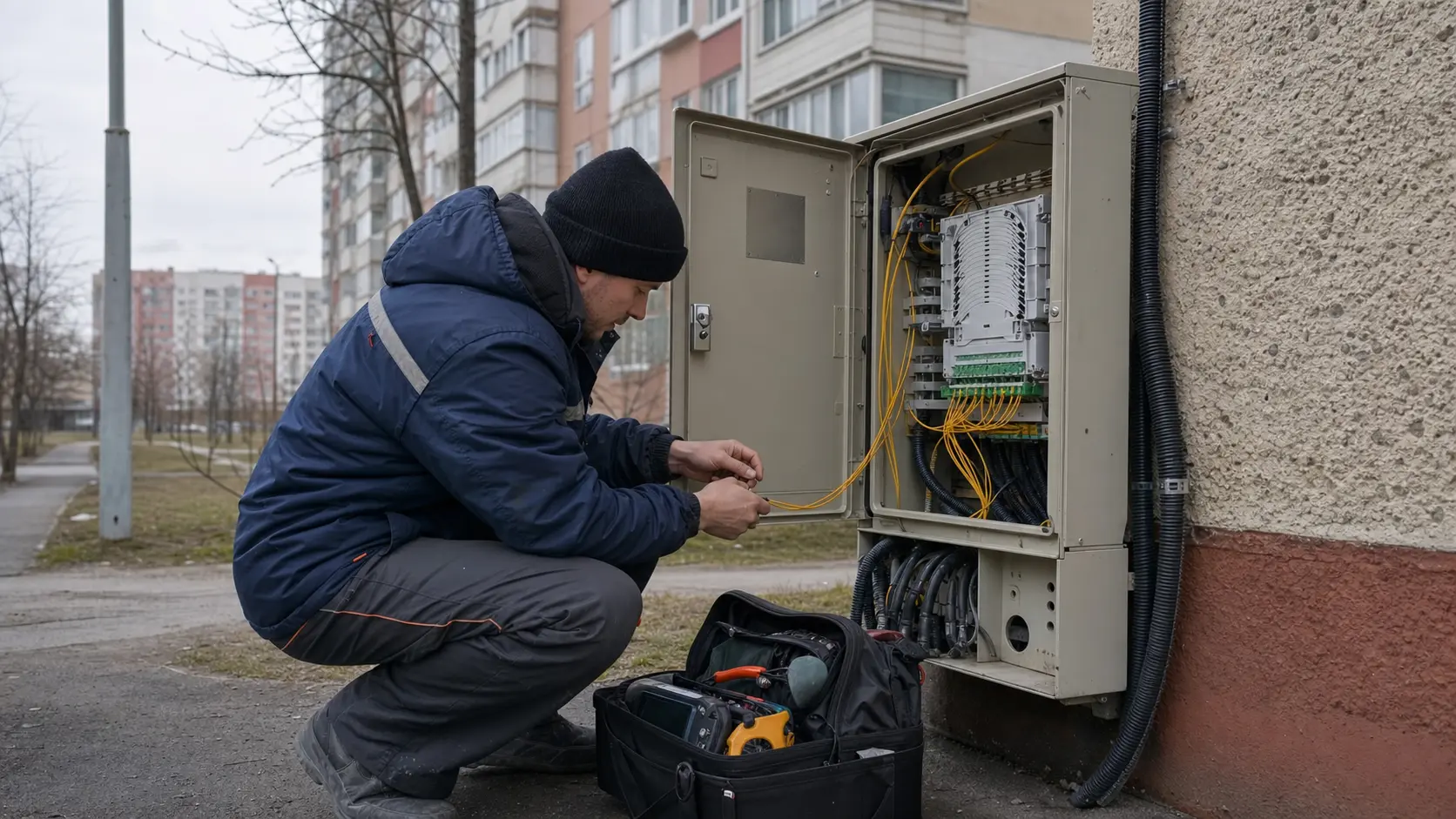
Sergei is the buyer archetype EcoConnect has to keep. He is not the average broadband shopper in a Moscow apartment tower. He is a remote accountant in a private house near the Mytishchi villages and garden settlements where the operator advertises private-sector access: Korgashino, Nikulskoye, Yudino, Sorokino, Zhostovo, Ostashkovo, Chiverevo, Boltino, Terpigoryevo, Prussy, Manyukhino, Ulyankovo, Podrezovo and a long list of SNT, cooperative and cottage settlements (https://www.ecoconnect.ru/dlya-dachi). His operating constraint is simple. If a drop cable is damaged, an optical terminal fails, a pole route needs attention or a support call disappears into a queue, a workday is lost before any abstract speed figure matters. His substitute is also simple: try Rostelecom or another large fixed operator where available, lean on mobile data for a month, share a building or settlement Wi-Fi arrangement, or delay the upgrade after one bad repair experience (https://mosoblast.rt.ru/-mytischi-/homeinternet, https://www.yota.ru/all-tariffs).
EcoConnect's own homepage creates the tension. The operator tells subscribers that from January 1, 2026 the unified private-sector Eco-500 GPON tariff will be 1,500 rubles per month, and that business-customer tariffs will also rise. It adds that from December 1, 2025, internet-service blocking for private-sector subscribers costs 200 rubles per month. The stated reasons are not vague inflation prose. The notice names higher costs for equipment suppliers, consumables used to maintain networks, rental of poles and fibre ducts, fibre-line channels and communications channels, and then connects the change to Federal Law No. 425-FZ and a technology fee on imported electrical goods (https://www.ecoconnect.ru/, https://publication.pravo.gov.ru/document/0001202511280017). That makes the increase less a pricing event than a disclosed cost stack.
The paid unit should therefore be defined early. EcoConnect is not selling a title called "fibre" or a decorative promise of speed. For the private-house buyer, the unit is a Mytishchi-area GPON and home-broadband subscription line: a 500 Mbps unlimited service, a fibre cable to the place where the customer equipment sits, a base customer device, installation of the customer device with Wi-Fi, support contacts, upstream internet access and the field labour needed to keep a rural or semi-rural drop working (https://www.ecoconnect.ru/dlya-dachi). For apartment blocks and the Pirogovsky address list, the paid unit is closer to a lower-cost Ethernet line, with Eco-100 and Eco-500 apartment or Pirogovsky tariffs advertised at 600 and 800 rubles per month, plus a 150-ruble dedicated-IP option (https://ecoconnect.ru/mkd, https://www.ecoconnect.ru/o-nas/pirogovskij). The difference matters because a private-house GPON line has more distance, more installation capital and more repair exposure than a concentrated multi-dwelling building line.
The central question is not whether 1,500 rubles is high or low in isolation. It is whether that monthly amount covers the field-service burden better than the customer's practical alternatives cover the household's failure cost. A customer who can buy a national operator's fixed line at a serviced apartment address sees one kind of market. A customer whose private house sits at the end of a local fibre route sees another. The operator's advantage, if it exists, is not brand scale.
It is local address knowledge, shorter dispatch geography, direct contactability, settlement-level concentration and the ability to decide quickly whether an address is technically feasible.
The Mytishchi footprint is narrow by choice, but narrowness must pay for itself
EcoConnect describes itself as a young internet partner working only in the Mytishchi district, and it explicitly frames the area as its home (https://www.ecoconnect.ru/). The about page repeats the local positioning and says the company provides high-speed internet access, telephony, communication channels, VPN for office connection and hosting, while working with dacha settlements, apartment buildings, commercial real estate and individual customers (https://ecoconnect.ru/o-nas/o-kompanii). A broad national provider can spread call-centre systems, backbone staff, routing engineering and marketing across many cities. A small operator has to win by making the local loop cheaper or more responsive at the address level.
That local loop has two surfaces. One is dense: apartment buildings and Pirogovsky blocks, where the operator advertises Gigabit Ethernet or Fast/Gigabit Ethernet availability, free or low connection fees, and 600-800-ruble tariffs for 100 Mbps or 500 Mbps service (https://ecoconnect.ru/mkd, https://www.ecoconnect.ru/o-nas/pirogovskij). In these addresses, the economics resemble a classic building-access game. The operator must get into the building, keep the switch and uplink stable, and spread support cost across many flats. If switching from another provider is free in Pirogovsky, as EcoConnect says, the commercial barrier is lower for a household that already has a wired alternative (https://www.ecoconnect.ru/o-nas/pirogovskij).
The other surface is dispersed: private houses, dacha settlements, SNTs and cottage communities. EcoConnect's private-house page lists many settlements and says the connection price from February 1, 2026 is 15,000 rubles. It also says the connection includes the fibre cable to the equipment location, a basic customer device and installation of that customer device with Wi-Fi (https://www.ecoconnect.ru/dlya-dachi). That price signals that the operator cannot treat a private-house line as a simple apartment activation. Fibre drops have to be installed, equipment has to be placed, route access has to be maintained and a truck roll has to be possible when the customer calls.
Narrowness helps only if it reduces the unit cost of that work. If EcoConnect has already built routes through a cluster of settlements, knows the pole and duct arrangements, can schedule technicians without a long national queue, and can reuse local spares, a small footprint can be an advantage. If the same narrowness produces low density, too many one-off addresses and a support load that cannot be spread across enough paying lines, it becomes the opposite. This is why the article's title points to repair distance.
The customer's recurring bill becomes economically defensible when the distance between fault, technician, spare part and billing relationship is short enough to prevent churn.
Public pages support the existence of a concentrated operating area, but not the density. They show the operator's declared geography, tariffs and contact channels. They do not show how many lines exist in each settlement, which roads carry fibre, how many subscribers share a splitter, how often crews are dispatched, or how many subscribers renew after the first year. That absence does not make the service weak. It means the investor or strategic reader should avoid treating the visible tariff page as proof of a complete unit-economic model.
The private-house GPON line is a support contract as much as a bandwidth contract
GPON is a passive optical-network access technology. Its appeal is that one optical line terminal can serve multiple customers through passive splitters and optical network terminals, with high downstream capacity and no active electronics in the outside splitter path. The technical family is described in ITU's G.984 recommendations, which are useful for understanding the access architecture but do not tell readers anything about EcoConnect's actual build quality or field operations (https://www.itu.int/rec/T-REC-G.984.1/en). In EcoConnect's case, the commercial page matters more than the standard. The private-house product is advertised as unlimited access at 500 Mbps, on GPON, with a Wi-Fi router at connection and a dedicated-IP add-on at 150 rubles per month (https://www.ecoconnect.ru/dlya-dachi).
For Sergei, the paid unit is therefore not just 500 Mbps. It is a bundle of four obligations. First, EcoConnect has to make the address serviceable and connect fibre to the equipment location. Second, it has to provide or configure a customer device that turns that fibre into useful home Wi-Fi. Third, it has to maintain upstream capacity and routing so that the subscription is more than an isolated access link. Fourth, it has to respond when the physical line, optical levels, router, billing status or upstream path fails.
Each obligation has a different cost shape. Fibre drops and customer devices are front-loaded. Pole or duct access, upstream capacity, licence compliance, billing systems and support numbers recur. Field visits are episodic but expensive because they use skilled labour, vehicles, time windows and spares. That is why EcoConnect's own price-increase notice is economically revealing. The company says the monthly increase follows higher costs for suppliers of equipment, consumables for network maintenance, rental of poles and fibre ducts, fibre-line channels and communications channels (https://www.ecoconnect.ru/). Those categories map directly to the private-house unit.
A national operator may have purchasing leverage and central systems, but it may also have less appetite to chase low-density private-house repairs if the address is outside a high-return build zone. A mobile operator may offer lower monthly data pricing and broad coverage, but mobile broadband is a shared radio product, not a fixed fibre drop into the house. MTS's Moscow-region mobile tariff page, for example, shows unlimited-GB offers at prices far below EcoConnect's private-sector GPON bill, while Yota's tariff page shows phone and internet options including 100 GB internet from 650 rubles per 30 days (https://moskva.mts.ru/personal/mobilnaya-svyaz/tarifi/vse-tarifi/mobile, https://www.yota.ru/all-tariffs). Those are real avoided-cost comparators, but they are not perfect substitutes for a stable fixed line when a household runs video calls, cameras, cloud backups and multiple devices.
The question is when the customer values repair assurance more than nominal monthly savings. A buyer who remembers a fast same-day visit after a storm will price the 1,500-ruble bill differently from a buyer who spent three days calling support. Public evidence cannot tell which story dominates EcoConnect's base. It can only show that the product's economics require such stories to exist at enough addresses.
Legal identity and public scale point to a micro-operator, not a hidden national platform
EcoConnect LLC is not difficult to identify in public records. The operator's own pages name OOO "EcoConnect" and list licence numbers 139337, 139338 and 139339 (https://www.ecoconnect.ru/o-nas/docs). The contact page gives the Moscow region and Mytishchi district, plus telephone and email contacts (https://www.ecoconnect.ru/o-nas/contact). Russian company-data pages based on official registers identify OOO "ECOCONNECT" by INN 5029178892 and OGRN 1135029009488, with registration on October 17, 2013, a legal address at Sovetskaya Street 1A in the Pirogovsky microdistrict of Mytishchi, and the main activity of communications based on wired technologies (https://www.tbank.ru/business/contractor/legal/1135029009488/, https://companies.rbc.ru/id/1135029009488-ooo-ekokonnekt/).
The ownership and management picture should be treated as context rather than a conclusion about service quality. T-Bank's contractor page lists Ruslan Aleksandrovich Absalyamov as the head from August 7, 2024, with founder stakes of 67% for Absalyamov and 33% for Radik Raifovich Iskhakov (https://www.tbank.ru/business/contractor/legal/1135029009488/). RBC Companies presents the same core identity fields and the main OKVED code 61.10 for wired-communications activity (https://companies.rbc.ru/id/1135029009488-ooo-ekokonnekt/). Those records show an operating legal person. They do not show the operator's field-crew capacity, contractor arrangements, equipment inventory or customer service performance.
The financial signal is more interesting. T-Bank's page shows 2025 accounting revenue of 40.20 million rubles and profit of 1.59 million rubles, while Companium's profile shows a rise from 29.3 million rubles of revenue and 309,000 rubles of net profit in 2024 to 40.2 million rubles and 1.6 million rubles in 2025 (https://www.tbank.ru/business/contractor/legal/1135029009488/, https://companium.ru/id/1135029009488-ehkokonnekt). Checko also reports 2025 revenue of 40.2 million rubles and notes a small-company employee signal in prior-year data (https://checko.ru/company/ehkokonnekt-1135029009488). Such aggregator pages should not be mistaken for audited management accounts, but the direction is clear enough for a research judgement: EcoConnect is a micro-to-small operator whose public revenue base is measured in tens of millions of rubles, not billions.
That scale cuts both ways. A 40-million-ruble revenue base can be meaningful for a local fibre network if the footprint is concentrated and repairs are efficient. It is also thin when compared with the purchasing, lobbying, marketing, roaming, brand and call-centre resources of national telecom groups. If the company has only modest disclosed profit, a seemingly small change in equipment prices, support load, pole-rental terms or wholesale capacity can matter. The private-sector move from 1,200 to 1,500 rubles per month is therefore not just a consumer-facing annoyance.
It may be an attempt to keep the line contribution positive as the cost base moves.
The licence surface is also real. EcoConnect's documents page links to Roskomnadzor communications licence records, and public search results for the regulator show OOO "ECOCONNECT" with INN 5029178892 and communications-service licences, including a registry page for licence 139339 issued on December 25, 2015 (https://rkn.gov.ru/communication/register/license/?id=139339, https://rkn.gov.ru/activity/connection/register/license/p18000/). T-Bank's contractor page lists three active communications licences with current licence identifiers, covering local telephone services, telematic services and data-transmission services other than data transmission for voice purposes (https://www.tbank.ru/business/contractor/legal/1135029009488/). For a broadband buyer, licensing does not guarantee uptime. It does establish that the company is not merely a reseller page with no regulatory footprint.
Apartment tariffs show where scale can be easier, and where switching can be harsher
The apartment side of EcoConnect's business is a useful comparison because it shows what the private-sector line is not. EcoConnect's multi-dwelling page advertises home internet up to 1000 Mbps over Gigabit Ethernet, with Eco-100 MKD at 600 rubles per month and Eco-500 MKD at 800 rubles per month. It also says connection is free and that extra equipment cost should be checked by phone (https://ecoconnect.ru/mkd). The Pirogovsky page similarly offers Eco-100 at 600 rubles and Eco-500 at 800 rubles, notes technical availability for higher speeds, and says a new connection costs 500 rubles while switching from another provider is free (https://www.ecoconnect.ru/o-nas/pirogovskij).
Those tariffs reveal the density premium. The same broad speed class that costs 1,500 rubles per month for the private-house GPON line appears at 800 rubles in apartment or Pirogovsky contexts. The difference does not automatically mean the private tariff is overpriced. It likely reflects the economics of concentration. A building line can spread active equipment, backhaul, support and sales effort across more households. A private-house route can require longer drops, more field time and more address-specific installation. EcoConnect's 15,000-ruble private connection price from February 2026 makes that distinction visible (https://www.ecoconnect.ru/dlya-dachi).
The competitive pressure also differs. In apartment buildings, a household may have several fixed alternatives. Beeline's Mytishchi home-internet page advertises packages including 100 Mbps, 500 Mbps and a 600 Mbps gaming-oriented package (https://mytishchi.beeline.ru/customers/products/home/internet/). Rostelecom's Mytishchi page advertises 500 Mbps home internet and general stable-connection claims for the city page (https://mosoblast.rt.ru/-mytischi-/homeinternet). MTS's Moscow home page presents home-internet offers that combine fixed access, TV and mobile features in the broader Moscow market (https://moskva.mts.ru/personal/dom/home-allmts). Address availability is the critical qualifier; these pages prove a visible substitute menu, not serviceability at every EcoConnect address.
Apartment economics are therefore more exposed to bundle competition and promotions. A national operator can attach mobile minutes, TV channels, cloud services, smart-home features and short-term discounts to a fixed line. EcoConnect does offer television through 24h.tv packages, with its TV page pointing subscribers to 24h.tv information and app guidance (https://ecoconnect.ru/televidenie-dlya-doma, https://24h.tv). But a small operator is unlikely to match the full bundle economics of mobile-plus-fixed national plans. Its best defence in apartments is not broad bundling. It is acceptable price, local availability, low installation friction and customer memory of good repair.
In private houses, the calculus is different. The customer may compare a 1,500-ruble GPON bill not with a cheaper fixed line at the same address, but with the cost of not upgrading, buying a mobile plan, or using a neighbour's connection in a limited way. That makes repair distance and installation certainty even more important. A household will tolerate a higher monthly price if the alternative is unstable radio or no fixed fibre. It will not tolerate that price if the operator behaves like a distant call centre after taking a local premium.
Public network records prove visibility, not service quality
EcoConnect's public technical footprint is newer than the legal entity. RIPEstat's AS overview for AS210281 identifies the holder as EcoConnect LLC and shows the autonomous system as announced on July 6, 2026 (https://stat.ripe.net/data/as-overview/data.json?resource=AS210281). RIPEstat's whois data shows AS210281, AS name EcoConnect, status ASSIGNED, creation on April 17, 2025 and import/export relationships in the RIPE record (https://stat.ripe.net/data/whois/data.json?resource=AS210281). RIPEstat's announced-prefixes data for the two weeks ending July 6, 2026 shows three /24 IPv4 prefixes: 195.178.98.0/24, 94.137.89.0/24 and 185.135.44.0/24 (https://stat.ripe.net/data/announced-prefixes/data.json?resource=AS210281).
IPinfo's AS210281 page is consistent with an ISP-type network in Russia and shows 768 IPv4 addresses, no IPv6 addresses, and peer/upstream information as observed by that service (https://ipinfo.io/AS210281). IPIP's whois page similarly identifies AS210281 as EcoConnect, EcoConnect LLC, Russian Federation, with RIPE registry data and public import/export lines (https://whois.ipip.net/AS210281). A DNS lookup for ecoconnect.ru and www.ecoconnect.ru resolved to 95.143.190.225 during this research pass, which points to a hosted public web surface rather than itself proving the access network. The important evidence is not the website IP. It is that EcoConnect has public AS visibility and announced address space.
Those records are bounded evidence. They can support claims about public routing surface, allocated autonomous-system identity, observed prefixes and some upstream or peer relationships. They cannot support claims about internal architecture, real customer count, optical split ratios, data location, service quality, security outcomes, uptime, profitability or field repair performance. In fact, the slight differences between RIPEstat, IPinfo and IPIP's public peer or import views are a reminder that technical databases are snapshots through particular collectors and interpretation layers.
They help map public surface; they do not replace operational records.
The absence of public IPv6 in IPinfo's summary is a small watchpoint, not a fatal flaw (https://ipinfo.io/AS210281). Many regional ISPs delay IPv6, and Russian household broadband demand may not force it immediately. But if EcoConnect wants to look more mature to business customers buying channels, VPN or hosting, IPv6 readiness would become part of the technical credibility package. Likewise, three visible /24s are enough to show public routing, but not enough to infer subscriber density. A CGNAT-heavy or private-addressed access network could serve many users through limited public space; a small public-address estate could also indicate modest scale. The technical record only frames the question.
The useful operational inference is dependence, but only at the right level. EcoConnect does not look like a fully independent national backbone. It appears to be a local access operator with upstream relationships. That is normal for the category. The risk is concentration: if upstream capacity, route diversity or settlement backhaul is thin, the customer experiences a fault as one event even if the failure sits outside the last-mile fibre. The margin equation must therefore cover not only repair trucks but also enough upstream resilience to stop wholesale incidents from becoming churn events.
Supplier and regulatory cost pressure are not abstract for a fibre operator
EcoConnect's price notice is unusually useful because it names the cost categories that matter to a local fibre operator. Equipment suppliers matter because GPON line terminals, customer optical devices, routers, optical modules, switches and spares have to be bought or replaced. Consumables matter because fibre maintenance uses cable, connectors, patch cords, drop materials, boxes and tools. Pole and duct rental matters because a private-house route has to cross physical corridors that are rarely free. Fibre-line channels and communications channels matter because access subscribers still need upstream internet capacity (https://www.ecoconnect.ru/).
The Russian policy references on the same notice are less direct but still relevant. Federal Law No. 425-FZ, published on the official legal-information portal on November 28, 2025, makes broad tax-code and legislative changes (https://publication.pravo.gov.ru/document/0001202511280017). The Federal Tax Service also described 2026 property-tax changes tied to that law in a December 2025 notice (https://www.nalog.gov.ru/rn77/news/activities_fts/16586443/). Separately, Interfax reported that the technology fee would be paid per unit of electronic component base or industrial product containing electronic modules, with a cap of 5,000 rubles per unit and rates to be set by the government (https://www.interfax.ru/russia/1059036). These references do not prove EcoConnect's exact cost increase. They support the broader point that electronics and tax changes were live cost concerns when the operator posted the tariff notice.
For small ISPs, such cost pressure is often more dangerous than headline inflation suggests. A large operator can smooth procurement cycles, hold inventory, negotiate vendor terms and cross-subsidise weak local builds with profitable urban markets. A local operator may buy fewer units, rely on narrower supplier channels and carry less spare inventory. If a batch of optical devices or routers becomes more expensive, the cost per new private-house connection rises immediately. If consumables are scarce or expensive, the repair queue becomes a working-capital problem.
If pole or duct terms move, a village route can become less attractive even if monthly revenue is stable.
The private connection fee should be read against this background. A 15,000-ruble connection charge from February 2026 looks high compared with apartment activation, but it may still be a partial recovery of real installation cost (https://www.ecoconnect.ru/dlya-dachi). The question is whether the connection fee discourages marginal households. If the fee prevents low-commitment customers from joining and then churning, it can protect the network. If it pushes a cluster below the density needed for local maintenance, it can make the network more expensive for everyone who remains.
This is where support labour becomes a financial variable. A technician's day has to cover travel, diagnosis, fix time and sometimes a second visit. In a dispersed settlement, one difficult fault can consume the contribution from several subscriptions. The operator's about page says the technical part of the team accepts requests around the clock and resolves issues as quickly as possible (https://ecoconnect.ru/o-nas/o-kompanii). That promise is commercially valuable only if the staffing and spare-parts model can bear it. Around-the-clock intake without enough field capacity can raise expectations faster than it improves retention.
Customer contactability is part of the product, and the evidence is mixed in a useful way
EcoConnect's public contact surface is visible. The site header repeatedly gives +7(495)505-6-707, +7(901)505-1623 and info@ecoconnect.ru, with working hours listed as Monday to Saturday 10:00-22:00 and Sunday closed (https://www.ecoconnect.ru/). The contact page gives the Mytishchi district and the same phone route (https://www.ecoconnect.ru/o-nas/contact). The payment or balance page for subscribers tells a user to replenish the account in the personal cabinet or contact subscriber service by phone, listing +7(495)505-67-07 and +7(901)505-16-23 (https://lknew.ecoconnect.ru/). These are concrete contactability signals.
There is also a tension. The about page says the technical team accepts customer appeals around the clock, while the site header lists normal public working hours and a Sunday closure (https://ecoconnect.ru/o-nas/o-kompanii, https://www.ecoconnect.ru/). The generous interpretation is that technical intake and commercial office hours differ. The harsher interpretation is that the site does not fully explain the repair escalation path. For the private-house customer, this distinction matters. Billing contactability is not the same as fault restoration. A homeowner who pays 1,500 rubles per month for a local GPON line needs clarity on what happens after a Saturday-evening cut, not only how to leave a weekday application.
The public weak-signal layer is thin. Searchable review and forum material tied clearly to EcoConnect's broadband service is not robust enough to carry factual claims about customer satisfaction. That is not itself evidence of good service or bad service. It simply leaves the article dependent on harder public records: tariff pages, legal identity, licences, routing records and substitute offers. If future local reviews, outage posts or social complaints become visible, they should be treated as market signals about repair load and support experience, not as verified operating metrics unless corroborated.
The customer path also contains a billing discipline signal. The subscriber page shown when money is lacking tells users to replenish the balance or contact subscriber service (https://lknew.ecoconnect.ru/). That is ordinary for prepaid or balance-controlled broadband, but it matters for churn and cash conversion. A small ISP can improve working capital by keeping subscriber accounts current. It can also create friction if households perceive suspension or service blocking as unforgiving, especially after a price increase and a 200-ruble monthly blocking fee for private-sector service (https://www.ecoconnect.ru/).
Support contactability therefore sits between economics and retention. If EcoConnect answers quickly, schedules locally and restores faults faster than a national queue, the tariff premium becomes rational. If contactability feels like ordinary small-company fragility, the same premium becomes an invitation to try a mobile plan, a larger fixed operator where available, or no upgrade. The buyer is not paying for friendliness alone. The buyer is paying to reduce failure cost.
Larger operators set the outside option even where they do not reach every address
EcoConnect does not compete in a vacuum. Rostelecom's Mytishchi home-internet page advertises 500 Mbps service and frames it as suitable for multiple devices, with stable connection claims (https://mosoblast.rt.ru/-mytischi-/homeinternet). Rostelecom's separate 500 Mbps page says that speed suits 4K streaming, online gaming, video conferencing and cloud work (https://mosoblast.rt.ru/-mytischi-/homeinternet/500-mbit). Beeline's Mytishchi home-internet page presents 100 Mbps, 500 Mbps and 600 Mbps packages, while the broader Moscow Beeline page carries similar home-internet product framing (https://mytishchi.beeline.ru/customers/products/home/internet/, https://moskva.beeline.ru/customers/products/home/internet/). MTS's Moscow home page advertises home internet up to 1 Gbit/s and fixed-mobile bundles (https://moskva.mts.ru/personal/dom/home-allmts).
These pages should be used carefully. They are evidence of visible substitute offers in the wider Mytishchi and Moscow-region market, not evidence that Rostelecom, Beeline or MTS can serve every EcoConnect private-house address. Availability is often address-specific. A private settlement where EcoConnect already has fibre and a national operator does not will price substitutes differently from an apartment building with several risers. But a substitute does not need to be perfect to discipline a tariff.
It only needs to be plausible enough for a dissatisfied household to consider switching, delaying or using mobile data as an interim solution.
Mobile is the second outside option. MTS lists Moscow-region mobile tariffs with unlimited-GB offers and large sharing allowances, while Yota advertises phone and internet plans including a "Only internet" option with 100 GB from 650 rubles per 30 days (https://moskva.mts.ru/personal/mobilnaya-svyaz/tarifi/vse-tarifi/mobile, https://www.yota.ru/all-tariffs). A mobile plan will not give the same fixed-line stability, latency or household device economics as fibre in every location. Yet it is an important comparator after a bad repair. The household does not ask whether mobile broadband is theoretically equivalent. It asks whether it can survive the next month without paying for a line that failed at the wrong time.
The third substitute is delayed upgrade. For some private-house customers, the 15,000-ruble connection fee and 1,500-ruble monthly bill create a decision point: connect now, wait another season, or rely on existing arrangements. Delayed upgrade is easy to underestimate because it does not appear as a competitor's tariff page. It is often the most powerful substitute in semi-rural broadband. A family can postpone cloud cameras, smart-home devices or remote-work redundancy if the up-front fee feels high and the repair promise is untested.
EcoConnect's answer has to be local advantage, not only speed. A 500 Mbps line is no longer exotic in the Moscow region. The differentiator is whether the operator can make a particular house serviceable, install without bureaucracy, answer the phone, and repair in a way that the larger operator or mobile substitute cannot. The tariff rise makes that differentiation more visible. A small operator can charge a local premium when customers believe the local loop will be cared for. It becomes exposed when customers see only a high monthly bill.
Revenue logic depends on density, add-ons and low avoidable churn
The public financial numbers allow a rough framing, not a full model. If EcoConnect's 2025 revenue is about 40.2 million rubles, as T-Bank and Companium report, then the operator is too small for national-scale assumptions but large enough to have a meaningful subscriber base or mixed business revenue (https://www.tbank.ru/business/contractor/legal/1135029009488/, https://companium.ru/id/1135029009488-ehkokonnekt). The published service menu supports a mixed model: private-house broadband, apartment broadband, Pirogovsky access, dedicated IP, television packages, telephony, channels, VPN and hosting (https://ecoconnect.ru/o-nas/o-kompanii, https://ecoconnect.ru/televidenie-dlya-doma).
Private-house GPON at 1,500 rubles per month can generate 18,000 rubles of annual recurring revenue per line before add-ons. A 15,000-ruble connection fee can recover part of the drop and equipment cost at activation (https://www.ecoconnect.ru/dlya-dachi). Apartment Eco-500 at 800 rubles per month generates 9,600 rubles per year before add-ons, but it should have lower connection and maintenance cost if many customers are concentrated in the same building (https://ecoconnect.ru/mkd). Dedicated IP adds 150 rubles per month where purchased. TV packages from 24h.tv are priced separately on EcoConnect's TV page, with package links and app guidance, and can add some revenue or retention value even if the economics depend on the partner arrangement (https://ecoconnect.ru/televidenie-dlya-doma, https://24h.tv).
The model becomes attractive if clusters of houses and buildings produce enough recurring revenue to absorb fixed network costs. It becomes fragile if each incremental customer requires too much field labour. Suppose a village cluster has many private-house customers on the 1,500-ruble plan and one technician can service the area efficiently. The local route becomes a defensible asset. Suppose instead that houses are scattered, customers join slowly, and support visits are frequent. Then the same tariff may only keep the operator afloat, while still looking expensive to the household.
Retention is central because the installation economics are front-loaded. A private-house connection that churns after a short period leaves the operator with unrecovered labour, route complexity and possibly customer equipment recovery issues. A customer that stays for three or four years can turn the same installation into a profitable line if repair cost is controlled. This is why switching after one bad repair experience is the most dangerous substitute. It destroys the long tail of the subscription.
Business customers could improve the mix. EcoConnect says it offers communication channels, VPN for office connection and hosting, and the homepage notice says tariffs for legal entities and individual entrepreneurs are increasing (https://ecoconnect.ru/o-nas/o-kompanii, https://www.ecoconnect.ru/). Business access can pay more than household access and value local response, especially for commercial real estate. But public records do not disclose the size, churn or margin of that segment. It should be treated as potential support for the economics, not as proven cross-subsidy.
The missing proof falls into economics, reliability and retention
The public case is strong enough to identify EcoConnect as a real regional ISP with a narrow local footprint, a price increase, service pages, licences and network visibility. It is not strong enough to declare that the 1,500-ruble private-house line is comfortably profitable. The missing proof falls into three classes.
The first class is economics. Public pages do not show subscriber counts by settlement, installation payback, route cost, pole or duct rental terms, wholesale capacity cost or the gross margin of private-house GPON versus apartment Ethernet. The tariff notice names the cost categories but not their amounts (https://www.ecoconnect.ru/). T-Bank and Companium report company-level revenue and profit, but company-level numbers cannot separate the GPON line from apartment service, business channels, telephony, hosting or TV add-ons (https://www.tbank.ru/business/contractor/legal/1135029009488/, https://companium.ru/id/1135029009488-ehkokonnekt).
The second class is reliability. Public technical records show AS210281 and three announced IPv4 /24 prefixes, but they do not show outage frequency, last-mile fault rates, upstream incident exposure, backup capacity, restoration time or customer-device failure rates (https://stat.ripe.net/data/announced-prefixes/data.json?resource=AS210281). The about page says technical requests are accepted around the clock, but public pages do not disclose repair service levels or escalation procedures (https://ecoconnect.ru/o-nas/o-kompanii). Reliability is exactly where the buyer experiences the difference between a local premium and a national substitute.
The third class is retention. Public records do not show churn, renewal after tariff increases, complaint volume, payment delinquency, seasonal dacha usage or the share of private-house customers who suspend service. The homepage's 200-ruble blocking fee for private-sector service is a small clue that suspension has become worth pricing explicitly, but it does not show how often customers suspend, for how long, or whether they return (https://www.ecoconnect.ru/). Retention proof would matter because the private connection economics depend on keeping lines active long enough to recover installation and support cost.
These missing pieces do not invalidate the company. They define what would change the judgement. Strong evidence of high private-sector renewal, fast repair in the listed settlements and stable upstream performance would make the 1,500-ruble GPON bill look like disciplined local pricing. Evidence of slow repairs, repeated suspensions, high churn after installation or heavy dependence on one fragile upstream route would make the same bill look exposed.
Regulatory and geopolitical risk show up through equipment, not just licences
The operating risk for EcoConnect is not mainly that it lacks visible legal standing. The company appears in public registers, its own documents page points to communications licences, and third-party contractor pages list three active communications licences (https://www.ecoconnect.ru/o-nas/docs, https://www.tbank.ru/business/contractor/legal/1135029009488/). The more practical risk is that a small fibre operator's equipment and maintenance chain sits within a stressed Russian telecom procurement environment.
Sanctions, import frictions, currency moves and domestic policy changes can all affect replacement electronics, optical modules, routers, switches and customer devices. The article does not need to assert a specific supplier shock to see the mechanism. EcoConnect itself points to equipment suppliers and consumables as reasons for the tariff increase (https://www.ecoconnect.ru/). The technology-fee reporting adds a policy layer: electronic products and component-containing goods face a new fee framework from September 2026, with rates to be set by the government and a per-unit cap reported by Interfax (https://www.interfax.ru/russia/1059036). A national operator can blunt such shocks with procurement scale. A local operator feels them per customer device and per repair.
Regulatory compliance also consumes management attention. Communications licences, data-transmission services, telematic services and telephone services each imply obligations beyond a simple commercial website. Roskomnadzor's registry pages and contractor databases show EcoConnect's licence surface, but they do not disclose compliance cost or audit burden (https://rkn.gov.ru/activity/connection/register/license/p18000/, https://rkn.gov.ru/communication/register/license/?id=139339). For a micro-operator, even ordinary compliance can be meaningful because management bandwidth is scarce.
Geopolitical internet risk is subtler. Russian networks operate in an environment where content access, cross-border capacity, equipment procurement and mobile-internet restrictions can change quickly. For EcoConnect, the immediate issue is not ideology. It is resilience. If customers use the line for work, education, cameras and payments, they will blame the access provider for problems that may originate in upstream routing, national filtering, content-platform disruption or mobile fallback limits. A local ISP can control the last mile and supplier choices.
It cannot control every policy or upstream event that shapes the customer's internet experience.
The commercial implication is that EcoConnect has to communicate and restore well when faults are not purely local. If a wholesale path degrades, the customer still calls EcoConnect. If a mobile fallback is disrupted or congested, the fixed line becomes more valuable. If fixed service fails at the same time, the operator loses credibility. The margin test is therefore not only about fibre repair distance. It also includes the distance between the customer's complaint and EcoConnect's ability to diagnose whether the fault is in the home, the drop, the settlement route, the upstream path or the wider Russian network environment.
The final judgement returns to Sergei's bad-repair decision
EcoConnect's best case is easy to state. It is a local operator with a declared Mytishchi-only footprint, real service pages, visible tariffs, legal records, licences, contact channels and a public AS. It knows the settlements it serves, has already crossed the hard threshold of building routes into private-house communities, and can charge 1,500 rubles per month for a GPON line because the customer is buying address-specific availability and repair proximity, not just speed (https://www.ecoconnect.ru/dlya-dachi, https://stat.ripe.net/data/as-overview/data.json?resource=AS210281). In that version, the tariff increase is disciplined cost recovery.
The weak case is equally clear. The public record does not show enough operational proof to know whether the local advantage is consistently delivered. A customer can see large-operator pages in Mytishchi, mobile unlimited or high-allowance tariffs in Moscow region, and the option of postponing a private-house upgrade (https://mosoblast.rt.ru/-mytischi-/homeinternet, https://mytishchi.beeline.ru/customers/products/home/internet/, https://moskva.mts.ru/personal/mobilnaya-svyaz/tarifi/vse-tarifi/mobile). If EcoConnect's repair scheduling is slow, if support contactability feels uncertain, or if upstream faults recur, the local premium loses its reason.
The article's judgement is therefore conditional rather than promotional. EcoConnect is a credible regional ISP candidate for BTW monitoring because its economics expose a live broadband question: whether small local fibre networks can still defend private-house access when supplier costs rise and national operators shape the customer's outside option. The public evidence supports the identity, footprint, tariff and network-surface facts. It leaves open the hard questions of margin, repair performance and retention.
For Sergei, the decision after one bad repair experience is the whole story. If EcoConnect restores his line quickly because the technician knows the local route and the operator can explain the fault, he stays, pays the 1,500-ruble monthly bill and treats mobile broadband as backup. If the fault drags on and the support path is unclear, he checks Rostelecom, tries a mobile plan, shares a neighbour's connection or delays the upgrade. EcoConnect's GPON line makes repair distance the margin test because the customer does not renew an access technology.
He renews the belief that the next failure will cost less with the local operator than without it.