
Summary
- What it says: For a Colorado software firm, the first invoice from commodity cloud can look like the efficient default; the second outage, the surprise egress bill, or the night when a customer asks who can touch the server before morning is where Data102's old local-colocation logic still has
- Main topic: Hosting economics; Cloud service dependency; Local cloud substitution; Network-resource evidence
- Context: Datacenter
The second outage is where the local invoice starts to make sense
Picture a Colorado Springs software company that has already done the obvious calculation. Its application is mostly hosted in a major cloud. The monthly bill is legible enough for finance. Developers know the console. A first outage, if it is short, becomes a postmortem, a vendor ticket and a few credits. The second outage is different.
It arrives after a hospital customer has asked about recovery time, after a local government prospect has asked where data is restored, after an executive has noticed that cloud egress and support tiers are not small footnotes, and after the engineering team has realized that "nearby" is not a sentimental word when someone has to swap gear, audit a cage, reboot a firewall or prove that a backup actually comes back.
That is the opening through which Data102 should be judged. Not as a nostalgia story about servers in racks, and not as a claim that local colocation beats cloud for every workload. The question is narrower: whether a Colorado Springs-centered infrastructure provider can still earn margin by selling control, support, disaster recovery, network choice and regional trust to customers who have already accepted cloud as the visible default.
The answer is not clean. Data102's public identity is layered. ARIN still shows Data102 as the organization tied to QSL-52, with a Colorado Springs address at 102 South Tejon Street and an update date in March 2026: https://whois.arin.net/rest/org/QSL-52. The RDAP version of the same registry identity lists five active Data102-linked autonomous-system records: AS17185 as D102-PHL-1, AS26896 as D102-COS-2, AS29724 as D102-ACULI-2, AS33302 as D102-COS-1, and AS46949 as D102-PHL-2; it also carries Hivelocity network-operations contact references on the Data102 entity record: https://rdap.arin.net/registry/entity/QSL-52. PeeringDB still lists Data102 as an organization in Colorado Springs, describes it as a regional datacenter and meet-me, and lists Data102 - COS01 and Data102 - COS02 as facilities: https://www.peeringdb.com/org/7747. But the commercial front now points toward Hivelocity. Hivelocity's Colorado Springs colocation page advertises a COS Colo Data Center at 102 South Tejon Street, with 24/7 support, multiple backbone providers, redundant uplinks, AI-UPS power, A+B power, N+1 cooling, security controls, SSAE-18 SOC 2 Type 2 certification and HIPAA compliance: https://www.hivelocity.net/products/colocation/colorado-springs/.
That split identity is the story. Data102 remains visible in registry and interconnection evidence, while the customer-facing seller has become part of a larger hosting and colocation group. For a buyer, that can either strengthen the pitch or weaken it. It strengthens the pitch if Hivelocity adds capital, inventory, staff, automation and a wider network behind the Colorado Springs facility. It weakens the pitch if the buyer cannot tell who owns the service relationship, which brand controls change windows, how local staff are prioritized, or whether a once-regional provider is now just one node in a larger platform.
The economic test therefore starts with the second outage. A customer can tolerate a higher local rack invoice if that invoice buys a simpler answer to an uncomfortable question: who is close enough, accountable enough and technically capable enough to help when the public cloud abstraction is not the whole problem? Data102's remaining importance is not that the brand is louder than Hivelocity. It is that the Data102 registry footprint, local facility history and Colorado Springs routing evidence reveal a real operating surface beneath the rebrand.
Data102 is a local name inside a larger ownership chain
The strongest public identity evidence is not a marketing page. It is the combination of registry records, M&A disclosures and current facility pages. ARIN's organization record says Data102, Colorado Springs, United States, with a support comment and rwhois referral: https://whois.arin.net/rest/org/QSL-52. BGP.tools shows active Data102 autonomous-system records. AS33302 is registered to Data102, carries the AS name D102-COS-1 in the embedded ARIN data, and shows a Colorado Springs organization address: https://bgp.tools/as/33302. AS17185 also shows Data102 and the same QSL-52 organization record, while carrying historical Quonix website references: https://bgp.tools/as/17185. AS46949 is smaller, but it likewise points to Data102 and the same organization identity: https://bgp.tools/as/46949. RDAP adds two records that are easy to miss in a thinner pass: AS26896 as D102-COS-2, registered in 2002 and last changed in 2020, and AS29724 as D102-ACULI-2, registered in 2003 and last changed in 2020: https://rdap.arin.net/registry/entity/QSL-52.
The ownership chain adds the commercial context. Business Wire announced in November 2021 that ColoHouse acquired Quonix, including Data102 and Turnkey Internet, adding locations in Albany, Philadelphia and Colorado Springs plus more than 300 colocation customers from the Quonix group: https://www.businesswire.com/news/home/20211109005267/en/ColoHouse-Continues-Acquisition-Strategy-with-Purchase-of-Quonix-Data102-and-Turnkey-Internet. Houlihan Lokey's transaction note is more specific from Data102's side: Quonix Solutions, LLC, identified with Data102, was acquired by ColoHouse; the transaction closed on October 19, 2021, and Data102 was described as a regional carrier-neutral data center services provider with colocation, IaaS, bandwidth, cloud and voice services, operating facilities in Colorado Springs, Philadelphia and Albany: https://hl.com/about-us/transactions/houlihan-lokey-advises-data102/.
Then the chain moved again. Hivelocity says it was acquired by Colohouse in Q2 2024 and now presents itself as a global provider with more than 50 data centers across six continents: https://www.hivelocity.net/about/our-company/. Data Center Map's Colorado Springs listing states the current operator as Hivelocity, identifies the site as 102 S. Tejon Street, Suite 220, and records both the 2021 Data102/Quonix acquisition and a 2025 Colohouse-to-Hivelocity rebrand: https://www.datacentermap.com/usa/colorado/colorado-springs/colohouse-colorado-springs/.
For investors or customers, this is not merely corporate trivia. Local colocation margin depends heavily on trust. A buyer wants to know whether the service culture is local enough to care and large enough to fund equipment, spares, compliance and carrier relationships. Data102's acquisition history is therefore ambivalent. ColoHouse's 2021 acquisition gave the Data102 assets a larger retail colocation and cloud platform. Hivelocity's later position adds dedicated-server, VPS, private-cloud and automation language.
But a Colorado customer evaluating the old Data102 value proposition has to map the old name to the current operator and then ask whether the local facility remains a service center or has become a back-office asset in a national portfolio.
That uncertainty is not fatal. Many infrastructure buyers are used to facility brands, network names and legal entities changing while the cage, cross-connects and support ticket queue remain. But it does raise the bar for the seller. The company cannot rely on generic "cloud" copy. It has to explain exactly what the Colorado Springs site does better than a cloud region plus a remote support plan.
The rack is not the product; the nearby control is
Hivelocity's current colocation page is helpful because it shows the commercial surface now attached to Data102's old Colorado Springs role, while also showing what remains opaque. The broader colocation page says the offer ranges from quarter racks to full racks and cages, and it emphasizes network, diesel power redundancy, cooling, security, monitoring and managed storage; it does not publish a Colorado Springs rack-rate card, so rack pricing still appears quote-led rather than self-service: https://www.hivelocity.net/products/colocation/. The Colorado Springs page narrows that to the COS site at 102 South Tejon Street and lists a premium transit blend, redundant internal uplinks, redundant uplinks to transit, multiple building fiber exits and DDoS detection with blackholing: https://www.hivelocity.net/products/colocation/colorado-springs/. Cogent's own service-location listing also names the Colorado Springs address as "ColoHouse (formerly operated by Data102)" at 102 South Tejon Street, giving an independent carrier-side confirmation that the old Data102 location remains a network-service location: https://www.cogentco.com/en/component/content/article?Itemid=&action=search&city=&continent=&country=United+States&id=40&metro=&site_type=DC&state=CO.
Those details matter because local colocation is rarely sold on raw rack units alone. If a customer only wants undifferentiated compute, the hyperscale cloud console will usually win the first comparison. If a customer wants a place to put owned hardware, a controlled firewall pair, a backup target that does not live inside the same cloud account, a regulated system with physical access procedures, or a latency-stable connection to regional users, the quote changes.
The rack becomes a bundle: space, power, cooling, carrier access, remote hands, monitoring, physical security, audit posture and a support relationship that can be escalated to people near the equipment.
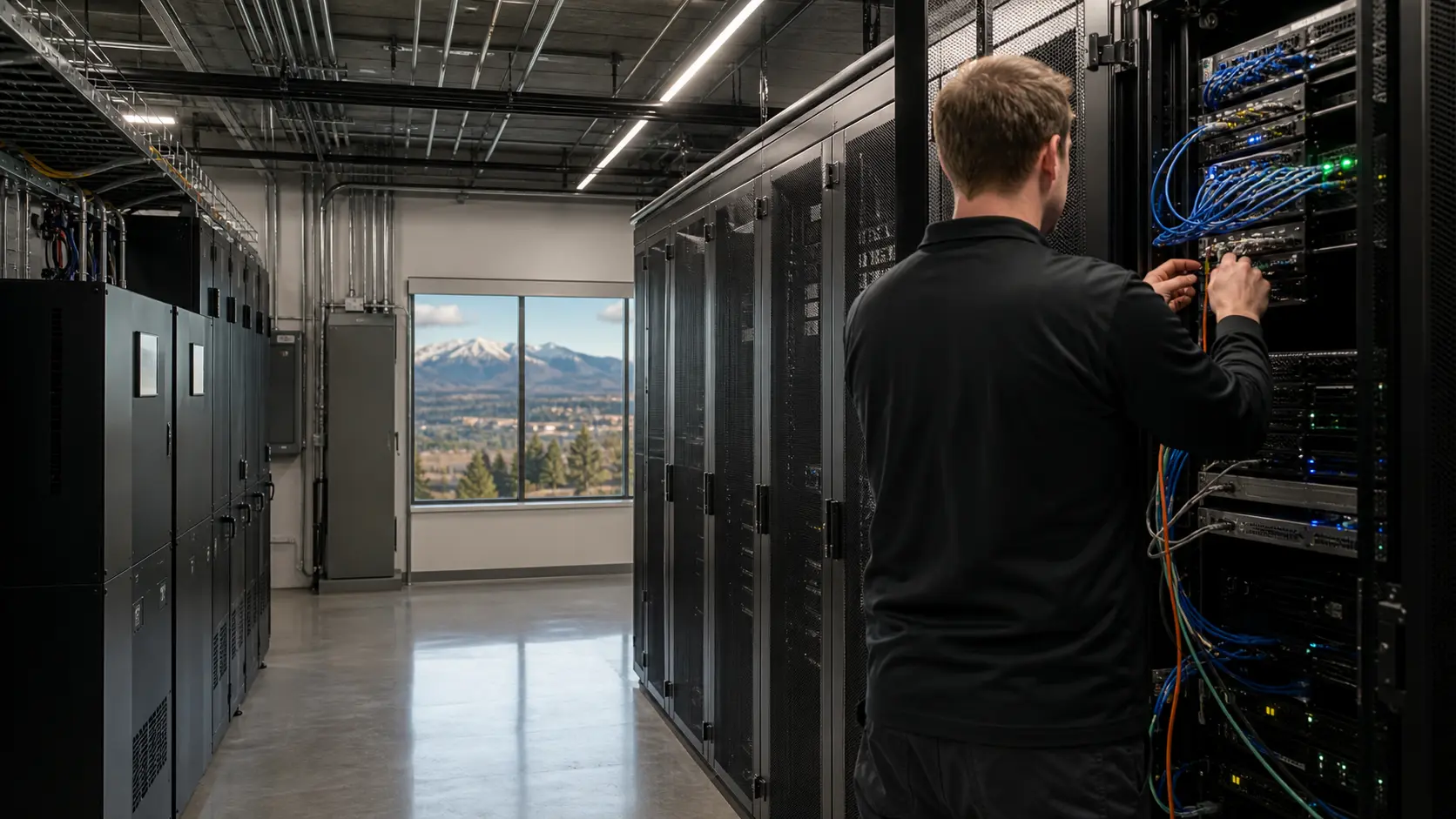
Data102's local appeal depends on that bundle. The Colorado Springs page advertises mantraps, layered RFID access, video surveillance, access logs, a 24-hour monitoring posture, after-hours security patrols and an operations support center. It also names A+B power to every cabinet, dedicated generator and fuel, single and three-phase power, 110 and 220V AC, telco-grade 48V DC A+B power, N+1 cooling and environmental monitoring. Those are not glamorous features, but they are exactly the things a cloud bill hides until a customer's own resilience policy asks where the physical failure domains are.
The priceable unit is not just "one cabinet." It is the reduced uncertainty around a set of failure modes. A cloud provider may offer stronger global resilience, but a small or mid-sized Colorado customer still has to design and pay for it. Multi-region cloud architecture means replicated data, extra operational skill, failover testing, network transfer charges, identity and access discipline, and a recovery plan that is not just a diagram.
A local colocation quote can be easier to explain if it says: here is the rack, here is the power, here is who can access it, here is the route diversity, here is the remote-hands process, here is how support responds when the backup appliance or firewall needs physical attention.
That is why the second outage is more important than the first invoice. First invoices compare line items. Second outages compare accountability. Data102's local margin is strongest when customers price the avoided delay, the lower ambiguity and the ability to prove continuity to their own customers.
The network evidence is real, but it also shows dependence
Data102 is not just a facility name. It has visible number-resource and routing evidence. BGP.tools shows AS33302 as a 21-year-old Data102 network with active status, 11 IPv4 prefixes and one IPv6 prefix originated, three upstreams and 25 peers at the time captured by the page: https://bgp.tools/as/33302. The same page lists Cogent, Lumen and Hurricane Electric as upstreams, and PeeringDB lists AS33302 with the AS-DATA102 route set, 20-50Gbps traffic levels, mostly inbound traffic, North American scope and a 10G IX-Denver presence using 206.53.175.42 and 2001:504:58::42: https://www.peeringdb.com/net/4838.
That evidence supports a simple claim: Data102's Colorado-facing product is not only a real-estate rack product. It is connected infrastructure with public routing history and exchange presence. The IX-Denver listing is particularly relevant because it puts the Data102 network into a regional interconnection context rather than a purely transit-only story. For Colorado customers, a Denver exchange signal does not guarantee performance to every destination, but it does suggest that Data102's network operations were built around regional traffic economics and not only around buying generic upstream bandwidth.
The other ASNs complicate the picture. AS17185 is tied to Data102 in BGP.tools, has AS name D102-PHL-1, shows two upstreams, and lists prefixes associated with Data102: https://bgp.tools/as/17185. PeeringDB presents AS17185 as Quonix Networks, with Quonix as the known name, an open peering policy, North American scope and a Philadelphia facility listing: https://www.peeringdb.com/net/17332. AS46949 is even smaller, with one IPv4 prefix, one upstream and a D102-PHL-2 AS name: https://bgp.tools/as/46949. These records make sense in light of the Quonix/Data102/Turnkey acquisition chain. They show an inherited network estate that spans names and sites rather than a single clean brand.
For customers, that is useful and risky at the same time. It is useful because a company with real prefixes, ASNs and exchange relationships has more operating history than a reseller with a website. It is risky because upstream dependence remains visible. On AS33302, BGP.tools lists Cogent, Lumen and Hurricane Electric as upstreams. On AS17185, it lists Cogent and Zayo. On AS46949, it lists Cogent. The facility page lists an even broader premium transit blend, including CenturyLink, Cogent, private transit to Denver, Hurricane Electric through IX-Denver, Zayo, Comcast, Underline and Lumen.
But the core point is unchanged: local colocation is still dependent on carriers, fiber entrances, transit pricing and operational routing judgment.
That dependence is not a weakness unique to Data102. Every regional data center has it. What matters is whether the provider turns carrier dependence into customer choice. A useful local colo product lets a customer choose blended internet access, private connectivity, direct cross-connects or a hybrid route to cloud and office sites. An inferior product simply passes through an upstream problem with a ticket. The public evidence supports the idea that Data102 had enough network substance to sell the first version.
The current Hivelocity-branded offer must prove, account by account, that this substance remains maintained and visible to customers.
Rack pricing competes with cloud egress, not with cloud slogans
The economic contest is often misframed. Colocation does not need to beat cloud on every variable cost. It needs to beat cloud on the workloads where steady power draw, owned hardware, predictable network use, disaster recovery, audit needs and local support have more value than instant global elasticity. DataBank's Denver cost guide frames colocation pricing as a combination of rack space, power usage and network bandwidth, while noting that real-estate costs, power, cooling efficiency, connectivity, compliance, redundancy and skilled labor influence Denver-area data center costs: https://www.databank.com/resources/blogs/cost-of-data-center-services-in-denver-what-to-expect/.
That is the right frame for Data102. A local customer pricing a half cabinet or full rack is not just comparing one monthly figure against a cloud instance. It is deciding whether a steady physical footprint is cheaper and safer than renting equivalent compute, storage and transfer inside a cloud platform. The cloud platform looks cheaper when the workload is spiky, global, temporary or highly automated. Local colocation starts looking better when the workload is steady, data-heavy, compliance-sensitive or tied to hardware and support practices that the customer wants to inspect.
Cloud egress is the most visible counterweight to the "cloud is always simple" story. AWS says customers receive 100GB of data transfer out to the internet free each month across services and regions, with further data-transfer pricing applying beyond that; the same AWS page's published egress table gives a first-10TB internet-out tier at $0.09 per GB and the next-40TB tier at $0.085 per GB for the common U.S. regions: https://aws.amazon.com/ec2/pricing/on-demand/. Google Cloud's network-pricing documentation lists North America internet data transfer out at $0.00 for the first GiB, $0.12 per GiB from 1 to 1,024GiB, $0.11 per GiB from 1,024 to 10,240GiB, and $0.08 per GiB above 10,240GiB; it also shows North American Cloud Interconnect transfer out at $0.02 per GiB in the United States/Canada case: https://cloud.google.com/vpc/network-pricing. Azure's bandwidth page lists internet egress from North America and Europe with the first 100GB per month free, then $0.087 per GB for the next 10TB and $0.083 per GB for the next 40TB on the Microsoft premium global network, with cheaper routing-preference tiers also shown: https://azure.microsoft.com/en-us/pricing/details/bandwidth/.
Hivelocity's public server pricing gives a useful adjacent price anchor even though it is not a Data102-only rack price. On the dedicated-server page, an E-2136 Coffee Lake server is listed at $65 per month with 16GB memory, 240GB SSD and 20TB/1Gbps bandwidth; an E-2236 plan is shown at $97 per month promotional pricing with 20TB/1Gbps; an AMD EPYC 7413 plan is shown at $381 per month promotional pricing with 512GB memory and 10TB/1Gbps; and a Threadripper Pro plan is listed at $750 per month with 1TB memory, NVMe storage and 20TB/10Gbps: https://www.hivelocity.net/dedicated-servers/. The same page says every server comes with at least 10TB of free outbound transfer, all inbound transfer and private transfer between Hivelocity servers are free, extra IPs are $2.50 per month, and third-party software installation without a managed plan is a flat $100 best-effort service: https://www.hivelocity.net/dedicated-servers/. A customer pushing 20TB out of a major cloud can face roughly four figures of egress before support, compute and operational complexity are counted; the exact bill depends on provider, route and region, but the Data102/Hivelocity contrast is no longer philosophical once bandwidth is measured in tens of terabytes.
Those cloud prices are not an argument against cloud. They are an argument against lazy comparisons. A Colorado company with a public API, video archive, backup stream, customer data export, analytics workload or nightly replication job can pay material transfer charges if architecture and usage are not disciplined. A local colocation setup can still have bandwidth charges, cross-connect charges and commit levels, but the customer may be able to buy a more predictable pattern, keep backup appliances near staff, and separate recovery infrastructure from the production cloud account.
The rack also competes with in-house build costs. 365 Data Centers' build-vs-buy analysis, using Uptime Institute cost assumptions, cites high capital costs for power, UPS, generators, HVAC, floor space and staffing, and gives sample build estimates running into millions of dollars even for small data rooms: https://365datacenters.com/data-center-colocation-build-vs-buy/. Data102's market is therefore not just "cloud or colo." It is "cloud, colo or do-it-yourself." The do-it-yourself option is where local colocation can look financially conservative. Few mid-sized Colorado firms want to manage generator fuel, cooling redundancy, carrier entrances, access logs and 24-hour monitoring for a small server room. A provider can spread those costs over many customers.
The pricing question becomes sharper: how much extra will a customer pay for a provider that is physically close, networked enough, compliant enough and responsive enough? Data102's margin exists if the answer is more than the commodity rack cost and less than the combined cost of cloud sprawl, in-house facilities and delayed incident recovery.
Power and cooling are the hidden center of the business model
Colorado Springs is not just a map pin. It is an energy and infrastructure market with local rules. Colorado Springs Utilities says utility costs can consume a significant portion of commercial and industrial operating expenses, and it describes Energy Wise rates, on-peak and off-peak periods, an Industrial Large Load Rate for industrial customers requiring more than 10MW, and demand charges based on highest short-term electricity use: https://www.csu.org/business/economic-development. Its business-rates page says a large power and light rate is aimed at businesses needing four megawatts of electricity with a 75% or higher annual load factor, because steady significant demand helps utility planning: https://www.csu.org/rates/business/.
That matters even if the Data102/Hivelocity Colorado Springs site is far smaller than a hyperscale build. Colocation economics are power economics. Cabinets are containers for contracted electrical capacity. Cooling follows power. Generator fuel, UPS systems, A+B distribution, environmental monitoring, preventive maintenance and utility tariff design all flow into gross margin. If a provider underprices power, high-density customers consume the margin. If it overprices power, cloud and larger metro facilities look better. If it cannot explain demand charges or density limits, customers discover the real bill after the sales quote.
Colorado Springs Utilities' March 2026 post on big power users is useful as a market signal. It says large customers of 10MW or more, often associated with data centers, require significant infrastructure, long-term power planning and regional market participation. The utility says large-load customers pay for new or upgraded transmission and distribution infrastructure, sign minimum 10-year agreements, pay full market-purchased power costs until resources are available, and provide collateral equal to 36 months of minimum monthly bills: https://www.csu.org/blog/big-power-users-protecting-costs. Those terms are aimed at much larger loads than a small local colo customer, but they show how data centers have moved from technical real estate into public utility policy.
Colorado's legislative debate points the same way. SB26-102, introduced in the 2026 session and shown as lost on the legislative page, would have created requirements for large-load data centers, defining them around new or added peak loads above 30MW and setting rules around renewable-energy matching, utility contracts, infrastructure costs, water reporting, operational water management and backup generation: https://leg.colorado.gov/bills/sb26-102. The bill did not become law, but it shows the regulatory direction: data centers are being evaluated for power, water, grid reliability and community impact.
For Data102, the near-term advantage is that a downtown Colorado Springs colocation facility with existing infrastructure may sell continuity without being judged like a new hyperscale campus. The longer-term risk is that all data-center operators, even regional ones, are pulled into a more skeptical policy environment. Buyers may ask not only whether a facility is reliable, but whether it has stable power cost exposure, sustainable cooling practices, water risk and a credible plan for rising density.
The Colorado Springs facility page's cooling claims are therefore central. Economizer-based cooling, variable-speed pumps and fans, low-PUE tuning and N+1 cooling are not decorative features. They are gross-margin defenses. Every watt saved in cooling or power distribution is capacity that can either support more customer load or protect margin against electricity and equipment costs.
Support labor is the product buyers cannot virtualize
The Data102 thesis depends heavily on support labor. Hivelocity's managed-services page says dedicated-server support includes live chat and phone support, 24/7 technical support, hardware diagnostics and replacements, OS reloads, intrusion monitoring, network and hardware SLA protection, and managed options that add patching, hardening, proactive monitoring and reactive support: https://www.hivelocity.net/services/server-management/. Its colocation pages also emphasize myVelocity monitoring, ticket management, managed storage, backup, data replication and the ability to add servers from on-site inventory.
That is the work a cloud console does not remove. It changes who performs it. A cloud customer still needs people who understand operating systems, firewalls, identity, backups, monitoring, recovery tests, cost controls and customer incidents. A local colocation customer still needs people who can rack, cable, replace, label, escort, test and document. The difference is that a regional provider can sell a combination of physical hands and network knowledge that a pure cloud bill does not include.
Labor costs are not minor. The Bureau of Labor Statistics' Occupational Outlook Handbook reports that computer network support specialists had a median annual wage of $73,340 in May 2024, while computer user support specialists had a median annual wage of $60,340: https://www.bls.gov/ooh/computer-and-information-technology/computer-support-specialists.htm. It also reports a median annual wage of $96,800 for network and computer systems administrators in May 2024: https://www.bls.gov/ooh/computer-and-information-technology/network-and-computer-systems-administrators.htm. These national figures are not Colorado Springs facility payroll data, but they show the order of magnitude behind 24/7 support promises. A continuous single-seat operation is 168 hours per week, or 4.2 forty-hour workweeks before vacation, sick time, training and management coverage. On wage medians alone, that implies roughly $253,000 per year using the computer-user-support figure and roughly $407,000 per year using the systems-administrator figure before benefits, payroll taxes, tools and supervisory cost.
Cloud support pricing shows the same labor monetization from the opposite side. AWS Support lists Business Support+ as the greater of $29 per month per account or 9% of monthly AWS charges up to $10,000, 7% from $10,000 to $80,000, 5% from $80,000 to $250,000 and 3% above $250,000; Enterprise Support starts at the greater of $5,000 per month or a similar tiered percentage: https://aws.amazon.com/premiumsupport/pricing/. Azure's support-plan page lists Developer at $29 per month, Standard at $100 per month and Professional Direct at $1,000 per month: https://azure.microsoft.com/en-us/support/plans. Google Cloud support lists Standard Support with a $29 minimum or 3% of monthly charges, and Enhanced Support with a $100 minimum or a 10%/7%/5%/3% tiered schedule: https://cloud.google.com/support. Data102/Hivelocity's opportunity is to turn the same support economics into a local service premium rather than a remote platform surcharge.
That support cost creates a margin puzzle. Customers like local support when things go wrong, but many resist paying for it when everything is quiet. A provider therefore has to package support into visible service tiers, response commitments and managed add-ons. If support is bundled too generously into cheap rack pricing, the provider eats labor cost. If support is too narrowly charged, the customer experiences the provider as a landlord, not as an operating partner.
The sweet spot for Data102/Hivelocity is to make local hands valuable enough to justify recurring service revenue while keeping self-service, monitoring and standardized procedures efficient enough to protect labor margin.
There is also a trust element that is difficult to price. A local software firm may value being able to call a provider that knows its cage and history. A customer in healthcare, local government, public safety, manufacturing or regional services may value a provider that can explain continuity in concrete terms. Hivelocity's public testimonials are broader than Data102 and not specific proof of Colorado Springs performance, but they point to the product category: customers praising staff knowledge, support response and reliability on the Hivelocity company page: https://www.hivelocity.net/about/our-company/.
The risk is that consolidation erodes the local feel. If a ticket flows into a national queue with no memory of the customer, nearby control loses its premium. If local staff remain empowered, the larger platform can improve the old Data102 proposition by adding inventory, tooling and broader network options. This is the point to watch in customer signals, not generic review scores.
Customer demand is regional, but competition is not
Colorado Springs is not an empty data-center market. Data Center Map lists Hivelocity - Colorado Springs 1 at 102 S. Tejon Street and shows nearby facilities including Lumen Colorado Springs 2 at the same street, Springs Hosting, T5, Raeden, Windstream and Novva: https://www.datacentermap.com/usa/colorado/colorado-springs/colohouse-colorado-springs/. Baxtel sizes the Colorado Springs market at 13 facilities, 1,397,273 square feet and 54MW, ranked 52nd in the United States and 59th in the Americas, with QTS Colorado Springs shown as the largest local data center at 15MW: https://baxtel.com/data-center/colorado-springs. Across Colorado, Baxtel lists 84 facilities, 5,365,332 square feet and 357MW, which is the competitive state context behind any buyer comparing Colorado Springs with Denver, Aurora or other Front Range options: https://baxtel.com/data-center/colorado-co. Data Center Dynamics reported in 2021 that Novva acquired a 37-acre Colorado Springs data-center campus with a 190,000-square-foot facility and 6MW of designed capacity, with plans to expand to 30MW and invest more than $200 million: https://www.datacenterdynamics.com/en/news/novva-acquires-data-center-in-colorado-springs-plans-200-million-expansion/.
That context cuts both ways. Competition proves there is a market for Colorado Springs infrastructure. It also pressures smaller or older facilities. A large campus can market renewable power, expansion capacity and enterprise scale. A downtown multi-tenant colocation site can market proximity, smaller increments, meet-me characteristics, local access and support. The products overlap, but they are not identical.
Denver-area competition is also relevant because many Colorado buyers will compare Colorado Springs with Denver. Iron Mountain's Denver DEN-1 page advertises a facility in a low natural-disaster-risk zone, 100% renewable power, compliance certifications and a customer ecosystem including cloud providers and network carriers: https://www.ironmountain.com/data-centers/locations/denver-data-center. DataBank's Denver guide frames Denver data-center costs around power availability, facility type, connectivity and scalability: https://www.databank.com/resources/blogs/cost-of-data-center-services-in-denver-what-to-expect/. Hivelocity's broader data-center page presents a global footprint and top-tier colocation positioning: https://www.hivelocity.net/data-centers/.
Data102's local edge has to be more specific than "Colorado." If the buyer wants a huge enterprise ecosystem, Denver may have more options. If the buyer wants a hyperscale-like campus, Colorado Springs has newer large-load narratives. If the buyer wants a modest rack, local hands, regional continuity and a site close enough for staff to visit without treating it as a day trip, the Data102/Hivelocity facility can be more relevant.
The customer base implied by the M&A record also matters. Houlihan Lokey described Data102 as serving local, regional and national carriers plus a wide array of small, medium and enterprise customers: https://hl.com/about-us/transactions/houlihan-lokey-advises-data102/. Business Wire said the Quonix acquisition added more than 300 colocation customers to ColoHouse, while Turnkey added another 1,500 customers: https://www.businesswire.com/news/home/20211109005267/en/ColoHouse-Continues-Acquisition-Strategy-with-Purchase-of-Quonix-Data102-and-Turnkey-Internet. Hivelocity's current Colorado Springs page adds a softer reputation signal by presenting the site as a "Rated Best Telecommunications Consultant in Colorado Springs" location, but without exposing the review count or methodology on the page: https://www.hivelocity.net/products/colocation/colorado-springs/. Taken together, the hard M&A customer counts and softer reputation language suggest Data102 was not only a speculative facility; it was a customer-bearing business whose post-acquisition retention is the key undisclosed fact.
If Hivelocity can sell Colorado Springs customers dedicated servers, VPS, managed support, backup, object storage, private cloud, colocation and portability in one relationship, Data102's old local customer base becomes a cross-sell surface. If customers see the rebrand as distancing the service from local accountability, churn risk rises. The competitive outcome depends less on facility marketing than on whether the local support and network experience remain credible after the brand stack changes.
Non-official signals show trust, not audited performance
Market chatter is useful here because local colocation decisions often spread through practitioner networks. It is not audited performance evidence, and it should not be treated as fact. But it can show what buyers notice. A Reddit thread in r/ColoradoSprings asking for colocation recommendations includes comments identifying Colohouse as formerly Data102 and praising responsiveness and past experience with D102: https://www.reddit.com/r/ColoradoSprings/comments/1aoo26q/colocation_datacenter_recommendation/. That is a small, informal signal, but it aligns with the thesis that the local brand reputation rested on support and proximity.
The signal also exposes a risk. When a local market says "formerly Data102," the brand still carries memory even if the corporate storefront has changed. That memory can be valuable because it reduces buyer anxiety. It can also fade quickly if new customers never hear the old name or if legacy customers feel that support is less personal. For a regional data center absorbed into a larger hosting platform, reputation is an asset that has to be actively preserved.
Public status information can play a similar role. Search-indexed Data102 status pages have historically referenced resolved issues such as Colorado Springs inbound dialing, platform connectivity, upstream packet loss and BGP session events at https://secure.data102.com/serverstatus.php?view=resolved. Because that endpoint was not reliably reachable during this research pass, it should not be treated as a complete current incident record. But the existence of such status traces is consistent with a provider that had to communicate operational faults to customers in ordinary language. That matters because continuity buyers do not expect perfection; they expect evidence of detection, escalation and clear recovery.
The more durable non-official signal is network visibility. BGP.tools and PeeringDB are not customer reviews, but they are public infrastructure views. A buyer can see AS33302's route set, upstreams, peers and IX-Denver presence. That is better than a purely brochure-driven claim. It lets a technical buyer ask sharper questions: Which carriers are active in the customer's cabinet? Is IX-Denver peering available to the customer or only part of blended service? What DDoS controls are included? How are route changes communicated? What are the remote-hands response commitments?
In this market, vague confidence is less valuable than falsifiable detail. Data102/Hivelocity's strongest public signals are the ones a buyer can test: registry records, facility address, routing tables, PeeringDB entries, support terms, certifications, utility constraints and the lived memory of local users.
Supplier dependence is broad, and that is the real risk surface
The supplier map is bigger than the company name. Data102/Hivelocity depends on electric utility capacity, UPS and generator systems, cooling equipment, building access, security vendors, fiber providers, transit carriers, exchange operators, support labor, monitoring tools, hardware spares and the corporate capital allocation of Hivelocity/Colohouse. Some of those dependencies are visible. The Colorado Springs facility page lists multiple transit and fiber-related names. BGP.tools shows upstreams by ASN. Colorado Springs Utilities sets the local power environment. M&A records show the ownership platform.
The risk is not that any one supplier exists. The risk is concentration or unclear accountability. If a small customer buys "local cloud" without asking what happens when Cogent, Lumen, Zayo, Hurricane Electric or a private Denver path has trouble, it has not bought resilience. It has bought a more local single point of confusion. If a buyer asks for carrier diversity, route policy, DDoS blackholing terms and failover procedures, the provider can turn supplier complexity into value.
Power is the hardest dependency because it cannot be rerouted like traffic. The facility advertises dedicated generator and fuel, AI-UPS power, A+B cabinet power and N+1 cooling. Those features reduce immediate facility-level risk, but they do not eliminate exposure to electricity rates, equipment maintenance, fuel contracts, density pressure or regulation. Colorado Springs Utilities' large-load posture shows how seriously the city is thinking about grid cost assignment for data centers: https://www.csu.org/blog/big-power-users-protecting-costs.
Corporate ownership is another dependency. Data102's registry identity is stable, but customer-facing ownership has changed. Buyers should not assume that local practice stayed unchanged after the 2021 and 2024 transactions. They should also not assume it worsened. Consolidation can fund better monitoring, spares, ticketing, automation and carrier contracts. It can also standardize away local discretion. The available public facts support both possibilities, so the right conclusion is conditional.
That conditionality is important for valuation. A regional colocation asset is worth more if it has sticky customers, power availability, carrier diversity, operating staff, compliance posture and cross-sell potential into managed services. It is worth less if customers only rented space because there were no alternatives, if power density is constrained, if the brand transition weakens local trust, or if larger Colorado facilities commoditize the local rack.
Data102's public evidence leans toward a defensible but not dominant niche. It has real infrastructure proof and a plausible customer problem. It does not have, from public sources alone, enough disclosure to claim superior uptime, superior margins, current customer counts, facility utilization, exact rack pricing or post-acquisition retention.
Regulation and geopolitics arrive through energy, not borders
For a Colorado Springs colocation provider, geopolitical risk is less about sanctions headlines and more about infrastructure policy, supply chains and the energy politics of data centers. The public debate around large-load data centers shows this. SB26-102's failed 2026 proposal would have imposed renewable matching, utility contract, water, backup-generation and reporting obligations on large-load data centers: https://leg.colorado.gov/bills/sb26-102. Colorado Springs Utilities' own large-load policy discussion says high-energy users should cover the full cost of serving their power needs and avoid shifting costs to the community: https://www.csu.org/blog/big-power-users-protecting-costs.
Data102's existing downtown footprint may be less exposed than a proposed 30MW or 60MW new campus, but it operates in the same political climate. When communities debate data centers, the conversation often starts with hyperscale projects and then spills over into all facilities. Customers may ask whether their provider has stable utility relationships, whether water is material to cooling, whether backup generation is compliant, whether power sourcing is credible and whether expansion can happen without political friction.
Supply-chain risk also matters. Generators, UPS components, switchgear, cooling equipment and network hardware have lead times and maintenance requirements. A provider with a larger parent can benefit from procurement scale and inventory. A regional site can still be constrained if capital is allocated elsewhere. Public pages do not disclose the state of spares, maintenance contracts or equipment age at the Colorado Springs site, so this remains an unresolved diligence question.
The operational risk is more immediate. A customer buying local colocation to escape cloud abstraction should not create a new single point of failure. The safest use case is often hybrid: production where cloud elasticity makes sense; local colocation for controlled hardware, backup, compliance appliances, data copies, private connectivity or disaster recovery; and a tested plan that explains when each side takes over. Hivelocity's own service menu, including colocation, managed support, backups and portability, points toward that hybrid sale: https://www.hivelocity.net/products/colocation/.
This is where Data102's local thesis can avoid nostalgia. It should not sell against cloud as if cloud failed. It should sell against architectural complacency. A second outage is expensive because it reveals assumptions. Local colocation earns its keep when it makes some assumptions visible: which building, which rack, which power feeds, which carriers, which staff, which runbook, which backup target and which bill.
The defensible niche is small enough to be overlooked
The most attractive part of the Data102 case is that it is not trying to be a hyperscale story. A regional colocation niche can be financially meaningful without being loud. It can live in the uncomfortable middle between office server closets and giant campuses: too physical for pure cloud economics, too small for a custom data-center build, too local for a distant wholesale site, and too operationally sensitive to leave to improvised backup habits. That middle is easy for market narratives to overlook because it does not produce the biggest megawatt numbers or the flashiest artificial-intelligence demand headlines.
For customers, the niche often begins with ownership. Some systems stay on owned equipment because licensing, appliances, storage hardware, customer contracts or operational habit make migration unattractive. Some systems move back from cloud because the steady-state bill is less attractive after the workload matures. Some systems remain hybrid because the company wants a recovery copy outside its main provider, or because it wants a local network path for customers, branches or field staff.
In each case, the buying question is not "cloud or no cloud." It is whether the company can hold enough control without rebuilding a data center itself.
Data102's visible evidence fits that kind of need. ARIN records prove a number-resource relationship. BGP and PeeringDB records show routing activity rather than a purely virtual storefront. Hivelocity pages show a facility and a support wrapper. Utility sources show why power, load factor and demand charges shape the product beneath the brochure. Market sources show nearby alternatives, which means customers can compare rather than accept a monopoly. None of that proves current profitability, but it does show why the asset could still matter in a market that otherwise treats local colocation as old infrastructure.
The danger is that this middle niche can be squeezed from both sides. Cloud providers keep improving migration tooling, private connectivity, backup services and cost dashboards. Large data-center operators can use scale to market lower risk, broader ecosystems and stronger compliance. Smaller hosting providers can compete on price for basic racks or dedicated servers. Data102/Hivelocity's defense is therefore service specificity: Colorado Springs access, known infrastructure, route options, power discipline, support responsiveness, and a sales motion that helps customers price recovery rather than merely rent space.
That is why ownership clarity should be part of the product. If the buyer knows exactly how Data102, Colohouse and Hivelocity relate, the brand stack can become a strength: local facility history plus larger-platform resources. If the buyer has to infer that relationship from registry records and third-party listings, uncertainty becomes a discount. The company does not need to revive every old brand cue, but it does need to make the operating promise legible: who owns the contract, who runs the site, who answers after hours, which network is being sold, and how a Colorado customer escalates when the second outage is no longer theoretical.
What would change the judgment
The positive case for Data102 is clear but bounded. The company has persistent ARIN identity, public routing evidence, a Colorado Springs facility tied to the old Data102 address, PeeringDB exchange and organization records, a plausible M&A path into a larger provider, and a market problem where local support and disaster recovery can command margin. The strongest version of the thesis is not "Data102 beats cloud." It is "Data102/Hivelocity can sell Colorado customers a controlled local layer next to cloud, and that layer becomes most valuable during incidents, audits, migrations and data-heavy operations."
Several private facts would strengthen that judgment. Current rack, power, cross-connect, remote-hands and bandwidth pricing for Colorado Springs would show whether the site earns margin from disciplined service packaging or from opaque quoting. Cabinet utilization, available kilowatts, average contracted power density, power-usage effectiveness and remaining generator/UPS headroom would show whether the downtown site can grow or is mostly a retention asset.
Revenue split between colocation, blended bandwidth, managed support, backup, dedicated servers and private-cloud services would show whether Data102's old base is being upsold into the Hivelocity platform. A carrier-by-carrier customer product map, not just a broad blend, would clarify how much route diversity customers can actually buy. Customer churn, net revenue retention and support response data after the 2021 and 2024 ownership changes would show whether consolidation preserved trust. Current audit scopes would show exactly which claims apply to the Colorado Springs site.
Several facts would weaken it. If the old Data102 customer base has materially churned, the local trust premium may have been spent. If the Colorado Springs site has limited density or aging infrastructure, larger local and Denver competitors can outflank it. If network diversity is mostly brochure language and customers rely on a narrow upstream mix, continuity value is lower. If support is routed through generic queues with little local authority, the nearby-control pitch becomes thin. If power costs rise or utility policy tightens in ways that affect even moderate facilities, margin can compress.
The current public evidence does not support a dramatic claim. It supports a disciplined one. Data102 is a useful Colorado Springs infrastructure case because its value is precisely where many cloud-first narratives are weak: physical control, local hands, known routes, recovery posture and trust after the second failure. The brand's public life is now quieter than the infrastructure evidence around it. That makes the buyer's diligence more important, not less.
For BTW's directory view, Data102 should be tracked as a company-linked infrastructure record with public ARIN and routing evidence, not as a generic data-center topic or an ASN in disguise. For an editorial reader, the reason to care is more practical: regional colocation still matters when commodity cloud is only part of the continuity plan. The margin is not in selling racks to people who forgot the cloud exists. It is in selling nearby control to people who already use the cloud and have learned, usually during the second outage, that ownership, support and recovery still have a location.