
Summary
- D-NET Communication Services SRL is best understood from public evidence as a Romanian business-connectivity and support provider, not as a commodity household broadband story. Its own site presents fiber, Ethernet, IPVPN MPLS, internet access, finance-network services, equipment support and 724365 care, while RIPE records show a Romanian LIR and AS202203 network surface.
- The economic question is whether customers pay D-NET for a working local access account that bundles field support, private or managed connectivity, peering and transit decisions, CPE, monitoring and outage response. A cheap bill from a larger national carrier or mobile substitute may win where downtime is tolerable; D-NET matters where the failed connection is more expensive than the line.
- Public proof is strongest for identity, network resources and company-published service positioning. It is weaker for private economics, reliability and retention: no public price book, audited SLA record, churn series or customer-count disclosure was found in the reviewed public record.
- Romanian market context is unforgiving. ANCOM reported more than seven million fixed internet connections by the end of 2025, fast 5G adoption and a fixed market led by Digi, Orange and Vodafone. A smaller provider must therefore compete on support precision, route discipline, business specificity and switching friction, not on mass-market scale alone.
- The key watchpoints are current customer and revenue mix, independent outage and repair performance, and the current upstream or peering reality behind AS202203. Those facts would determine whether D-NET is a defensible specialist account or a small network squeezed by national-carrier substitutes.
The Paid Unit Is A Continuity Account, Not A Cheap Line
The first question is not whether a Romanian household or small office can find a lower advertised broadband price. In most Romanian cities, it can. The sharper question comes after the first outage, the first missed card payment, the first failed remote session, or the first branch office morning when staff can open the door but not the systems behind the business. At that moment the buyer is not pricing a bare access line.
The buyer is pricing a local access-and-continuity account: the circuit, the service promise, the route to the wider internet or private network, the device on the wall, the technician who can reach the site, the provider who knows whether a fault is in the customer premises, the last mile, the metro handoff or the upstream path.
D-NET Communication Services SRL sits in that decision space. The company website at https://dnet.ro/ describes D-NET as a Romanian provider of connectivity, Ethernet, IPVPN MPLS, fiber services and finance-network services. Its about page at https://dnet.ro/about-us/ says the company has grown from a team founded in 2002 and works with business customers, enterprise clients and public-sector institutions. Its services page at https://dnet.ro/services/ presents fiber services, connectivity services, finance-network services and professional services as a bundle. That is not the language of a mass retail offer built around a discounted household bundle. It is the language of business access where continuity, configuration, field work and managed support can be the product.
That framing matters because the Romanian broadband market already has powerful substitutes. ANCOM's June 2026 fixed-internet market release at https://www.ancom.ro/en/about-us/media-en/press-releases/over-7-million-fixed-internet-connections-by-the-end-of-2025/ reported more than seven million fixed internet connections by the end of 2025, with FTTH reaching 5.7 million connections and Digi, Orange and Vodafone holding the top three positions by fixed connections. The same release said 4 out of 10 fixed connections were Gigabit connections and that internet services generated the largest revenue share in the telecom sector. In that environment, a local or specialist provider cannot assume scarcity at the household access layer. It has to justify the account around the line.
The paid unit can be described through seven mechanisms. First is operating capacity: whether the provider has the network desk, field coverage and escalation habits to answer a fault before the customer's own business cost outruns the monthly bill. Second is scarce specialist labour: the engineers and field technicians who can handle MPLS, fiber handoff, customer-premises equipment, banking links and branch troubleshooting. Third is capital intensity: fiber, WDM, switching, routing, optics, spares, monitoring systems and upstream commitments must be paid for before an incident happens.
Fourth is compliance and data-locality burden: not because D-NET's public pages prove a regulated-service outcome, but because finance-sector connectivity and private business networks require a different operating posture from best-effort household broadband. Fifth is upstream supplier dependence: a small autonomous system's quality depends partly on peering, transit, route policy and supplier diversity. Sixth is switching cost: a business customer may not move easily if the link touches branch WAN design, bank or public-institution systems, private addressing, equipment maintenance and service reporting.
Seventh is the practical substitute: national fiber, mobile broadband, another local ISP, a leased line from a larger carrier, or simply tolerating repair delay.
The evidence therefore has to be read with care. D-NET's public pages tell us what the company says it sells. RIPE and RIPEstat records tell us that AS202203 and associated prefixes are visible in the public routing system. Romanian regulator data tells us the national access market is deep and competitive at the retail layer. Those sources do not, by themselves, prove margins, outage performance, customer satisfaction, internal architecture or the commercial health of the account.
But they do identify the economic test: D-NET matters if a customer pays for Romanian field support, managed business connectivity and route discipline that is harder to replace than a low monthly broadband bill.
Identity, Network Surface And Public Reachability
The strongest identity record in the public technical evidence is the RIPE database. A RIPE REST search for D-NET Communication Services SRL at https://rest.db.ripe.net/search.json?query-string=D-NET%20Communication%20Services%20SRL&source=ripe returns organisation ORG-SDCS12-RIPE, with org-name D-NET Communication Services SRL, country Romania, registration number 14815071, org-type LIR, a Bucharest address on Dr. Joseph Lister, and contacts under the DNET-COM-MNT maintainer. That record also ties the company to an abuse contact role and to administrative and technical contact data. The important point is narrow: the record supports D-NET's status as a Romanian RIPE organisation and local internet-number-resource holder. It does not prove the number of customers, revenue scale, SLA history or network quality.
The inverse RIPE query at https://rest.db.ripe.net/search.json?inverse-attribute=org&query-string=ORG-SDCS12-RIPE&source=ripe adds the public resource surface. It returns IPv4 allocation 89.31.24.0 - 89.31.27.255, IPv6 allocation 2a13:ea00::/32 and aut-num AS202203 with as-name D-NET-COM-AS. The aut-num record includes route-policy fields naming upstream or peer relationships, including references to AS5541, AS28684, AS6796, AS8708, AS24745, AS2914, AS38981 and AS202183. Those fields are evidence that the public registry expects D-NET's network to be considered through interconnection and upstream relationships, not just as an isolated local access plant. They are not evidence of current contract terms or traffic share.
RIPEstat adds a live routing view. The AS overview endpoint at https://stat.ripe.net/data/as-overview/data.json?resource=AS202203 identifies AS202203 as D-NET-COM-AS D-NET Communication Services SRL and marks it announced. The announced-prefixes endpoint at https://stat.ripe.net/data/announced-prefixes/data.json?resource=AS202203 showed, for the observed period checked, prefixes including 2a13:ea00::/32, 85.121.8.0/22, 89.31.24.0/22 and 93.120.91.0/24. The routing-status endpoint at https://stat.ripe.net/data/routing-status/data.json?resource=AS202203 showed AS202203 visible to RIS peers for IPv4 and IPv6 and recorded observed neighbours. This is meaningful because it shows public reachability. It still does not tell the buyer whether the installer arrives on time, whether an outage was handled well, or whether packet loss was acceptable on a specific enterprise circuit.
The company's own domain also links the public web presence to the network surface. A DNS query for dnet.ro A records through Cloudflare's DNS-over-HTTPS endpoint at https://cloudflare-dns.com/dns-query?name=dnet.ro&type=A returned 93.120.91.19 during review, and RIPEstat prefix overview for 93.120.91.0/24 at https://stat.ripe.net/data/prefix-overview/data.json?resource=93.120.91.0/24 showed that prefix announced by AS202203. That is a useful identity signal: the website is not merely using a generic hosted page with no visible link to the company's network footprint. The domain's MX lookup at https://cloudflare-dns.com/dns-query?name=dnet.ro&type=MX returned Barracuda email-security hosts, which is a supplier-dependence clue but not a judgment about email resilience or security outcome.
Public reachability is an input to the access-account thesis because it narrows the company from a generic consultancy name to a visible Romanian autonomous system with address resources and a website on its own announced space. A buyer who cares about continuity should still ask a different set of questions: Which access loops are owned, leased or partner-delivered? Which customer circuits sit on which metro or national backhaul? Which upstreams carry default or regional routes? Which paths are protected? Which faults are handled by D-NET staff and which require supplier dispatch? Public records do not answer those questions.
They define the surface on which those questions should be asked.
What D-NET Says It Sells
D-NET's service pages put the company in a specialist connectivity position. The services page at https://dnet.ro/services/ groups the offer into fiber services, connectivity services, finance-network services and professional services. That grouping is important because it attaches access to support. The company is not only describing a last-mile line. It is describing a bundle in which optical links, managed IP services, banking connectivity and customer-premises work sit together.
The fiber page at https://dnet.ro/fiber-services/ is the clearest capital-intensive claim. D-NET describes dark fiber, hybrid optical networks, ring configurations, exclusive fiber pairs, customer control over electronics, WDM, point-to-point and point-to-multipoint designs, and capacities from 100 Mbps to 40 Gbps. It also says NOC and field technicians monitor and maintain sites around the clock. Read strictly, this proves only a company-published positioning. It does not prove how much fiber D-NET owns, how much it leases, where it is located, or how many current customers use those services. But it explains why the account is not easily compared with a household fiber bundle. Dark fiber and hybrid optical work price time, route design, spares, optics, site access and customer-specific integration.
The connectivity page at https://dnet.ro/conectivity-services/ is even more revealing. D-NET describes Ethernet services for LAN interconnection, metro, national and international reach, protocol transparency, fixed fiber or WDM links without sharing or overbooking, availability up to 99.999 percent, backup options and proactive monitoring. Its IPVPN MPLS section says the company introduced private internet in 2005 and MPLS in late 2009, provides a managed MPLS network with service-level guarantees, supports regional and local support, offers classes of service, and operates a private backbone. Its internet-access section says the service is business-grade, used by national and local ISPs, corporates, content providers and hosting companies, with private interconnections and geographically diverse upstreams.
Those statements should not be treated as independently audited performance data. The page's claims about interconnection size, saturation and upstream geography are supplier and engineering claims, not public traffic measurements. The useful economic read is that D-NET is selling risk reduction. A business-grade dedicated internet account, an Ethernet link, an MPLS private network or a dark-fiber path has value when the customer can quantify the cost of downtime, failed transactions, branch isolation or poor application performance.
The service promise is not "more megabits for less money." It is "fewer operational surprises at a site or set of sites that matter."
The finance-network page at https://dnet.ro/finance-network-services/ deepens that interpretation. D-NET describes Banking IPVPN, SWIFTNet connection packs through a Colt partnership, and financial extranet services. It references access for Romanian banks to the National Bank of Romania, the Credit Bureau, ANAF and the Bucharest Stock Exchange, as well as connectivity in Romania and Moldova. The public page does not prove current bank customer names, current traffic, certification status for every service, or a verified partnership record for every claim. But it signals the kind of buyer D-NET wants to address: one for whom a generic internet access line is not the whole job.
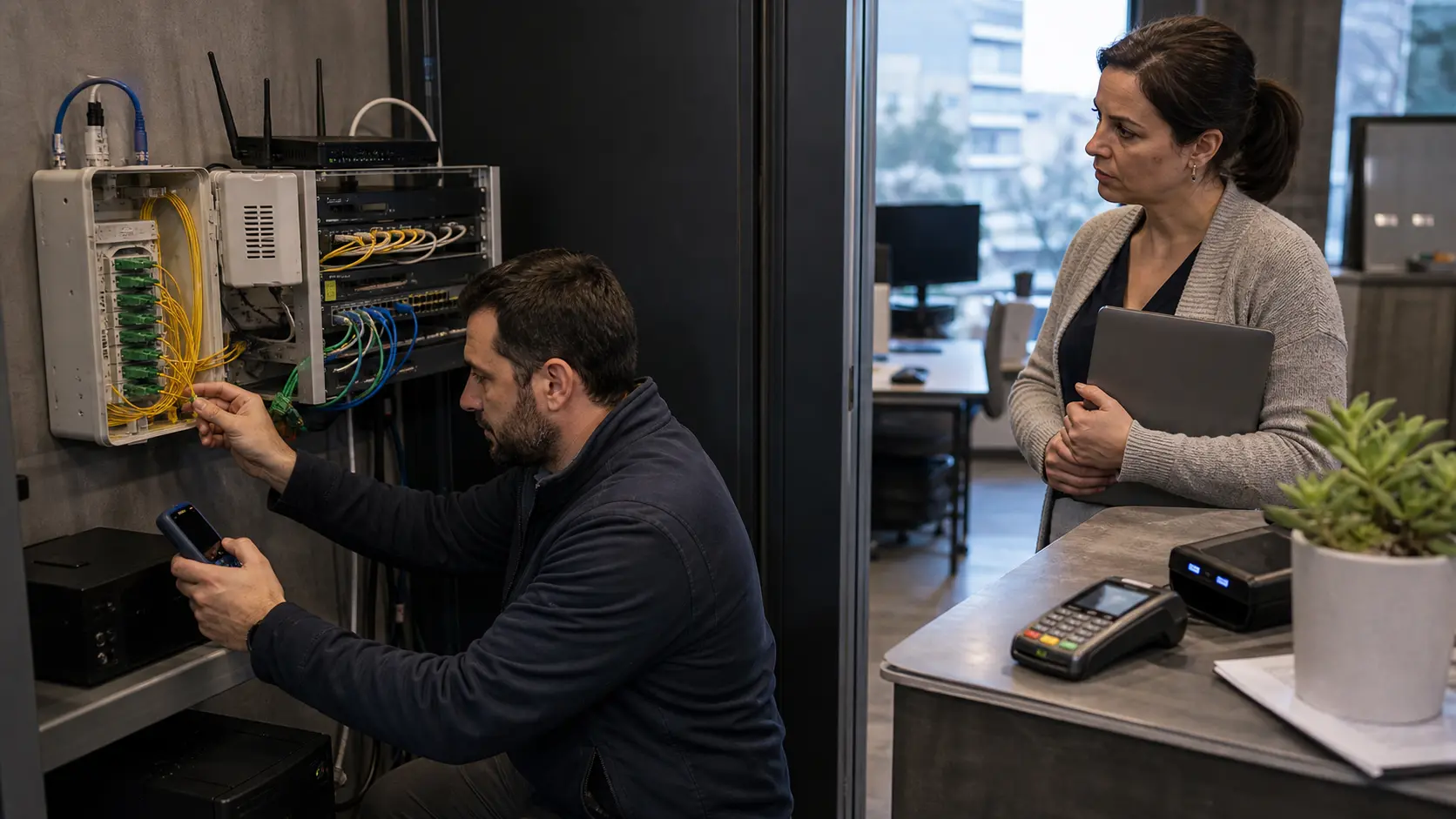
The professional-services page at https://dnet.ro/professional-services/ closes the loop. D-NET describes site surveys, internal cabling, hardware configuration and installation, technical support, remote diagnosis, on-site maintenance and rapid resource deployment. Equipment services cover layer 2 and layer 3 WAN equipment, IPPBX systems, servers and storage. In other words, the provider's public offer reaches into the customer's site. That is where the economics of a local ISP account change. The router, optical handoff, rack power, cross-connect, cable path, IP addressing, firewall change, voice device, server room access and after-hours technician become part of the margin.
This matters especially for small businesses and local institutions. A business can buy a mass-market access line and hope that a national carrier's standard support process is enough. That is often rational. But the first time the trouble ticket lands in a queue while the business owner cannot process payments or reach a private application, the avoided cost of a specialist account becomes visible. D-NET's public pages are designed to sell into that moment. Whether the company consistently delivers it is a separate, private-evidence question.
Romanian Market Pressure Makes Scale A Substitute
Romania is not a market where a small connectivity provider can rely on general broadband scarcity. ANCOM's fixed-internet release at https://www.ancom.ro/en/about-us/media-en/press-releases/over-7-million-fixed-internet-connections-by-the-end-of-2025/ gives the scale problem. More than seven million fixed connections, rapid FTTH growth and a large share of Gigabit fixed links mean many buyers already expect high headline speeds. The release also says the top three providers by fixed connections were Digi, Orange and Vodafone. That concentration matters because a large provider can spread core-network investment, retail systems, procurement, customer-care tooling, field logistics and marketing across a far larger base.
ANCOM's April 2026 release on Digi local-access regulation at https://www.ancom.ro/en/about-us/media-en/press-releases/ancom-primeste-aprobarea-comisiei-pentru-reglementarea-accesului-la-reteaua-digi-romania-in-aproape-6-mii-de-localitati/ shows the other side of scale. ANCOM said Digi Romania had significant market power in 5,894 localities where the regulator's analysis found Digi was sole provider or market leader with a share above 97 percent, affecting millions of inhabitants and households. The proposed remedy was wholesale access under reasonable and nondiscriminatory conditions. For D-NET, the lesson is not simply that Digi is big. It is that physical access and local reach are strategic assets, and that smaller providers often live downstream of infrastructure and market-power realities they do not control.
The quality benchmark is also rising. ANCOM's Netograf release at https://www.ancom.ro/despre-noi/media/comunicate-de-presa/netograf-58-in-2024-viteza-medie-de-download-a-ajuns-la-446-mbps-pentru-internetul-fix-prin-cablu-si-la-58-mbps-pentru-internetul-mobil/ reported national average fixed-cable download speeds of 446 Mbps and mobile download speeds of 58 Mbps in 2024 user measurements. It also described user-experience metrics across social networking, file transfer, streaming and games. Those are consumer-facing measurements, not D-NET-specific results. But they shape expectations. If basic fixed broadband feels fast enough for many ordinary use cases, a specialist business provider must defend a premium through uptime, support, private-network capability, service-level clarity, local fault handling and integration.
The practical substitutes are therefore strong. Digi's fixed internet offer is visible through its own service page at https://www.digi.ro/servicii/internet/internet-fix. Orange presents fixed fiber services at https://www.orange.ro/servicii-fixe/internet-prin-fibra/. Vodafone presents fixed internet services at https://www.vodafone.ro/servicii-fixe/internet-fix. A buyer may also replace a fixed link with 4G or 5G backup, use another local ISP, buy a leased line from a national carrier, or accept a longer repair window because the site is not mission-critical. These substitutes define D-NET's margin ceiling. The company has to be good enough at the work national bundles do not personalize.
This is why D-NET should be priced through support discipline rather than headline speed. A mass-market line may be the right answer for a household, a secondary office or a business that can tether through mobile for a day. A managed local account is more persuasive for a bank branch, regional office, hosted service, warehouse, clinic, public-sector office, trading-related application or small enterprise that cannot tolerate ambiguity about who owns the fault. If the buyer cannot measure the cost of downtime, the specialist account looks expensive.
If the buyer can measure it, the specialist account may be the cheaper option even at a higher monthly fee.
The geography of support also matters in a national market led by large carriers. A Romanian provider can advertise national or regional reach, but the customer experiences that claim at the address level: the building entry, the fibre route, the landlord or facility contact, the cabinet, the technician's travel time, the available spare, and the provider's authority over the last stretch of access. ANCOM's market numbers explain why headline capacity is no longer scarce; they do not remove local operational friction.
A small Bucharest office, a branch in another city and a site outside the largest urban cores may have very different repair economics even when the sold service name is the same.
That is the space in which a specialist can still defend an account. If D-NET knows the customer's access route, maintains a realistic escalation path and can coordinate business-support work around the customer's operating hours, it can sell certainty that a generic package does not promise. If it cannot, the national operators' scale becomes harder to fight. The market pressure is therefore double-edged: Romania's broadband depth raises customer expectations, but it also forces serious business buyers to separate cheap access from accountable continuity.
Field Support Is The Marginal Cost
The most important line on D-NET's site may not be a speed claim. It may be the customer-care language. On https://dnet.ro/services/, D-NET says its Customer Care Center is available 724365 and that mean time to repair can be a maximum of four hours by contract. It also describes proactive monitoring, repair, escalation, account management, change requests and performance reporting. This is the economic center of the account. A four-hour repair promise, when real and properly scoped, prices standby labour, escalation discipline, spare equipment, dispatch reach, supplier management and the provider's willingness to absorb operational complexity before the customer does.
The phrase "by contract" is doing heavy work. It implies that the actual repair obligation depends on the customer's service agreement, site, access type and fault class. A customer should not read a website line as a universal guarantee across every service. The right diligence question is what the contract says about fault classification, excluded conditions, planned work, supplier-controlled access loops, CPE responsibility, service credits, response versus restoration, and escalation timing. Public evidence does not answer those clauses. It shows that D-NET sells support as part of the offer.
Scarce labour is not just call-centre labour. D-NET's professional-services page at https://dnet.ro/professional-services/ points to site surveys, internal cabling, hardware configuration, remote diagnosis, technical assistance, on-site maintenance and layer 2 or layer 3 equipment work. That labour is scarce because it has to be locally deployable and technically specific. The same technician or engineer may need to understand fiber handoff, VLAN tagging, customer routing, firewall coordination, power, rack access, voice equipment, IP addressing, monitoring alarms and the difference between a customer's LAN problem and a provider edge problem.
This is where small and specialist providers can win. A large national provider may have more field staff in aggregate, but a business customer can still value a local or specialist team that knows the site, the customer contact, the router model, the branch pattern and the application sensitivity. Conversely, if a small provider cannot staff that promise, the account becomes fragile.
The buyer should ask how many people can actually touch the service, whether coverage is in-house or subcontracted, how spare equipment is held, what happens outside Bucharest, and whether D-NET's finance-network and private-connectivity services have a separate escalation path.
Field support also sets the churn boundary. A customer can forgive a fault if the provider communicates clearly, sends the right person, owns the handoff with upstream suppliers and explains the root cause. A customer may leave after one bad outage if the provider appears uncertain, understaffed or dependent on a third party it cannot influence. This is why private retention data would matter so much. Public pages can show that D-NET understands the support thesis. They cannot show whether customers renew after bad weeks.
Support labour is also where a local account becomes difficult to automate away. A trouble ticket can be opened through a portal, but an access problem still has a physical and organisational path. Someone has to determine whether the customer's router is reachable, whether optical levels changed, whether a switch port is down, whether a local power event damaged equipment, whether a building cable was cut, whether the upstream path changed, whether a bank or public-institution endpoint is reachable, and whether a third-party supplier must be pushed.
For the customer, the valuable provider is not the one that can recite every possible fault. It is the one that can narrow the fault quickly enough to reduce business loss.
This is why D-NET's professional-services language matters. Site surveys and internal cabling are not glamorous, but they influence future repair time. A well-documented install gives the support desk better information when an alarm appears. Known hardware configurations reduce diagnostic uncertainty. On-site maintenance creates a path for action when remote tools stop being enough. Equipment services create accountability at the customer edge, where many providers otherwise draw a hard boundary and ask the customer to call someone else.
These details can justify a higher account price when the customer has learned that "the internet is down" is rarely a single technical condition.
The danger is that the same labour model can become the constraint. Specialist engineers are expensive, and field technicians cannot be duplicated as easily as bandwidth. If a provider wins too many complex accounts without enough staff, service promises become a queue. If it keeps too much labour idle for rare incidents, margins suffer. D-NET's public record does not show staff count, dispatch coverage, subcontractor use or after-hours staffing. The buyer should treat those questions as central diligence, not as administrative detail.
Capital, CPE And Backhaul Decide The Real Bill
A low monthly access price often hides the cost stack. For a D-NET-style business account, the customer's invoice has to pay for more than bandwidth. It must cover the local access loop or dark-fiber path, optical equipment, routers or switches, customer-premises installation, monitoring, spares, engineering hours, address-resource administration, upstream transit or peering costs, support tooling, account management, finance-sector or private-network design, and the capital tied up in redundancy before it is used.
If a provider promises backup options, ring designs, WDM links or high availability, the unused path is part of the value, not wasted capacity.
D-NET's fiber and connectivity pages make that cost structure visible. The fiber page at https://dnet.ro/fiber-services/ refers to exclusive fiber pairs, ring configurations, end-to-end customer control and WDM. The connectivity page at https://dnet.ro/conectivity-services/ refers to Ethernet links, protocol transparency, no sharing or overbooking for certain fixed fiber or WDM links, backup options, MPLS, classes of service and a private backbone. Each feature adds a cost and a failure mode. Each also adds a way to protect a customer from the limits of a generic broadband service.
Customer-premises equipment is easy to underprice. The router, switch, optical module, firewall handoff or voice gateway may sit in a small rack and look minor compared with the monthly invoice. But it determines whether the provider can see the fault, apply a configuration change, replace hardware quickly, separate customer LAN problems from access problems, and preserve a known design across branches. D-NET's equipment-services language suggests that it wants to own or support some of that edge. That can reduce customer complexity.
It can also create switching cost because the replacement provider must understand or replace the on-site design.
Backhaul and upstream choices add another layer. If a local access provider depends heavily on leased facilities, wholesale handoffs or a small number of upstreams, its cost and quality depend on supplier terms. If it owns or controls more of the path, it carries more capital risk. Neither case is automatically better. A small provider can be excellent if it chooses suppliers well, monitors aggressively and escalates faults effectively. A small provider can be weak if it sells support promises that its leased or third-party dependencies cannot honour.
The buyer's cost paragraph should therefore include the cost of failure. A shop losing card processing for a day, an office losing VPN access during payroll, a clinic unable to send files, a bank branch with a private-network failure, or a local ISP customer with cascading complaints may lose more than a year of line-price savings in one incident. That does not mean every buyer should choose D-NET. It means the rational comparison is the total continuity cost: line price plus equipment plus support plus outage probability plus repair time plus the customer's own loss when the connection fails.
Peering And Transit Discipline Are Evidence, Not Decoration
For a local or specialist ISP, the public routing surface matters because it reveals whether the provider is visible as an autonomous network and how it presents reachability. AS202203 is the anchor. RIPEstat's overview at https://stat.ripe.net/data/as-overview/data.json?resource=AS202203 identifies the holder as D-NET Communication Services SRL. The announced-prefixes endpoint at https://stat.ripe.net/data/announced-prefixes/data.json?resource=AS202203 shows the prefixes seen in the public routing system during the reviewed window. The routing-status endpoint at https://stat.ripe.net/data/routing-status/data.json?resource=AS202203 showed broad visibility through RIS peers.
The as-routing-consistency endpoint at https://stat.ripe.net/data/as-routing-consistency/data.json?resource=AS202203 is useful because it compares registered routing policy with BGP observations. During review it listed prefixes found in both BGP and Whois, including 85.121.8.0/22, 89.31.24.0/22, 93.120.91.0/24 and 2a13:ea00::/32. It also showed some ASNs in both BGP and Whois and other ASNs seen in BGP but not in Whois, with names available from RIPEstat's AS-name endpoint such as https://stat.ripe.net/data/as-names/data.json?resource=AS6796,AS24745,AS2914,AS49544,AS13004,AS204111,AS9009,AS15958,AS39737,AS9050,AS3356,AS21215. The point is not to turn every neighbour into a business relationship claim. The point is to show that the provider's public account depends on route hygiene, upstream choice and interconnection changes that a customer rarely sees directly.
The RIPE aut-num fields name route-policy relationships that include local, regional and global networks. The observed neighbour set includes names such as Orange Romania, NTT, M247 Europe, Prime Telecom, Level3/Lumen and others. Some names may reflect transit, peering, route-server paths, customer relationships or historical policy. Public routing data does not tell us the price, capacity, contract or SLA behind any path. But it tells a buyer what to ask: Are there diverse upstreams? Are there route filters? Is there IPv6 support? What happens if one upstream degrades?
Which routes are preferred for European content, American services or Romanian banks? How does D-NET monitor path performance?
Romania's exchange environment also matters. InterLAN's public site at https://www.interlan.ro/ describes InterLAN-IX as a neutral national interconnection platform with points of presence across Romanian cities and international locations, route-server service, Ethernet interconnection and aggregate traffic peaks around 1 Tbps. D-NET's public RIPE policy references AS24745, identified in RIPEstat AS-name data as Balcan-IX Orange Romania. That is not a claim that D-NET is a current InterLAN member; the reviewed InterLAN partner page did not prove that. It is a reminder that Romanian ISP economics often depend on where traffic is exchanged, how local content is reached and whether peering reduces dependence on paid upstream transit.
The absence of a PeeringDB profile is also a signal, but only a weak one. A query to https://www.peeringdb.com/api/net?asn=202203 returned no entity during review. PeeringDB is a voluntary database and not every network maintains a public profile. Absence does not prove poor peering, weak engineering or small customer value. It does suggest that public self-service diligence is limited. A prospective customer or partner would need to ask D-NET directly for current upstreams, peering policy, points of presence, traffic engineering approach and escalation model.
Peering and transit discipline matter because they translate directly into the continuity account. A customer may never read a BGP table, but it feels the outcome when a path to a cloud service is congested, a European route detours, a bank endpoint becomes unstable, or an upstream incident causes packet loss. The provider's job is not merely to announce prefixes. It is to choose, monitor and change paths in a way that preserves business applications. D-NET's public records show enough network surface to make that question real. They do not prove the answer.
IPv6 is part of the same discipline. D-NET's RIPE and RIPEstat records include 2a13:ea00::/32 as an IPv6 allocation and an observed announced prefix. That does not show how many customer services use IPv6 or whether customer support handles it well. It does show that the network's public resource base is not IPv4-only. For business buyers, IPv6 support can matter less as a marketing feature than as an indicator that the provider is maintaining current routing and addressing competence.
The practical question is whether IPv6 is available, documented, monitored and supported on the customer's service, not merely present in the registry.
Route discipline also affects supplier negotiation. A small provider with visible alternatives can sometimes push a transit supplier, shift traffic or improve a path faster than a provider with only one meaningful route. A small provider with limited alternatives may still deliver excellent service if its main suppliers are strong, but it has less room to manoeuvre during upstream trouble. Public routing records reveal some hints about alternatives and visibility; they cannot reveal leverage. The commercial value comes from the provider's ability to convert those alternatives into practical reliability when the customer calls.
Finance-Sector Positioning Raises The Operating Bar
D-NET's finance-network page is the strongest clue that the company wants to be assessed above the consumer-ISP layer. At https://dnet.ro/finance-network-services/, D-NET describes Banking IPVPN, SWIFTNet connection packs and financial extranet services. It says its MPLS network can provide dedicated access for Romanian banks to the National Bank of Romania, the Credit Bureau, ANAF and the Bucharest Stock Exchange. It also describes SWIFTNet service in partnership with Colt and a regional financial extranet based on Colt PrizmNet.
The correct reading is careful. These are company-published service claims, not an independent list of active bank contracts or audited transaction volumes. The page does not prove that a particular Romanian bank uses D-NET today, nor does it prove current certification status for every named service. It does, however, show why D-NET's account might be materially different from retail broadband. Financial-sector connectivity usually creates a high cost of ambiguity. The question is not whether a speed test looks good on a quiet afternoon.
The question is whether the link, route, CPE, support desk and escalation path can meet the customer's operational and compliance expectations.
Compliance burden appears in D-NET's public positioning as well. The about page at https://dnet.ro/about-us/ states that the company has implemented and applies ISO 9001:2015, ISO 14001:2015 and ISO/IEC 27001:2013. Public site claims of ISO systems should not be treated as a substitute for current certificates, scopes, audit reports or customer-specific controls. But they help explain the business market D-NET is courting. A provider selling into banks, public institutions and managed enterprise connectivity has to speak the language of quality, environmental management and information security, even if the article cannot independently verify the certification details.
Data locality and regulatory sensitivity are part of the buyer's reasoning. A Romanian business may want support in Romania, local language escalation, local site knowledge, private connectivity to Romanian institutions and a provider that understands domestic operating norms. That does not mean every packet stays in Romania or that local ownership automatically improves security. It means the account can carry value that is not visible in a generic price comparison.
If a bank branch, public institution or regional service needs a predictable Romanian contact for a network issue, local support and private connectivity can be part of the purchased product.
The finance-sector positioning also increases the burden of proof. A provider that claims mission-critical connectivity should be prepared to show customers current certificates, service scopes, audited process evidence where relevant, incident handling procedures, access controls, business-continuity design, vendor dependencies and references. Public pages are the start of that conversation, not the end. The stronger the customer's dependency, the less it should rely on website language alone.
For D-NET, the strategic upside is clear. Finance and enterprise accounts can be stickier than household broadband, can value support, and can justify private network design. The strategic risk is also clear. These buyers are demanding, switching may happen after trust breaks, and national carriers or global providers can compete for the same regulated or enterprise accounts. The account depends on credible execution, not just local identity.
The compliance and finance angle also changes how outages are judged. In an ordinary retail setting, the customer's main questions may be speed, price and whether a technician eventually arrives. In a finance-linked or private-network setting, the customer may need incident records, escalation notes, change windows, access approvals, security contact handling and evidence that the provider followed the agreed process. A provider can lose trust even if it restores the link, if the customer cannot reconstruct what happened or cannot explain the incident internally.
That is why the operational paperwork around the connection can be part of the paid unit.
There is also a procurement implication. A buyer choosing between a national carrier and D-NET may not be choosing only network reach. It may be choosing between standardized procurement comfort and specialist attention. Large carriers can look safer because they are familiar, large and already approved by many institutions. A specialist can look safer when the customer needs a named team, a particular finance-network path, or a provider willing to integrate equipment and support around an unusual site. The public evidence places D-NET in that specialist contest.
It does not prove that D-NET wins every procurement contest against larger carriers.
Substitutes: National Fibre, Mobile, Another Local Provider Or A Leased Line
The practical substitute for D-NET depends on the customer's tolerance for downtime and complexity. For a household or very small office, the substitute may be simple: take a Digi, Orange or Vodafone fixed service, add mobile backup, and accept standard support. The national market data from ANCOM makes that a credible path. Fast fixed broadband is common enough that a specialist provider cannot assume every buyer needs bespoke support.
For a small business with one site, the substitute is more nuanced. A national fiber bundle may provide enough speed at a lower price, but support may be standardized. Mobile backup may keep email and card terminals alive for a while, but it may not replace static addressing, stable latency, VPN design or a private link. Another local ISP may provide personal support but not the same finance-network or MPLS positioning. A leased line from a large carrier may provide stronger formal SLA language, but it may be more expensive or less flexible in customer-premises work.
Delayed repair tolerance is the cheapest substitute: the customer simply accepts that a bad outage is part of business risk.
For a multi-site business, branch network, bank-related service or institution, switching is harder. The customer may have IPVPN design, classes of service, private addresses, router configurations, firewall rules, monitoring dependencies and contacts trained around the existing provider. Moving away can require surveys, new access tails, parallel running, equipment replacement, route changes, testing windows and a period when both providers must be paid. This is where D-NET can retain accounts if support is good. It is also where a poor incident can become decisive because the customer's switching cost is high but not infinite.
For another ISP, hosting company or content-related buyer using D-NET's business-grade internet positioning, the substitute is direct transit, another upstream, an exchange connection or a larger wholesale provider. D-NET's site says its dedicated internet service is used by national and local ISPs, large corporates, content providers and hosting companies. The economics there depend on price per Mbps, burst policy, route quality, local reach, DDoS and security posture, support responsiveness and how the provider behaves when a path degrades. Public evidence does not show whether D-NET wins that comparison today.
The conclusion on substitutes is therefore conditional. D-NET looks less attractive when the buyer only needs cheap speed, can tolerate repair delay, or can use a national operator's standard support. It looks more attractive when the buyer needs a known Romanian support path, business-grade access, managed private connectivity, finance-sector integration, equipment work and route choices that can be discussed with engineers rather than hidden behind a consumer help desk.
That same substitute judgement must sit at the end of the thesis: national fiber and mobile can replace the commodity line, but they do not automatically replace the continuity account.
The substitute analysis should also include doing nothing. Many small businesses underinvest in connectivity because the monthly savings are visible and the outage cost is hypothetical until it happens. That behaviour is rational when downtime has little cost or when a mobile hotspot is an adequate fallback. It becomes fragile when the business depends on online payments, remote inventory systems, cloud accounting, branch VPN, hosted voice, regulatory reporting or private financial connectivity. D-NET's opportunity is to sell before that failure, but the buyer often understands the value only after one.
That timing problem is a classic local-ISP economics issue: the provider must price preparedness in a market that often shops for bandwidth.
Unofficial Market Signals Are Colour, Not Verdict
Several public signals should be treated as colour rather than proof. D-NET's website contains some dated visual and footer elements, including a 2016 footer, while its service language describes long-running business and financial-connectivity work. That combination suggests a relationship-led provider whose sales may not depend on consumer-style web merchandising. It could also suggest the public website is not the company's main operating record. It should not be converted into a conclusion about service quality.
The absence of a PeeringDB entity at https://www.peeringdb.com/api/net?asn=202203 is similar. For content networks, carriers and exchange-facing networks, PeeringDB can be a useful way to publish locations, policy and contact details. Some small or regional networks do not maintain profiles even when they operate real services. D-NET's absence from that public venue makes outside diligence harder; it does not prove poor peering. A prospective partner would still need a current interconnection pack from the company.
The limited public review surface is also ambiguous. A mass-market ISP often leaves a trail of retail complaints, price comparisons, speed-test chatter and social posts. A specialist business provider may have fewer public reviews because its accounts are private, contractual and relationship-managed. Lack of consumer noise can mean fewer retail customers. It can also mean the public web is not where the customer relationship happens. The only fair conclusion is that public sentiment does not provide a reliable independent measure of D-NET's repair quality or customer retention.
The company's public language also mixes broad technology claims with finance-sector specificity. A cautious buyer should separate the two. Broad phrases such as high availability, resilience, latest technologies or competitive advantage are normal marketing language. More specific claims, such as services to banks, SWIFTNet connection packs, MPLS history, 724365 care and a contractual repair target, are more useful because they point to verifiable contract questions. The buyer should ask for current references, service descriptions, proof of coverage at the site, and the actual SLA schedule.
Another unofficial signal is that D-NET's public web presence is on a prefix announced by its own AS202203. That is a positive identity clue, but not a quality score. Some excellent providers host public websites externally. Some weak providers host websites on their own networks. The relevant question is whether the same operational discipline visible in public routing records applies to customer circuits, monitoring, incident response and supplier escalation.
These market signals help shape the thesis but should not decide it. The thesis rises or falls on execution that is mostly private: whether customers renew after outages, whether repair promises are met, whether upstream choices avoid avoidable degradation, whether field technicians can reach sites quickly, and whether the company can keep specialist labour while competing with national operators and larger enterprise carriers.
Proof Boundary: What Public Evidence Can And Cannot Carry
The direct public proof is clear. D-NET is identifiable in RIPE as a Romanian LIR through ORG-SDCS12-RIPE. AS202203 is publicly visible and associated with D-NET in RIPEstat. The company website describes business connectivity, fiber, Ethernet, IPVPN MPLS, internet access, finance-network services, professional services and support. The dnet.ro domain resolved to an address inside a prefix announced by AS202203 during review. ANCOM data shows the Romanian fixed and mobile internet market is mature, concentrated at the top and increasingly fast.
InterLAN's public site shows that Romanian interconnection economics include a national neutral exchange environment, even though the reviewed public partner page did not prove D-NET as a current member.
The implications are also clear, but they are implications. D-NET's public profile makes most sense as a specialist Romanian business-connectivity account. Its value would come from support, private or managed connectivity, field work, customer-premises equipment, finance-sector familiarity, route choices and switching friction. Its threat comes from national-carrier scale, mobile substitution, wholesale dependencies and the difficulty of proving reliability without private records.
The missing private evidence falls into three classes. The first is economics: public records did not provide revenue, margin, customer count, service mix, price book, cost per access loop, utilization, upstream cost or capital-spending data. Without those numbers, the article cannot say whether D-NET's account is financially expanding, stable or squeezed. The second is reliability: public records did not provide independent outage history, SLA attainment, repair-time distribution, packet-loss history, complaint rate, Netograf results specific to D-NET or customer incident reports.
Without those numbers, the article cannot say whether the support promise is consistently delivered. The third is retention: public records did not provide churn, renewal rates, reference customers, lost-account reasons, contract duration or share of revenue under multi-year enterprise agreements. Without those numbers, the article cannot say how sticky the account is after customers experience real faults.
This proof boundary is not a weakness in the research; it is the central commercial question. Many regional and specialist connectivity providers are priced by facts that are private by nature. A public observer can see number resources, services, market context and some routing behaviour. The buyer sees contracts, incidents, invoices and people. D-NET's public evidence is strong enough to justify tracking the company as a Romanian specialist connectivity provider. It is not strong enough to rank its service quality against every national or local substitute.
Watchpoints That Would Change The Judgement
The first watchpoint is current customer and revenue mix. If D-NET can show a growing base of enterprise, finance, public-institution or ISP customers with multi-year renewals, the specialist-account thesis strengthens. If most revenue is low-margin resale access, one-off installation or accounts that can easily move to national carriers, the thesis weakens. A public or customer-provided split between dark fiber, Ethernet, IPVPN MPLS, dedicated internet, finance-network services and professional support would be decisive.
The second watchpoint is independent reliability and repair evidence. A verified series of outages, repair times, SLA compliance, complaint outcomes or customer references would matter more than website availability claims. Evidence that D-NET meets four-hour contractual repair obligations across relevant sites would strengthen the account. Evidence of repeated delays, unclear fault ownership or customer churn after outages would weaken it sharply.
The third watchpoint is current route and supplier diversity. Updated upstream contracts, points of presence, peering policy, route monitoring and capacity evidence would show whether AS202203 is engineered for the business promises attached to it. If D-NET has diverse, well-managed paths and strong Romanian interconnection, route discipline can be part of the product. If it depends on a narrow supplier set or lacks clear escalation power, national carrier substitutes become more persuasive.
D-NET's public account therefore lands in a specific place. It is not a mass-market cheap-line story. It is a Romanian business-access and continuity story whose value depends on field support, managed connectivity, finance-sector familiarity, CPE competence and peering or transit discipline. The practical substitute is always present: national fiber, mobile broadband, another local ISP, a large-carrier leased line, or acceptance of slower repair. D-NET matters when the buyer can prove that those substitutes replace bandwidth but not the accountable local continuity account.