
Summary
- The useful unit for judging Crave Technologies is not the headline gigabit claim. It is the island fibre install: Proximity Fiber advertises a 1000 Mbps down and 1000 Mbps up fibre-to-the-home plan at C$124.99 a month, plus a C$149.99 installation fee, in a Grand Manan footprint that began in North Head and expanded along Route 776 toward Ingalls Head (http://www.proximityfiber.com/packages/ and http://www.proximityfiber.com/faq/).
- What the customer buys is a working service bundle, not a strand of glass alone: an appointment, a drop, customer-premises electronics, Wi-Fi handoff, billing continuity, outage communication, troubleshooting steps, and a local support path with a Grand Manan address, telephone number, weekday office hours and service-availability requests (http://www.proximityfiber.com/contact/ and http://www.proximityfiber.com/support/troubleshooting/).
- The install is expensive because the market is small and geography-bound. Grand Manan is a Bay of Fundy island with a census-derived population of 2,595 and a small east-side settlement pattern, while Proximity's own news archive describes utility-pole construction, contracted build crews, bucket-truck work, splicing equipment, 12,000 metres of fibre arriving for phase 2, microwave link upgrades across the bay, and later access to fibre in NB Power undersea cables (https://en.wikipedia.org/wiki/Grand_Manan and http://www.proximityfiber.com/news/).
- Technical records support the claim that Crave has a real public internet surface, but they do not prove customer count, support quality or internal architecture. ARIN ties AS394501 and direct IPv4 and IPv6 allocations to Crave Technologies at Grand Manan; RIPEstat showed the AS announced on July 5, 2026; PeeringDB lists Crave as Proximity Fiber with a regional Cable/DSL/ISP profile; Hurricane Electric counted six announced prefixes, one internet exchange and 20 observed peers (https://rdap.arin.net/registry/autnum/394501, https://stat.ripe.net/data/as-overview/data.json?resource=AS394501, https://www.peeringdb.com/api/net?asn=394501 and https://bgp.he.net/AS394501).
- The bull case is that a local fibre operator can sell accountability and island-specific engineering where national networks historically underserved the location. The bear case is that every bad install, missed support call, underused route segment, damaged customer device, ferry-delayed repair or churned household can erase months of gross margin in a market where the address base is finite.
The install is the priced unit
Crave Technologies Ltd. is easier to understand if the first question is not "how fast is the package?" but "how many good installs can one island support?" Proximity Fiber advertises a rural fibre-to-the-home service on Grand Manan, not a national mass-market broadband product. The public package page lists one fibre plan, 1000 Mbps down and 1000 Mbps up, at C$124.99 per month. It also lists a C$149.99 installation fee for all new connections and says unlimited data is subject to fair use policies (http://www.proximityfiber.com/packages/). Those three public numbers define the envelope: a household pays a monthly price that looks modest beside the civil work and support obligations embedded in the connection, and the operator receives an upfront fee that is not large enough to absorb many mistakes.
That makes the install the real unit of economics. An island fibre install begins before the technician touches the home. The provider has to know whether the address sits inside the covered streets, whether the nearest route has capacity, whether a pole line or aerial drop can be used, whether a weather window is sensible, whether a customer appointment will be kept, whether customer-premises equipment is in stock, whether the fibre can be spliced cleanly, and whether the Wi-Fi router will leave the customer with the service experience the tariff implies. A perfect install becomes a monthly annuity.
A weak install becomes a support case, a truck roll, a credit discussion and possibly a lost household.
Proximity's own FAQ gives the market boundary. It says customer installations on Grand Manan in the North Head area started in May 2019, that phase 1 covered portions of North Head from Pettes Cove to Dock Road with a lower Whistle Road extension, and that phase 2 construction extended coverage down Route 776 from Dock Road to Ingalls Head Road (http://www.proximityfiber.com/faq/). That is not a generic rural internet claim. It is a named island build, road by road, with a limited service area. The record does not show how many customers exist inside that footprint, but the geography is enough to show why unit economics matter. A provider cannot solve a small island's margin problem by assuming endless density. It must recover the cost of each pole route, splice, drop, support call and backhaul dependency from a bounded pool of addresses.
The package page sharpens that point because fibre is not the only product. Proximity also lists wireless plans at 5/5 Mbps for C$80.00, 10/10 Mbps for C$104.99, 20/20 Mbps for C$134.99 and 40/40 Mbps for C$154.99 a month, each with no data caps in the public description (http://www.proximityfiber.com/packages/). The price ladder is economically revealing. The fibre plan is faster and cheaper than the top wireless plan, which suggests that the mature fibre route can be the better product when the address is reachable. It also suggests why the install has to be done well. If the fibre route is built and take-up is good, the operator can sell a superior service at a price that should reduce churn. If the route is thin or the installation process consumes too much labour, the attractive retail price can become a margin trap.
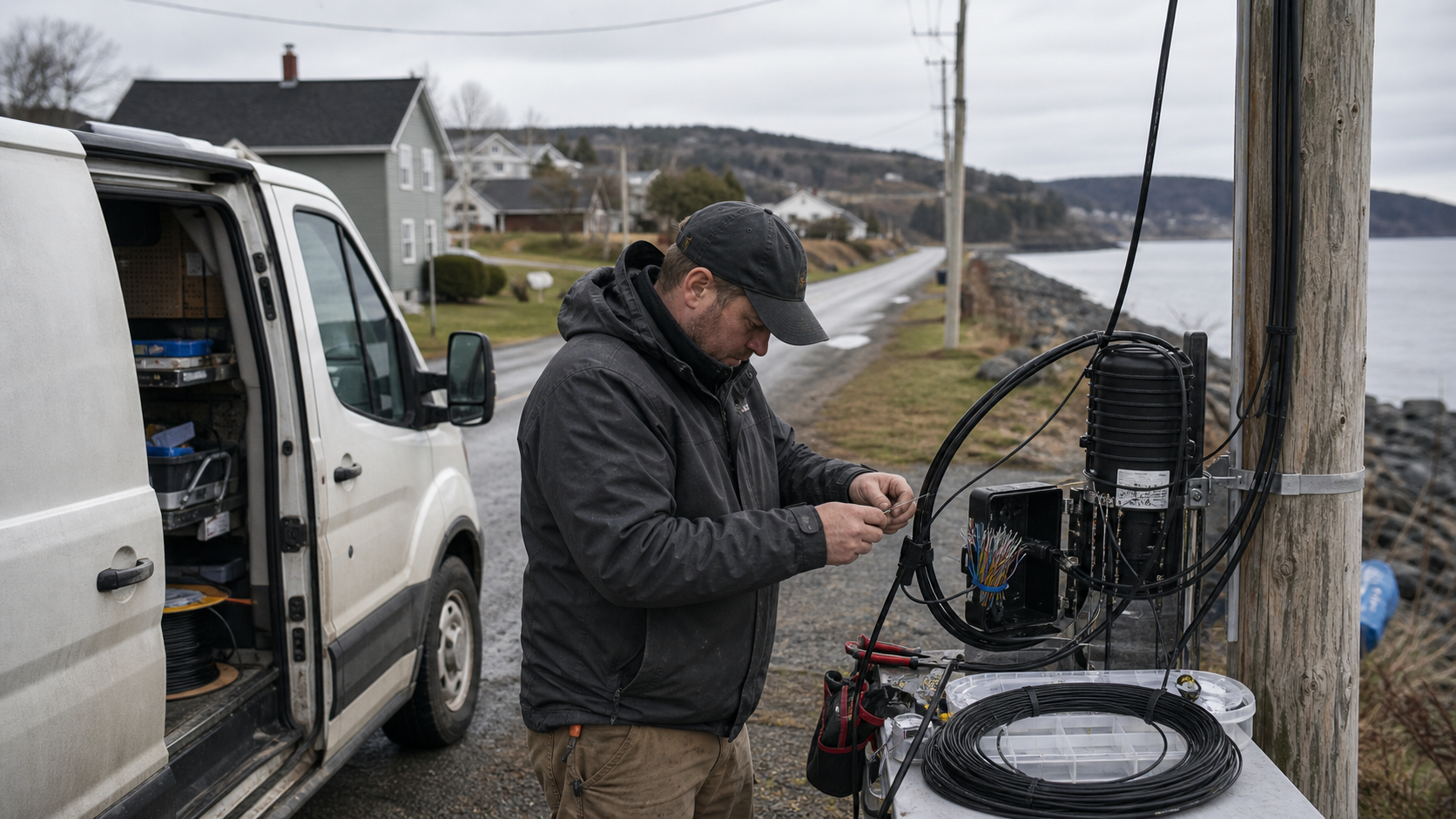
The contrast between a C$149.99 installation fee and the field work described in the company's news archive is the central tension. The archive says a new bucket truck was added to help crews work faster, that a fibre splicing trailer was prepared so the company could make direct-to-home connections and repairs without waiting for outside contractors, that construction crews from K-Line were expected in North Head for one to two weeks, that crews would string fibre optic cable on utility poles, and that phase 2 supplies included more than 12,000 metres of cable (http://www.proximityfiber.com/news/). Those items are capital, labour and coordination, not web-page decoration. The customer sees an appointment and a monthly bill. The provider sees asset utilization.
That is why the margin test is not whether a 1000/1000 plan can be written on a package page. It is whether enough customers can be connected with low rework, low churn, low equipment loss and manageable support cost to pay for the island-specific network. In a city, a provider can average a failed install across thousands of nearby prospects. On Grand Manan, every serviceable road segment is a thinner ledger. The economics are local, physical and repetitive.
What the customer is actually buying
The customer is buying working internet, but that simple phrase hides a service bundle. Proximity's contact page lists a Grand Manan address at 42 Moses Lane, a telephone number, weekday hours from 9:00 AM to 5:00 PM, and a form that lets the customer choose request types including request for service, service availability, technical support, press inquiry, billing and other (http://www.proximityfiber.com/contact/). That surface matters because rural fibre is not an anonymous download-speed commodity at the moment of purchase. The customer wants to know whether the company can reach the house, when a crew can come, whether billing will be stable, who answers when service fails, and whether the local operator is accountable enough to justify switching from whatever service previously worked poorly.
The install creates that accountability. A fibre customer buys the outside drop, the splice, the indoor handoff, the electronics that bring the optical connection into usable Ethernet or Wi-Fi, the router setup, the explanation of what to do when devices fail to connect, and the expectation that a local support team can separate a home Wi-Fi issue from an access-network issue. The troubleshooting page shows how practical that bundle is. It tells customers to check whether all devices are down, examine power supplies, verify that the black cable through the wall is connected to the port marked POE, reseat connectors, reboot the power adapter, check router lights, and verify the WAN and LAN cables before requesting a visit (http://www.proximityfiber.com/support/troubleshooting/). That page reads like a support-cost map. Each step a customer completes can save a dispatch; each step a customer cannot perform becomes labour for the provider.
The same page says the company may send a technician if necessary, but if the technician fixes the connection by doing one of the listed steps, the customer may be charged C$59.99 plus HST for the technician visit, labelled as a truck roll. It also says damaged equipment may be billed at retail value, labour to replace damaged equipment is C$99.99 per hour plus HST, and a site-visit fee may also be charged. Accounts in arrears may be asked to pay the balance plus a truck-roll fee before a technician is dispatched (http://www.proximityfiber.com/support/troubleshooting/). This is not a brochure detail. It is a statement of where the operator thinks margin is lost. The company is telling customers that a support visit has a cost, that customer-premises equipment is an asset, and that billing status affects dispatch.
Those rules are easy to justify in a small-market cost stack. A field visit on Grand Manan is not just a technician's wage. It can include vehicle time, scheduling friction, weather risk, spare device inventory, ladder or bucket-truck safety, a customer who may not be home, and the opportunity cost of not connecting the next paying customer. The public fee of C$59.99 plus tax is a deterrent against avoidable visits, not a full statement of cost recovery. The C$99.99 per hour labour rate for damaged equipment tells customers that preventable device work will not be silently absorbed by the monthly fee.
Whether customers welcome those rules depends on how fair and clear the support process feels in practice.
The customer also buys billing continuity. The troubleshooting page's arrears language is blunt: a delinquent account can affect dispatch. In a national broadband business, that may be one line in a policy manual. In a small island ISP, it is a cash-flow control. The operator has to collect monthly revenue predictably because the cost base is not fully variable. Fibre routes, backhaul, peering, office hours, insurance, vehicles and spare parts continue to exist even when a few customers delay payment. A local provider that is too lenient can end up financing its customers.
A provider that is too strict can harm the local trust that makes the business defensible. The margin sits in that discipline.
The customer also buys outage communication. Proximity's status page displayed an "All Clear" status while also carrying a message that services were starting to be restored and that customers would receive a proactive five-day credit (http://www.proximityfiber.com/status/). A single status-page snapshot should not be converted into an outage-rate claim. It does show the kind of public communication a local operator has to manage: acknowledge restoration, apologize, credit customers and offer a report-an-issue path. The credit language is especially relevant to unit economics. Credits are the cost of preserving trust when the service promise is interrupted. They are also a reminder that broadband margin is not only installation cost minus monthly price; it is monthly price minus faults, credits, truck rolls and churn.
The bundle finally includes local legitimacy. Proximity's FAQ says the service is designed, developed and delivered by Crave Technologies Ltd., building on a decade of wireless internet experience and a rural-community focus (http://www.proximityfiber.com/faq/). The news archive says Crave provides fixed wireless and fibre-to-the-home services on Grand Manan Island (http://www.proximityfiber.com/news/). Those claims matter because the customer is not merely choosing a technology. The customer is choosing whether a local provider can do the last-mile work better than a distant incumbent or satellite substitute. That is a serious economic proposition, not a sentimental one. Local trust has value only if it lowers churn, improves installation conversion, reduces support friction and gives the company enough density to keep crews productive.
Why the island install is expensive
The phrase "rural FTTH" can sound like a single construction problem. On Grand Manan, it is a market-size problem, a logistics problem and a maintenance problem at the same time. Grand Manan is an island in the Bay of Fundy; the public census-derived profile puts the village population at 2,595 and the land area at 150.56 square kilometres, with settlement concentrated largely along the eastern side and Route 776 serving as the main north-south road (https://en.wikipedia.org/wiki/Grand_Manan). Those figures are not subscriber estimates. They are the denominator that disciplines every broadband claim. A fibre route can be socially valuable and still commercially difficult if the address density is low and route miles are long.
The company's own history makes the field work visible. In January 2019, Proximity said construction crews from K-Line would arrive on the island and work in North Head for one to two weeks, with trucks and crews operating down as far as Dock Road. A later January item said crews had laid strand across much of the planned coverage area and were running fibre optic cable, including slack loops needed for repairs and expansion. A February item said construction was complete and that crew members were deploying enclosures that would act as connection points between network segments and homes (http://www.proximityfiber.com/news/). In one sense, this is ordinary outside-plant construction. In another, it is the whole business: strand, fibre, slack loops, enclosures, drops and splices have to be placed before recurring revenue appears.
The island setting makes each stage less forgiving. If a contractor, material shipment or specialized repair crew has to reach Grand Manan, the route is not the same as driving across a city grid. The public Grand Manan profile describes a ferry crossing from Blacks Harbour to Grand Manan that takes about one and a half hours (https://en.wikipedia.org/wiki/Grand_Manan). That does not mean every Proximity task requires a ferry trip; the company's local address and equipment indicate local presence. But the ferry still matters to supply chains, contractor availability and emergency escalation. When spare fibre, electronics, bucket-truck parts or outside specialists must come from off-island, time and weather become cost inputs.
Weather is not an abstraction in the company's own news. A September 2019 phase 2 construction item says crews would be stringing fibre optic cable on utility poles and describes the work as hard, done in all kinds of weather, while asking drivers to slow down and give crews room (http://www.proximityfiber.com/news/). That line is important because the install is not only a customer-service appointment. It is a safety-managed construction activity in a public road environment. A utility-pole aerial build must account for traffic, height, wind, rain, slack storage, pole access, make-ready constraints and future repairability. The more a route is exposed to weather and road conditions, the more the provider needs good records and resilient field procedures.
Customer-premises equipment is another cost layer. The troubleshooting guide refers to power adapters, POE ports, AirCube-type and AirRouter-type Wi-Fi routers, WAN ports, LAN ports and cables entering through the wall (http://www.proximityfiber.com/support/troubleshooting/). The exact current device mix is not public, and those examples should not be treated as a complete architecture diagram. They still identify the economic categories: powered electronics, indoor routers, cable terminations and customer handling. Every installed device can fail, be unplugged, be damaged, be misconfigured, be blamed for a Wi-Fi problem or be returned late. The device cost is not fully recovered on the day of installation unless the operator charges enough upfront, which the public C$149.99 install fee may or may not do.
Splicing skill is a local-margin asset. In January 2019, Proximity wrote that its fibre splicing trailer was nearly ready and that, with its own fibre splicing equipment, it could establish direct-to-home connections or make network repairs without waiting for outside contractors (http://www.proximityfiber.com/news/). That is not just operational pride. It is a make-or-buy decision. If every splice depends on an outside contractor, the operator loses schedule control and pays contractor margins. If the operator owns the equipment and skill, it carries capital cost and training but can connect homes and repair faults faster. On an island, that control can be decisive because a small delay can stretch into customer frustration and churn.
Route utilization is the hardest cost to see from public pages. A 12,000 metre fibre delivery for phase 2 sounds impressive, and it is meaningful physical evidence that a real build was under way (http://www.proximityfiber.com/news/). But cable metres do not equal profitable customers. The business question is how many paying homes or businesses can be attached per metre of strand and fibre, how many will choose the service, how many will keep paying after the first year, and how often each route segment requires maintenance. A rural route with ten homes can be essential infrastructure and still be weak from a private-margin standpoint if take-up is low or if support cost is high.
The installation fee therefore should be read as a behavioural tool as much as a cost-recovery tool. A C$149.99 fee screens for seriousness, contributes something to the visit and creates a customer perception that the connection has value (http://www.proximityfiber.com/packages/). It does not make utility-pole construction cheap. It does not pay for undersea transport, peering, staff, office time or truck inventory. It does not protect the operator against a customer who leaves after a few months. That recovery has to come from a long enough subscription life and enough route density. In a small geography, the install is a bet on retention.
Backhaul is the hidden island cost
The last-mile drop is visible to the customer. Backhaul is less visible but may be the more strategic cost. Proximity's news archive shows that early operations used microwave links across the bay. A May 2019 item said the company would upgrade links across the bay with a new generation of microwave transmission equipment and that, during the work, traffic would move over a secondary link without the same capacity as the primary links, potentially causing slowdowns (http://www.proximityfiber.com/news/). That post is a valuable clue because it shows the difference between a local fibre route and a complete internet service. A home can have fibre to the wall and still depend on how the island reaches the wider internet.
Microwave backhaul can be the right answer for a rural island, especially before a fibre transport route is available. It avoids some civil construction, can be deployed faster and can create redundancy. But it also introduces capacity, alignment, weather, licensing and equipment constraints. The public post does not disclose capacity or architecture, so it should not be used to diagnose network performance. It does show why the customer is not simply buying "fibre".
The customer is buying the chain from home to aggregation, from aggregation to off-island transport, from transport to transit and peering, and from there to the services the household or business actually uses.
The major strategic update came in 2020. The news archive says Crave Technologies and NB Power signed a memorandum of understanding regarding the Fundy Isle cables and the fibre optics within them. It says the agreement would allow Crave to bring better products and services to existing clients and expand across the Fundy Isles. A later October 2020 item says a long-term access agreement granted Crave access to the fibre optic portions of undersea power cables that NB Power installed in 2019 to connect Grand Manan, Campobello and Deer Island, and also granted NB Power access to portions of Crave's fibre optic infrastructure on Grand Manan Island (http://www.proximityfiber.com/news/).
That is the closest public evidence to a structural backhaul improvement. It should still be bounded. The company news page proves that Crave publicly announced an agreement and described its purpose. It does not disclose capacity, lit services, costs, service-level terms, construction completion across every island, or how much traffic moved over those fibres at any later date. For economic analysis, however, the access agreement matters because undersea fibre changes the shape of the island install.
If off-island transport becomes higher capacity and more reliable, then local FTTH customers can receive the service quality implied by the 1000/1000 plan. If backhaul is constrained or costly, the last-mile install can overpromise.
The CRTC's Broadband Fund page gives the policy backdrop without proving anything specific about Crave. The CRTC says the fund exists to help Canadians access reliable high-speed internet and cellphone services regardless of where they live, with rural, remote and Indigenous communities explicitly named as the gap it targets. The page, modified June 30, 2026, says 68 projects had been funded, C$783.7 million awarded, 54,477 households supported and 5,973 kilometres of fibre transport infrastructure included in funded projects (https://crtc.gc.ca/eng/internet/internet.htm). Those national figures explain why rural transport is a public-policy problem. They do not say Crave received funding. They simply make clear that the economics Proximity faces are not unique: fibre transport, not just retail packages, is often where rural broadband fails.
For a small ISP, backhaul affects support economics as much as speed. If a fault is in a customer's router, a support representative can guide a reboot. If a fibre drop is damaged, a local crew can repair it. If a route segment is down, the operator can dispatch field labour. If off-island transport is congested or impaired, the customer still calls the local number, but the root cause may sit beyond the customer's house. The support burden follows the retail brand, not the physical cause. That is why better transport can reduce churn even when customers never see it.
The public routing data points in the same direction. PeeringDB lists Crave Technologies Ltd., also known as Proximity Fiber, with a Cable/DSL/ISP information type, a regional scope, heavy inbound traffic ratio, IPv6 enabled, an open general peering policy, and a listed website and peering policy URL (https://www.peeringdb.com/api/net?asn=394501). PeeringDB also shows a TorIX attachment at 10,000 Mbps and facility entries for Telehouse Toronto at 151 Front Street West and Fibre Centre in Moncton (https://www.peeringdb.com/api/netixlan?net_id=8868 and https://www.peeringdb.com/api/netfac?net_id=8868). These are self-maintained interconnection records, not audited financial statements. But they support the idea that the company has to think beyond island drops: Toronto exchange presence, Moncton facility presence and transit paths are part of the service bundle.
Backhaul therefore turns the island install from a local construction job into a network-integration job. A clean drop matters, but so does the path away from the island. A cheap monthly plan is not cheap if the operator has to buy expensive transport, maintain low-utilization routes and answer every buffering complaint. A high monthly plan is not defensible if customers can get a substitute that feels good enough. The install earns its margin only when local fibre, off-island transport and internet reachability work together.
Evidence of value, and evidence that falls short
The strongest evidence of value is the company's own operating record of physical build milestones. Proximity's archive says construction started in January 2019, construction was complete for phase 1 in February, the first fibre-to-the-home customer was connected in March, phase one backbone connections covered the deployment area by June, phase 2 construction was under way in September, and phase 2 construction was complete in October 2019, extending service from North Head as far as the intersection of Route 776 and Ingalls Head Road in Grand Harbour (http://www.proximityfiber.com/news/). Those items support the central claim that this is not merely a paper ISP. The company publicly documented construction, splicing, first customer connection and expansion.
The second evidence class is price and product differentiation. The fibre plan's 1000/1000 Mbps at C$124.99 per month is materially different from the older wireless tiers, which top out at 40/40 Mbps for C$154.99 per month (http://www.proximityfiber.com/packages/). That public ladder implies that fibre, once constructed, can offer better economics or better capacity than wireless. It also gives customers a reason to value the install: the service is not just a marginal upgrade from 20 Mbps to 40 Mbps. It is a shift to symmetric gigabit service where available.
The third evidence class is local support instrumentation. Proximity has a contact form with service-availability and technical-support categories, a telephone number, weekday hours, a status page, and a troubleshooting guide that names specific customer equipment and explains when truck-roll and labour charges may apply (http://www.proximityfiber.com/contact/, http://www.proximityfiber.com/status/ and http://www.proximityfiber.com/support/troubleshooting/). That does not prove the support is good. It proves the company has public support processes and has had to formalize the distinction between customer-side troubleshooting and provider-side dispatch. For an island ISP, that distinction is a margin-control mechanism.
The fourth evidence class is external network record consistency. ARIN RDAP identifies AS394501 as CRAVETECHNOLOGIESLTD and lists Crave Technologies Ltd. at 42 Moses Lane, Grand Manan, New Brunswick, with active status and NOC hours in the registration comments (https://rdap.arin.net/registry/autnum/394501). ARIN RDAP also ties direct allocations including 45.45.172.0/22, 134.195.32.0/22, 23.150.0.0/24 and 2605:1ec0::/32 to Crave Technologies (https://rdap.arin.net/registry/ip/45.45.172.0/22, https://rdap.arin.net/registry/ip/134.195.32.0/22, https://rdap.arin.net/registry/ip/23.150.0.0/24 and https://rdap.arin.net/registry/ip/2605:1ec0::/32). RIPEstat's AS overview showed the AS announced at the July 5, 2026 query point and names the holder as Crave Technologies Ltd. (https://stat.ripe.net/data/as-overview/data.json?resource=AS394501). These are hard identifiers.
The fifth evidence class is interconnection visibility. Hurricane Electric's BGP page for AS394501 lists the company website, Canada as country of origin, six originated and announced prefixes, five IPv4 and one IPv6, 2,304 originated IPv4 addresses, one internet exchange, 20 observed BGP peers, and TorIX in Toronto with IPv4 and IPv6 addresses (https://bgp.he.net/AS394501). RIPEstat's announced-prefixes endpoint listed six prefixes in the two-week view from June 21 to July 5, 2026, including 45.45.172.0/22, 134.195.32.0/22, 23.150.0.0/24 and 2605:1ec0::/32 (https://stat.ripe.net/data/announced-prefixes/data.json?resource=AS394501). Again, these records prove public routing surface, not user experience.
What falls short is just as important. Public pages do not disclose subscriber count, churn, average revenue per user, capital cost per passing, take-up by road segment, install completion time, repair time, wholesale or transport cost, customer-satisfaction scores, pole-attachment terms, number of staff, vehicle utilization, device failure rates or peak-time throughput. The official news archive says feedback was positive after early connections, but that is company speech, not an independent customer sample (http://www.proximityfiber.com/news/). Public status and troubleshooting pages show support mechanisms, but they do not reveal the denominator of trouble tickets.
The evidence therefore should not be stretched beyond its limits. Crave's public record supports a thesis about the cost stack of an island fibre install. It does not support a claim that the business is profitable, that the service is superior at every address, that customers are uniformly satisfied, or that the company has full island coverage today. Proximity's news archive includes aspirations for full island coverage and Fundy Isles expansion, but the FAQ's coverage description remains phase-specific and should be treated as a more precise public boundary unless a current coverage map proves more (http://www.proximityfiber.com/faq/ and http://www.proximityfiber.com/news/).
That boundary improves the analysis rather than weakening it. The most useful conclusion is not a broad endorsement. It is that the installation unit can be evaluated through visible proxies: monthly price, install fee, truck-roll fee, labour rate, device terms, coverage roads, construction milestones, backhaul announcements, public AS records, peering posture and local geography. Those proxies show why a small rural fibre ISP can be economically impressive and fragile at the same time.
Network records prove reachability, not the customer experience
The technical record around AS394501 is unusually helpful for a company of this size because it connects the retail brand to internet-number resources. ARIN lists the autonomous system as active, with the name CRAVETECHNOLOGIESLTD, registration on September 29, 2015, last changed on February 14, 2024, and a registrant entry for Crave Technologies Ltd. at 42 Moses Lane in Grand Manan (https://rdap.arin.net/registry/autnum/394501). That proves a public routing identity tied to the company. It does not say what proportion of traffic belongs to fibre customers, wireless customers, business services, internal operations or future expansion.
The ARIN IP records show a layered resource history. The 23.150.0.0/24 network is named CRAVETECHLTD and was registered in 2016; the IPv6 block 2605:1ec0::/32 is named CRAVE-IPV6 and was registered in 2019; 134.195.32.0/22 was registered in 2020; and 45.45.172.0/22 was registered in 2021 (https://rdap.arin.net/registry/ip/23.150.0.0/24, https://rdap.arin.net/registry/ip/2605:1ec0::/32, https://rdap.arin.net/registry/ip/134.195.32.0/22 and https://rdap.arin.net/registry/ip/45.45.172.0/22). That sequence fits a growing network-resource surface, but it is not a customer-count graph. IP allocations can be used for many purposes and can be underused, reserved, assigned to services or routed in aggregate and more-specific forms.
RIPEstat's July 5, 2026 view says AS394501 was announced and lists six visible prefixes in the preceding two weeks (https://stat.ripe.net/data/as-overview/data.json?resource=AS394501 and https://stat.ripe.net/data/announced-prefixes/data.json?resource=AS394501). Its neighbour view shows left-side neighbours including Arelion, Hurricane Electric and Frontier Networks, with additional uncertain neighbours in the observation set (https://stat.ripe.net/data/asn-neighbours/data.json?resource=AS394501). These records indicate internet reachability and upstream/peer visibility, but they cannot tell a reader whether a Grand Manan household's video call was stable on a given evening.
Hurricane Electric adds a broader public view. It reports six prefixes originated and announced, one exchange, 20 observed peers, 2,304 originated IPv4 addresses and observed IPv4 and IPv6 peers, with TorIX listed as the exchange location (https://bgp.he.net/AS394501). It also shows zero RPKI-originated valid routes in that page view. That last point should be handled carefully. It is a routing-hygiene signal from one public BGP view, not a service-quality verdict. It suggests there may be room for stronger public route-origin validation visibility, but it does not mean routes were unreachable or that customers were affected.
PeeringDB is useful but self-reported. Its AS394501 entry names Crave Technologies Ltd., gives "Proximity Fiber" as an alternate name, categorizes the network as Cable/DSL/ISP, marks IPv6 as enabled, uses a regional scope and says the general peering policy is open (https://www.peeringdb.com/api/net?asn=394501). The netixlan endpoint shows TorIX operational at 10,000 Mbps, while the netfac endpoint lists Telehouse Toronto and Fibre Centre in Moncton for the network (https://www.peeringdb.com/api/netixlan?net_id=8868 and https://www.peeringdb.com/api/netfac?net_id=8868). Those entries help explain how a Grand Manan retail ISP touches the wider internet economy. They are not proof of throughput, profitability or installed base.
This distinction is especially important because network records can feel more objective than customer reviews. They are objective about their domain: the AS exists, prefixes are registered, routes are visible, peering records list locations, and public internet observers see paths. But the customer buys availability, latency, support responsiveness and billing trust. Those qualities sit downstream from the records and cannot be inferred automatically. A network can look clean in RDAP and still answer support calls poorly. A network can have modest public routing records and still serve a small community well.
For Crave, the technical record strengthens the serious case. It would be weaker if Proximity Fiber were only a landing page and a phone number. Instead, the records show a local broadband operator with its own AS, IPv4 and IPv6 resources, BGP visibility, peering database presence and public facility/exchange disclosures. That is meaningful institutional evidence. The correct conclusion is bounded: Crave has a real public routing and interconnection surface associated with Proximity Fiber; the economics of the island install still have to be judged through customer density, support cost and retention.
Competitors, substitutes and churn risk
The competitive set on Grand Manan is not limited to another fibre builder on the same road. It includes incumbent fixed service where available, older wireless service, satellite service, mobile data as a stopgap, and the customer's willingness to tolerate a lower-quality connection if switching is easy or cheaper. Proximity's own FAQ frames Bell Aliant FibreOp as an urban-focused service and says Proximity Fiber is 100 percent designed, developed and deployed by Crave Technologies for rural areas underserved by major telecom providers (http://www.proximityfiber.com/faq/). That is a positioning claim, but it identifies the competitor archetype: national brands may have resources, while the local provider claims rural fit.
The package table shows the internal substitute as well. A household outside the fibre footprint may buy Proximity wireless; a household inside the fibre footprint can compare wireless with fibre. Because the 1000/1000 fibre plan is priced below the 40/40 wireless plan, fibre should reduce churn where it is available if service quality is strong (http://www.proximityfiber.com/packages/). But it can also reset expectations. A customer paying for symmetric gigabit is less likely to forgive congestion, weak Wi-Fi setup or slow support than a customer who knows they bought a fallback wireless product. Better access raises the service bar.
Satellite is the other unavoidable substitute in rural Canada. Current satellite pricing and availability are address-sensitive, so they are weaker comparators than Proximity's own published package table. The economic point does not need a precise current satellite price. Low earth orbit satellite service gives remote households a non-local alternative where fibre or fixed wireless is unavailable or disappointing. It does not require the same local pole route. It does require customer equipment, sky visibility and an external network whose support and congestion characteristics are not controlled by a Grand Manan crew.
That substitute weakens a local ISP's monopoly comfort but may strengthen the local ISP's differentiation if fibre support is materially better.
Xplore and other rural providers create similar pressure, although address availability and current prices can vary by location and qualification. Competitor offers are therefore best treated as customer-choice context, not a full price matrix. A resident deciding whether to wait for a fibre drop, keep a wireless plan, order satellite or rely on a national provider is comparing more than megabits. The resident is comparing installation friction, upfront hardware, monthly price, local support, seasonal occupancy, business need, streaming performance, video calls, weather resilience and the trust that someone will answer when the service fails.
Churn is the risk that turns those comparisons into economics. A C$149.99 installation fee helps, but it does not protect the provider if a customer leaves before the route and drop cost is recovered. A C$124.99 monthly plan produces C$1,499.88 over a full year before tax and before costs. That gross revenue has to contribute to the customer drop, CPE, office support, repairs, backhaul, transit, peering, billing, bad debt, credits, vehicles, insurance and the shared cost of route construction.
If a customer churns after a few months because the install was poor or support felt unresponsive, the operator loses future margin and may still have unrecovered equipment or drop cost.
Seasonality can complicate the base. Grand Manan's public profile describes tourism and seasonal/non-resident ownership as part of the island context, though exact current property-use shares should be treated cautiously (https://en.wikipedia.org/wiki/Grand_Manan). Seasonal homes can be attractive if they buy service and produce less peak support demand, but they can also reduce annual revenue if service is paused, cancelled or used intermittently. Local businesses, fishery-related households, tourism operators, remote workers, schools, health services and year-round residents may value uptime differently. The operator must price and support a mixed base without the density of an urban market.
The local accountability premium is valuable only if it converts into lower churn. A customer who can call a Grand Manan number and get a clear answer may tolerate a temporary issue. A customer who receives a proactive credit after a service restoration may stay. A customer who is charged for an avoidable truck roll may accept it if the policy was clear and the technician fixed the problem. But the same customer can leave if the policy feels punitive, if credits do not match pain, if the install creates recurring Wi-Fi problems, or if a satellite or national offer becomes good enough.
The local provider's advantage is relational, but the margin is numerical.
Competitor pressure is therefore healthy for the analysis. It prevents rural fibre from being treated as automatically profitable because it is socially needed. Rural customers need good broadband, but they still compare alternatives. Proximity's defensible position is not simply "we are on the island." It is "we can build, install, support and backhaul this connection better than the substitutes at a price that keeps enough customers long enough." That is a harder claim and a more useful one.
What would make the margin durable
The first requirement is take-up density. Fibre routes become more attractive when enough homes and businesses connect along the same strand. The company does not publish take-up by road, so no outside reader can calculate it. But the build history makes the problem visible: phase 1 North Head, phase 2 down Route 776, and planned or aspirational expansion beyond the first footprint (http://www.proximityfiber.com/faq/ and http://www.proximityfiber.com/news/). Each expansion should be judged by how much new paying density it adds relative to route length, construction complexity and maintenance exposure.
The second requirement is low rework. A good install should not require repeated visits. The troubleshooting guide is an attempt to keep avoidable support out of the field: customers check power, POE, router lights, cable seating and reboots before a technician is dispatched (http://www.proximityfiber.com/support/troubleshooting/). That reduces truck rolls if customers follow it and if the guide matches the real installed equipment. It also creates a risk: if the guide feels like a barrier to help during a real network fault, it can damage trust. Durable margin requires clear triage, not support deflection.
The third requirement is local field control. The splicing trailer, bucket truck and local address all support this point (http://www.proximityfiber.com/news/ and http://www.proximityfiber.com/contact/). If Crave can splice, repair and install without waiting for outside contractors, it can shorten outage duration and schedule new connections faster. But local control has fixed cost. Tools, vehicles and skilled staff have to be used enough to pay for themselves. A small island operator needs the crew busy but not overloaded, stocked but not wasteful, quick but safe.
The fourth requirement is backhaul resilience. The 2019 microwave link upgrade and the 2020 NB Power undersea cable access announcement show why off-island transport is strategic (http://www.proximityfiber.com/news/). A last-mile fibre network that cannot reach the wider internet reliably will lose its premium quickly. Conversely, stronger transport lets the operator sell the gigabit plan with more confidence and support business customers whose tolerance for downtime is lower. The public records do not reveal redundancy or capacity, so the investment case remains incomplete from the outside. The direction is clear: transport quality is margin quality.
The fifth requirement is billing and credit discipline. The status page's proactive five-day credit language and the troubleshooting page's arrears and truck-roll policies show both sides of the same problem (http://www.proximityfiber.com/status/ and http://www.proximityfiber.com/support/troubleshooting/). The provider must credit customers when service failure warrants it, but it must also collect revenue and charge for avoidable visits or damaged equipment. In a small community, policy tone matters. Too harsh and churn rises. Too soft and costs leak. Durable margin comes from rules that customers see as fair before a dispute begins.
The sixth requirement is technical hygiene. ARIN, RIPEstat, PeeringDB and Hurricane Electric show a real public network surface; they also identify places where continuous care matters, including prefix announcements, upstream diversity, IX participation and route-origin validation visibility (https://rdap.arin.net/registry/autnum/394501, https://stat.ripe.net/data/announced-prefixes/data.json?resource=AS394501, https://www.peeringdb.com/api/net?asn=394501 and https://bgp.he.net/AS394501). These records are not marketing copy. They are part of the institutional trust that business customers, peers and upstreams may examine. A rural ISP does not need the footprint of a national carrier, but it does need clean public records and reliable operational practice.
The seventh requirement is honest coverage language. Proximity's homepage says the service is currently deployed on Grand Manan and asks customers to contact the company for coverage details (http://www.proximityfiber.com/). The FAQ names specific roads and phases (http://www.proximityfiber.com/faq/). That combination is better than vague national coverage claims because it lets the company avoid selling addresses it cannot serve. Overpromising coverage would create failed installs, support complaints and reputational damage. In a small market, a refused sale can be healthier than a bad install.
If those requirements are met, the island fibre install becomes a defensible unit. A customer is installed once, supported efficiently, retained for years, and connected through a network whose backhaul and public routing surface can carry the promise. If they are not met, the same install becomes a thin-margin project with high emotional stakes: customers depend on it, the operator has too few addresses to waste, and every field mistake is visible in the community.
The investment case in one appointment
The economic unit can be reduced to one appointment at one address. The customer asks whether Proximity can serve the property. The company checks the address against a limited coverage footprint. If the address is reachable, it schedules the work, sends a crew or technician, installs the drop and equipment, verifies service, explains the router and troubleshooting basics, starts billing, and then hopes the customer stays long enough to repay the cost of that work and a share of the network around it. The customer thinks the purchase is internet. The provider knows it is a small infrastructure investment.
The public evidence is unusually good for analyzing that appointment. The plan price and install fee are public. The truck-roll fee, damaged-equipment terms and labour rate are public. The support contact surface is public. The route phases are public. The news archive records construction, splicing, bucket-truck and cable-supply milestones. The undersea cable access announcement indicates the backhaul problem. ARIN, RIPEstat, PeeringDB and Hurricane Electric show the public internet surface. CRTC context shows that rural transport and household connectivity are national policy concerns, not a local curiosity (http://www.proximityfiber.com/packages/, http://www.proximityfiber.com/support/troubleshooting/, http://www.proximityfiber.com/news/, https://rdap.arin.net/registry/autnum/394501 and https://crtc.gc.ca/eng/internet/internet.htm).
What remains private is the final answer: whether the margin is actually attractive. Public records do not show route-level take-up, install cost, fault rates, customer tenure or transport contracts. That absence matters. A serious analysis should not pretend that public records reveal a full profit-and-loss statement. The right conclusion is narrower and stronger. Crave Technologies has built and documented a real rural island fibre service under the Proximity Fiber brand, with visible pricing, support policies, field-build history, backhaul milestones and network resources.
The business case turns on whether each install becomes a long-lived, low-support customer rather than a recurring field-cost burden.
That is why the title is a margin test. Grand Manan fibre is not interesting because "rural broadband is good" or because gigabit speeds look modern. It is interesting because a small geography-bound operator has to make the civil, technical and human parts of the installation pay. The customer buys a working connection, but Crave sells an operating promise: we can reach this road, connect this home, support this router, keep this account active, move traffic off the island, and remain accountable when something breaks. The promise is valuable precisely because it is hard.
The bull case is clear. If Proximity Fiber can keep installs clean, route density high, backhaul strong, support local and churn low, the island build can become a durable regional-ISP asset. The bear case is just as clear. If every difficult house consumes multiple visits, if backhaul upgrades lag demand, if public routing hygiene weakens institutional trust, if customers use satellite or national substitutes after one bad month, or if seasonal and low-density routes do not cover their upkeep, the 1000/1000 package becomes an attractive offer with a fragile margin. The company earns its economics one installation at a time.