
Summary
- AY TELEKOM BILGI TEKNOLOJILERI LIMITED SIRKETI matters because its public business surface points to a local fixed-access account, not a pure raw-bandwidth sale: home customers buy ADSL/VDSL, fibre, Air Fiber or AyFiber packages, but also installation, modem handling, relocation, support, payment continuity and the option to cancel without a long commitment.
- The company's own pages identify an Adana-based operator that says it has been in the information-technology sector for decades, continued as Ay Telekom from August 2012, and received Turkish ICT authority authorisations for infrastructure operation and internet service provision on 16 October 2012; those are company-authored claims, not independent proof of scale.
- Public tariffs show the cost structure more clearly than the slogans. AY Telekom publishes no-commitment unlimited packages, installation and relocation charges, a monthly fibre gateway fee, e-Devlet digital approval, operator-change forms and a waiver for customers switching from other operators, so churn and installation work sit inside the commercial offer.
- RIPE records identify
ORG-ATIB3-RIPE, an Adana address, LIR status, a 2020 creation date,185.179.100.0/24,2a10:47c0::/29, maintainer, role and abuse contacts. RIPEstat showed AS212269 announced on 7 July 2026 with three IPv4 /24s, while the IPv6 allocation was not announced in the checked RIPEstat snapshot. - Upstream dependence is visible. RIPEstat neighbour data for AS212269 showed AS9121, TTNet Turk Telekomunikasyon Anonim Sirketi, and AS34984, Superonline Iletisim Hizmetleri A.S.; a RIPEstat consistency view also listed a whois-only AS200404 relationship. This supports a bargaining and dependency story, not a claim that AY Telekom controls all physical access.
- Unofficial complaint pages are useful only as market signals. Sikayetvar listed hundreds of Ay Telekom complaints and recent examples around Adana, Saricam, Yuregir, Hatay and Kirikhan outages, customer-service reachability, installation and billing; these posts do not establish representative service quality, but they show why recovery labour and churn risk are the paid unit.
The visit begins with a customer deciding whether to stay
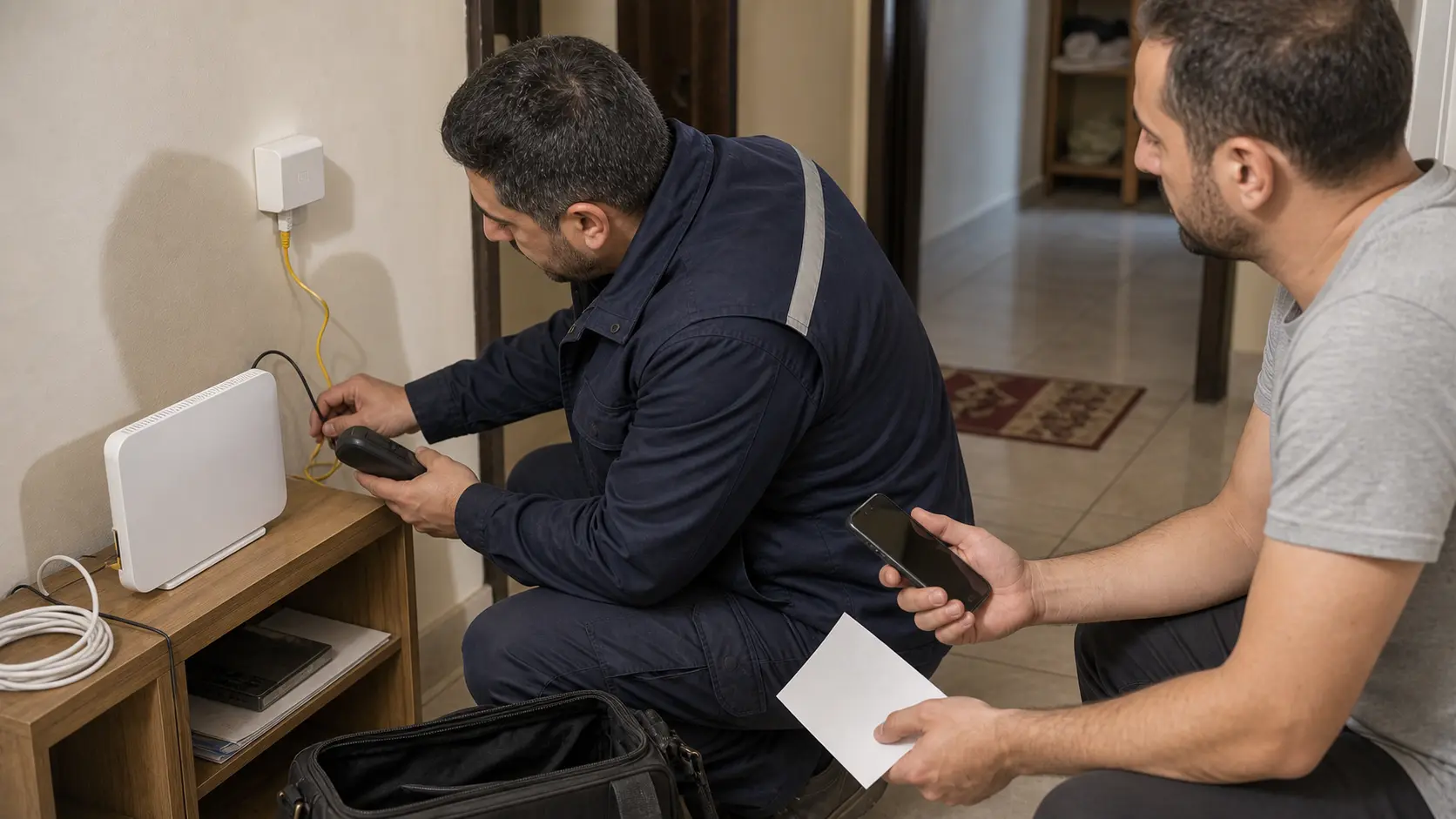
Start with the part of the access business that does not appear in a headline speed table. A customer in Adana, Saricam, Yuregir or another served locality has a modem that looks alive, a payment that may already have cleared, and a household or small business that cannot work around another day of unreliable internet. The installer or support worker arrives after the easy sale is over. The customer is no longer asking whether a 35 Mbps or 100 Mbps package sounds good.
The customer is asking whether this supplier can explain the fault, decide whether the problem is inside the premises or upstream, schedule a technician, keep the account open, and make the next month feel less risky than switching.
That is the right opening for AY TELEKOM BILGI TEKNOLOJILERI LIMITED SIRKETI because the public evidence is strongest around the account surface rather than around a broad audited network map. The company's consumer site at https://www.aytelekom.com.tr/ presents no-commitment, unlimited home internet, with ADSL/VDSL, fibre, Air Fiber and AyFiber packages. The contact page at https://www.aytelekom.com.tr/iletisim lists an Adana address, an 0850 phone number, [email protected], opening hours shown as 08:30 to 21:00 for the whole week, and a footer that markets 7/24 support. The support promise is therefore not incidental. It is part of the public product.
The commercial problem is that support becomes expensive exactly when it matters. A new subscription can be sold through a form, a call centre, a dealer, an online payment page or an e-Devlet approval step. A poor installation, line fault, wireless issue or payment dispute turns the account into manual work. Someone must answer the phone, match the customer to an address, inspect the last-mile condition, understand whether the service is delivered over incumbent infrastructure, fixed wireless, local fibre or another route, and decide how much of the customer's anger can be solved by AY Telekom rather than by another network owner.
That is why the paid unit should be called a local access and field-support account. It includes a connection, but the connection is only the visible unit. The customer is also buying the possibility of a working visit, a fault diagnosis, a support escalation, a replacement or returned gateway, a cancellation process, a transfer from another operator, and a payment channel that keeps the line alive. For a regional ISP, these are not soft extras. They are the margin test.
AY Telekom's own tariff pages make the retention problem explicit. On its ADSL/VDSL page at https://www.aytelekom.com.tr/tarife/vdsl and fibre page at https://www.aytelekom.com.tr/tarife/fiber, the company lists no-commitment packages, says package speeds are up-to values rather than guaranteed speeds, publishes relocation and installation charges, and says customers moving from other operators are not charged a fee. That is a direct signal that the company prices churn and switching friction as part of the offer.
The article therefore should not become a raw-bandwidth profile. A raw-bandwidth profile would compare 16 Mbps, 35 Mbps, 100 Mbps or 1000 Mbps as if a household buys only throughput. AY Telekom's public evidence points to a messier business. The buyer prices whether a local supplier can recover from a broken installation or outage faster than a national operator, another ISP, mobile broadband, satellite, an in-house workaround or waiting for a better line. The customer may leave for price. The customer may also leave because the next recovery visit fails.
Company identity is public, but scale is not
AY Telekom's "Kurumsal" page at https://www.aytelekom.com.tr/sayfa/kurumsal says the business has operated in the information-technology sector for 30 years, continued under the Ay Telekom name from August 2012, and received authorisation from Turkey's Information and Communication Technologies Authority for infrastructure operation and internet service provision on 16 October 2012. The same page states a mission of customer-focused integrated communications and a vision of high-quality internet service. These are company-authored claims. They support identity and positioning, but they do not prove subscriber count, revenue, margin, service-level performance or geography.
The contact record is more concrete. The public contact page at https://www.aytelekom.com.tr/iletisim gives the address as Ozgur Mahallesi, Kaktus Caddesi, Cumali Cevikalp Is Merkezi, floor 3, No. 13, 01220 Yuregir/Adana. RIPE database records independently identify the RIPE organisation ORG-ATIB3-RIPE as AY TELEKOM BILGI TEKNOLOJILERI LIMITED SIRKETI, country TR, organisation type LIR, with an Adana address and phone contact at https://rest.db.ripe.net/search.json?query-string=AY%20TELEKOM%20BILGI%20TEKNOLOJILERI%20LIMITED%20SIRKETI&source=ripe&flags=no-filtering. The address wording differs in floor detail, but both point to the same Adana operating base.
The RIPE NCC member directory also lists the company under Turkey at https://www.ripe.net/membership/member-support/list-of-members/tr/aytelekom/. That matters because RIPE membership and LIR status impose a public resource-administration role. It does not by itself prove that every retail line uses AY Telekom-owned access plant. It does prove that the company has a public number-resource footprint beyond a reseller storefront.
The public consumer brand is plain: packages, application, billing, forms, support, payment, announcements and contact. The site at https://www.aytelekom.com.tr/ describes "taahhutsuz" and "sinirsiz" internet, uses "surprise bill" and fixed-price language, and advertises e-Devlet subscription approval. The FAQ at https://www.aytelekom.com.tr/sayfa/sikca-sorulan-sorular says the service does not require a fixed telephone subscription, says subscriptions have no commitment, and directs customers to the website, subscriber centres, the 0850 number or a preliminary application form.
That mix makes AY Telekom a local-retail access company in the evidence we can see. It is not a pure hosting company, not a data-centre operator in public materials, and not a national incumbent. Its public unit is a household or small-business fixed internet account with local handling. The article can say that. It should not claim audited network kilometres, current subscriber numbers, regional market share or customer retention without private data.
The identity also includes digital operating surfaces. The website links to an online transaction centre at https://aytelekom.com, a payment page at https://www.aytelekom.com, a speed-test page at https://hiztesti.aytelekom.com.tr, forms, support content and announcements. The contract-and-forms page at https://www.aytelekom.com.tr/sayfa/sozlesme-formlar tells applicants that contracts and other forms can be transmitted through e-Devlet digital approval after online or call-centre application. That is important because subscription activation is a regulatory and administrative workflow as much as a technical installation.
The conservative conclusion is that AY Telekom has enough public evidence to justify a business-model article, but not enough to let the article pretend to know the company's margins. The strongest public facts are: it sells fixed internet packages; it publishes installation, relocation, device and cancellation-related terms; it advertises support; it has an Adana contact surface; it appears in RIPE records as an LIR; AS212269 has visible IPv4 routing; and public complaint pages show recurring customer pain around outages, installation and support. The economics must be built from those facts and the limits around them.
The tariff table hides installation and recovery cost
The most useful part of AY Telekom's website is not the speed ladder. It is the detail below the packages. The ADSL/VDSL tariff page at https://www.aytelekom.com.tr/tarife/vdsl shows 16 Mbps, 35 Mbps and 100 Mbps packages; the fibre page at https://www.aytelekom.com.tr/tarife/fiber shows 25 Mbps, 35 Mbps and 100 Mbps fibre packages; the Air Fiber page at https://www.aytelekom.com.tr/tarife/airfiber shows lower wireless packages such as 12 Mbps, 16 Mbps and 25 Mbps; and the AyFiber page at https://www.aytelekom.com.tr/tarife/ayfiber shows 35 Mbps, 100 Mbps and 1000 Mbps tiers. The numbers are useful, but the economics are underneath them.
The same tariff pages state that prices include 20% VAT and 10% special communications tax. They list a 1,100 TL relocation fee for fibre, a 1,100 TL relocation fee for ADSL/VDSL, a 1,100 TL activation fee for naked VDSL, a 900 TL home-installation service fee where requested for naked VDSL, a 1,100 TL home-installation, fibre modem and activation fee for naked fibre, and a 60 TL monthly HGW use fee for fibre tariffs. They also say that subscribers switching from other operators are not charged a fee. This is the part that explains the paid unit better than the bandwidth number.
Installation is cash and labour before retention exists. A no-commitment customer can leave, but the provider still faces sales handling, address check, line availability, customer equipment, appointment scheduling, gateway inventory, paperwork, technical support and first-month billing. If the customer cancels quickly, those costs can be hard to recover. That is why installation fees, device terms and churn waivers matter. They show how AY Telekom tries to balance a low-friction sale with enough economic protection to pay for actual work.
The no-commitment promise changes the margin equation. A locked contract can hide weak service because the customer pays to leave. AY Telekom publicly leans the other way: no long commitment, flexible packages, no quota, no surprise billing. That can attract customers who distrust long contracts, especially in areas where fixed broadband quality is uneven. It also raises churn risk. If service fails after the first bad week, the customer can compare AY Telekom with Turk Telekom, Superonline, TurkNet, mobile broadband or another local provider and ask why the account should remain open.
The operator-change form makes churn administrative, not abstract. The forms page at https://www.aytelekom.com.tr/sayfa/sozlesme-formlar links individual and corporate operator-change forms. In practice, this means AY Telekom wants to handle customers who are already with another ISP. Winning that customer is not only a marketing event. It requires a correct transfer, a clean contract, a working line, billing coordination and support if the old provider or incumbent infrastructure creates a handover problem. A bad transfer can turn the first month into a complaint before the customer has formed loyalty.
The payment page at https://www.aytelekom.com.tr/sayfa/odeme-yontemleri shows another layer of account continuity. It lists bank and payment channels including Ay Telekom's online transaction centre, major Turkish banks, Faturamatik, Pratikislem, PTT and bank-transfer details, and it asks bank-transfer payers to include subscriber name and number. Payment access matters because a customer who loses service after a payment or cannot reconcile a bill may judge the provider's reliability by account recovery rather than by network performance.
The service terms also state that offered speeds are not guaranteed speeds because physical connection conditions matter. That caveat is important. It admits the reality of fixed access: speed depends on line quality, address, port availability, wireless path, customer equipment, gateway, upstream load and local conditions. For the customer, the practical question is not whether the advertised speed exists in a table. It is whether the provider can inspect and improve the conditions when the delivered service falls short.
That is the first economic answer required here. What does the customer actually buy? The customer buys a local access account that bundles a speed tier, installation or activation, address-specific feasibility, equipment, billing, support, potential operator transfer and recovery from faults. Why is that unit costly? Because every weak address and every outage requires labour, supplier coordination and customer handling that cannot be fully automated. What can public evidence prove? It can prove the public terms and claims, but not the cost per installation, the success rate, the first-call resolution rate or the churn curve after failures.
Field labour is the product when the first month goes wrong
AY Telekom's public language says a great deal about field labour even when it does not publish technician headcount. The tariff pages describe installation and relocation charges. The contact page publishes an address and service hours. The FAQ says customers can apply through the site, subscriber centres, the call centre or a form. The footer repeatedly markets 7/24 support. The quality-policy page at https://www.aytelekom.com.tr/sayfa/kalite-politikasi states that the company provides telecommunications services, internet service provision, infrastructure installation, maintenance, repair and technical service activities, and commits to service continuity, legal compliance and process improvement.
That policy wording is company-authored, but it is economically revealing. "Infrastructure installation, maintenance, repair and technical service" is not a slogan a pure virtual reseller would need to foreground. It is the work that turns an access promise into a paid account. A field worker may need to examine the fibre handoff, a wireless receiver, an indoor cable, a gateway, a power issue or a building route. A support representative may need to identify whether the customer is on an AY-owned segment, an incumbent last-mile path, a partner path, or a wireless service.
Each case has a different cost and a different blame boundary.
The first month is especially dangerous. A customer who pays an installation or activation charge expects service to work quickly. If it does not, the initial support interaction decides whether the customer sees the fee as fair setup cost or as a loss. The complaint page at https://www.sikayetvar.com/ay-telekom is not a representative survey, but it shows why this moment matters. On 8 July 2026, it displayed 363 complaints, a 46/100 score and 56 evaluations, with recent posts alleging connection interruptions, prolonged outages, unresponsive customer service, installation problems, billing issues and local mentions such as Adana Saricam, Yuregir, Hatay Kirikhan and Aksaray. These posts are individual claims, not verified operational metrics. They are still valuable as market signals because they identify the places where support labour becomes retention risk.
The assignment's requested opening from an outage visit is therefore not literary colour. It is the business mechanism. A customer with no service does not care that a tariff is no-commitment and unlimited. The customer cares whether the provider knows what failed, whether a technician will come, whether an upstream operator has to act, whether payment records are visible, whether the modem or gateway is the issue, and whether the company communicates before the customer leaves. Every one of those actions costs money.
Field labour is also how a smaller provider differentiates against national scale. Turk Telekom's home-internet page at https://bireysel.turktelekom.com.tr/evde-internet/yeni-musteri-kampanyalari shows national fixed broadband offers, commitment periods, free installation language and speeds up to 1000 Mbps. Superonline at https://www.superonline.net/ markets fibre, DSL, Superbox, technical support, online transactions and technical-team tracking. These providers can compete with brand recognition, broader support systems and infrastructure reach. A regional supplier cannot win by pretending scale does not matter. It can win when a customer believes the local team will work harder on that address, that building, that transfer or that post-outage recovery.
The same logic applies against mobile broadband. A customer with repeated fixed-line trouble may buy a mobile hotspot or use a phone plan as a backup. Mobile access is easier to start and avoids a home visit, but it can carry data, indoor-coverage, latency and congestion limits. AY Telekom's account is valuable where fixed or fixed-wireless access becomes more predictable than a mobile workaround and where support can actually improve the address-specific condition. It is vulnerable where mobile service is good enough and the fixed account creates repeated manual pain.
The hardest public fact to verify is the quality of the field operation. We cannot see truck rolls, install completion times, repeat visits, spare equipment, partner schedules, technician utilisation or fault categorisation. The article must therefore avoid declaring AY Telekom good or bad at service recovery. It can say the economics depend on it. It can also say that public complaints make the question commercially material. If a no-commitment customer sees the first outage handled well, the account can survive. If the first outage becomes silence, the low-commitment promise becomes a path out.
Upstream bargaining is visible in AS212269
The network-resource evidence adds a second dimension to the paid unit. RIPE identifies AY TELEKOM BILGI TEKNOLOJILERI LIMITED SIRKETI as ORG-ATIB3-RIPE, a Turkish LIR, with an Adana address, reg-nr 62692, admin and technical role AA36447-RIPE, abuse role AR60805-RIPE, and maintainer mnt-tr-aytelekom-1. The inverse RIPE lookup at https://rest.db.ripe.net/search.json?inverse-attribute=org&query-string=ORG-ATIB3-RIPE&source=ripe&flags=no-filtering shows 185.179.100.0 - 185.179.100.255 and IPv6 allocation 2a10:47c0::/29 tied to the organisation.
RIPEstat then shows what is visible in routing. The AS overview for AS212269 at https://stat.ripe.net/data/as-overview/data.json?resource=AS212269 identified the holder as AS-Aytelekom AY TELEKOM BILGI TEKNOLOJILERI LIMITED SIRKETI and showed the ASN announced at the query time on 7 July 2026. The announced-prefixes view at https://stat.ripe.net/data/announced-prefixes/data.json?resource=AS212269 showed three IPv4 /24s visible in the two-week window ending 7 July 2026: 194.37.92.0/24, 185.179.100.0/24 and 194.5.232.0/24.
Those three prefixes do not all mean the same thing. The 185.179.100.0/24 block is directly tied to AY Telekom's organisation in RIPE. The RIPEstat prefix overview at https://stat.ripe.net/data/prefix-overview/data.json?resource=185.179.100.0/24 showed the prefix announced by AS212269, and the routing-status view at https://stat.ripe.net/data/routing-status/data.json?resource=185.179.100.0/24 showed last seen origin AS212269 with broad RIS visibility in that snapshot. The IPv6 allocation 2a10:47c0::/29, however, was not announced in the RIPEstat prefix overview checked at https://stat.ripe.net/data/prefix-overview/data.json?resource=2a10:47c0::/29.
The other two visible IPv4 prefixes require more cautious wording. The RIPE object for 194.5.232.0 - 194.5.232.255 at https://rest.db.ripe.net/ripe/inetnum/194.5.232.0%20-%20194.5.232.255.json labels the netname AyTelekom and description "Ay Telekom" but ties the org field to ORG-NTC7-RIPE, NETPLUS TELEKOMUNIKASYON VE BILISIM HIZMETLERI LTD. STI., with AY Telekom roles and abuse contacts. That supports an assigned PA or partner-supply reading, not a direct owned-allocation reading. The 194.37.92.0/24 RIPE lookup at https://rest.db.ripe.net/search.json?query-string=194.37.92.0%2F24&source=ripe&flags=no-filtering identifies netname JETNET, includes AY Telekom's maintainer among route maintainers, and shows route objects for AS200404 and AS212269. That also points to shared or historical resource relationships, not a simple single-owner story.
The upstream side is clearer. RIPEstat's AS neighbour data at https://stat.ripe.net/data/asn-neighbours/data.json?resource=AS212269 showed AS34984 and AS9121 as visible left-side neighbours on 7 July 2026. The AS overview for AS9121 at https://stat.ripe.net/data/as-overview/data.json?resource=AS9121 identifies TTNet Turk Telekomunikasyon Anonim Sirketi. The AS overview for AS34984 at https://stat.ripe.net/data/as-overview/data.json?resource=AS34984 identifies TELLCOM-AS Superonline Iletisim Hizmetleri A.S. The AS routing-consistency call at https://stat.ripe.net/data/as-routing-consistency/data.json?resource=AS212269 also lists AS9121 and AS34984 as import/export peers visible in BGP and whois, and AS200404 as a whois-only import/export relationship in that check.
This evidence matters commercially because it turns upstream bargaining into part of the customer bill. A local access ISP needs transit, handoff, route quality, numbering, abuse handling, monitoring and commercial terms. The customer sees the monthly price. AY Telekom sees upstream cost, routing dependence and the need to explain when a problem lies beyond its direct control. A supplier can still add value if it coordinates those dependencies well. It loses value if upstream trouble becomes an excuse rather than a recovery plan.
The public evidence does not prove traffic volume, capacity commitments, peering contracts, transit prices, congestion, latency, packet loss or redundancy. It proves only that AS212269 is visible, that the visible IPv4 routing surface includes three /24s in the RIPEstat view, that the direct IPv6 allocation was not visible in that particular snapshot, and that the visible neighbours include two large Turkish networks.
The economic conclusion must stay inside that boundary: AY Telekom has network-resource control and upstream dependence; the account's value depends on whether that control and those dependencies are operated well enough to prevent churn.
The website itself shows supplier dependence
AY Telekom's own public web and API surfaces are useful because they show a different kind of supplier dependence. RIPEstat's DNS chain for https://stat.ripe.net/data/dns-chain/data.json?resource=www.aytelekom.com.tr showed www.aytelekom.com.tr resolving through aytelekom.com.tr to 37.77.25.188, with ns1.aytelekom.com.tr and ns2.aytelekom.com.tr listed as authoritative nameservers. The DNS chain for https://stat.ripe.net/data/dns-chain/data.json?resource=api.aytelekom.net showed api.aytelekom.net also resolving to 37.77.25.188, with ns1.aytelekom.net and ns2.aytelekom.net as authoritative nameservers.
The IP route is not AY Telekom's AS212269. RIPEstat's prefix overview at https://stat.ripe.net/data/prefix-overview/data.json?resource=37.77.25.188 aligned the address to 37.77.25.0/24, announced by AS42216, and the RIPEstat whois view at https://stat.ripe.net/data/whois/data.json?resource=37.77.25.188 identified the prefix as TR-VAULTR, described as VAULTR - Istanbul. That does not weaken AY Telekom's access business by itself. It simply shows that the public website and API surface use external hosting infrastructure rather than AS212269. For a small ISP, that can be sensible. Public web operations, customer forms and payment-related pages can sit on a hosting supplier while customer access traffic uses separate network resources.
The site code visible in public pages adds another operating detail. Several pages include calls to https://api.aytelekom.net/api/Application/AddApplication for application submission, https://api.aytelekom.net/api/Form/ContactForm for contact forms, and https://www.aydsl.com/ttapi/TT_Il_Liste.php for infrastructure-query lists. RIPEstat's DNS chain for https://stat.ripe.net/data/dns-chain/data.json?resource=www.aydsl.com showed the www.aydsl.com endpoint behind Cloudflare addresses. These observations support an account-management and application-processing surface, not a direct claim about subscriber databases or operational quality.
This matters for the economic unit because the customer experience spans website, forms, call centre, digital approval, payment channels and technical access. If a customer applies online, signs through e-Devlet, pays through a bank channel, receives a gateway, and then calls during an outage, the account has already crossed multiple systems. Any one of them can create friction. A cheap advertised tariff is only useful if the administrative chain is clean enough that installation and recovery are not trapped in account confusion.
The public forms page strengthens that point. At https://www.aytelekom.com.tr/sayfa/sozlesme-formlar, AY Telekom says online or call-centre applications can send contracts and other forms through e-Devlet digital approval, and provides individual and corporate operator-change forms. That is not just a convenience feature. It is a way to reduce paperwork delay and make churn-in from another operator easier. It can also create a dependency on identity, approval and form-handling processes that customers will judge during onboarding.
The payment-methods page is similarly operational. At https://www.aytelekom.com.tr/sayfa/odeme-yontemleri, AY Telekom lists multiple banks and payment points, plus PTT and IBAN transfer details. Payment recovery can decide whether a customer outage becomes a technical issue or an account issue. A customer who has paid but remains disconnected will not separate billing from network service. For a no-commitment ISP, billing accuracy is retention infrastructure.
The public website also publishes price-update announcements at https://www.aytelekom.com.tr/duyurular. The 1 July 2025 notice says ADSL, VDSL and fibre internet packages would be updated from that date, while customers with a price guarantee would continue under existing tariffs. The same announcement page includes a 1 July 2024 price update and an older Adana/Saricam maintenance notice from 20 April 2021. These are small public signals, but they matter. Price changes test customer loyalty; maintenance notices test communication quality; fixed-price guarantees become retention promises.
The supplier-dependence conclusion is therefore layered. AY Telekom's public route evidence shows upstream telecom dependence. Its public website and API evidence show hosting and digital-process dependence. Its public tariff and form evidence shows administrative dependence. The customer buys the bundle. The provider must keep those layers aligned.
Regulation gives permission, not proof of performance
Turkey's Information and Communication Technologies Authority, BTK, is the relevant regulator. Its English public site at https://www.btk.gov.tr/en identifies the institution and links consumer, internet, legislation and information-centre resources. Its communication-services statistics page at https://www.btk.gov.tr/en/communication-services-statistics lists official statistics publications, including 2025 third-quarter statistics and news bulletin files. Its English electronic-communications market-data page at https://www.btk.gov.tr/en/electronic-communications-market-data-eng lists 2025 Q1, Q2 and Q3 market data. These pages matter because fixed broadband is a regulated market, not a purely private subscription business.
AY Telekom's own "Kurumsal" page says the company received BTK authorisation for infrastructure operation and internet service provision on 16 October 2012. The FAQ at https://www.aytelekom.com.tr/sayfa/sikca-sorulan-sorular also says Ay Telekom is a licensed internet service provider authorised by the information and communication authority. Those statements are company-authored; the article has not independently matched a BTK licence register entry during this research. The right wording is therefore that AY Telekom publicly claims BTK authorisations and publishes regulated-service materials, while the strongest independent technical authority evidence comes from RIPE.
Regulation creates costs that do not show up in a speed table. Internet service providers must maintain customer contracts, billing accuracy, lawful service terms, complaint handling, tax treatment, data protection, abuse contacts, consumer communications and records required by law. AY Telekom's public materials reflect some of those costs: contracts, operator-change forms, privacy pages, cookie policy, personal-data protection page, information-security policy, payment channels, support contact and complaint-facing support language. The account is not only a wire. It is a regulated customer relationship.
The company's information-security policy at https://www.aytelekom.com.tr/sayfa/bilgi-guvenligi says the firm operates in internet service provision and infrastructure operation, and refers to confidentiality, integrity, physical and electronic information assets, business continuity, emergency plans, data backup, malware avoidance, access control and incident reporting. This is again company-authored policy language, not proof that every control works. But it points to the compliance and continuity work that a smaller ISP must fund even when customers compare it only on monthly price.
The tax line in the tariff detail also matters. By stating that prices include VAT and special communications tax, AY Telekom is pricing in a regulated Turkish telecom cost structure. A customer may care only about the final lira amount, but the provider's margin is squeezed between tax-inclusive retail pricing, installation labour, support labour, gateway inventory, upstream contracts, payment costs, bad debt, customer churn and price sensitivity. A tariff can look high compared with a generic online offer and still be thin after local recovery costs.
Consumer protection also affects retention. The public site advertises no long commitment, no quota and no surprise bills. The same site says the service is for individual use and not for commercial use; if commercial use is detected, AY Telekom reserves rights to warn the subscriber and, if commercial use continues, close or cancel the line in line with subscription terms. That wording matters for small-business edge cases. A home-office, shop, remote worker or microbusiness may buy a consumer account and then judge it as business-critical. The provider may see a consumer tariff. The mismatch creates support and churn risk.
BTK's public statistics pages are useful for context because they show that the regulator regularly publishes market data. They do not, from the pages cited here, prove AY Telekom's subscriber share or service quality. The article should therefore treat the Turkish broadband market as regulated and competitive, while avoiding any claim that AY Telekom holds a measurable national position. Its importance is local and operational: customers in reachable areas may depend on it because switching service is costly, not because it controls national market share.
The regulatory conclusion is sober. Authorisation and RIPE membership make AY Telekom a public resource and service actor. They do not prove service recovery. The facts that would change the judgement are licence-status confirmation from BTK records, complaint-resolution metrics, regulator complaint volumes by operator, audited subscriber counts, and evidence on whether AY Telekom's advertised support and continuity policies are matched by actual incident handling.
Competition prices failure, not just speed
AY Telekom faces a substitute set that is immediate. The first substitute is the national incumbent or a large fixed provider. Turk Telekom publishes home-internet campaigns at https://bireysel.turktelekom.com.tr/evde-internet/yeni-musteri-kampanyalari, with multiple commitment terms, installation claims, speeds up to 1000 Mbps and incentives for customers moving to Turk Telekom. Superonline's public home page at https://www.superonline.net/ markets fibre, ADSL/VDSL, Superbox 5G, infrastructure lookup, support, technical-team tracking, digital assistant and app-based account actions. Large providers can compete on brand, infrastructure reach, bundled products, mobile links and operational scale.
The second substitute is another alternative fixed ISP. TurkNet at https://turk.net/ is a common Turkish comparison point for customers searching for independent internet offers, and other local or regional ISPs appear in Turkish complaint and broadband discussions. AY Telekom cannot assume that a customer who wants no long contract has nowhere else to go. The very language it uses to win customers from other operators also tells customers they can leave again.
The third substitute is mobile or fixed wireless. AY Telekom itself sells Air Fiber, which means wireless access is part of its own offer as well as a competitive threat. Turkcell Superonline's Superbox positioning, mobile hotspots and ordinary mobile broadband all compete when a household values quick connectivity over a fixed install. Mobile can be less predictable for heavy use, gaming, home offices or video calls, but it avoids the appointment problem. If a fixed installation fails repeatedly, mobile becomes more attractive even when it is technically inferior for sustained use.
The fourth substitute is satellite or delayed installation. Starlink's availability map at https://www.starlink.com/map is relevant as a global substitute category, though service availability and legality depend on country-specific approvals and local buying options. Even where satellite is not a simple local retail substitute, it frames a customer's expectation that remote areas should not have to wait forever. Delayed installation is also a substitute: a customer may postpone a fixed service, rely on mobile data, borrow a neighbour's line or wait for another provider to expand infrastructure.
The fifth substitute is staying with a poor incumbent rather than risking a transfer. AY Telekom's churn-in offer removes a fee for customers switching from other operators, but the customer still faces uncertainty. Will the new line work? Will the old account close cleanly? Will the gateway arrive? Will the new operator handle the address correctly? Will the first invoice be clear? The economic value of a smaller provider is that it can reduce those doubts through hands-on account handling. If it cannot, the customer may remain with the incumbent despite dissatisfaction.
This is why competition prices failure. When service works, the customer compares price and speed. When service fails, the customer compares the cost of being ignored, the time to repair, the ability to reach someone, the cost of a visit, and the administrative pain of switching. AY Telekom's no-commitment model turns failure into a more immediate churn test. The company can use that model to win customers who dislike contracts, but it also gives disappointed customers a simpler exit story.
AY Telekom's public tariff table is aggressive in some tiers and relatively constrained in others. AyFiber shows 35 Mbps, 100 Mbps and 1000 Mbps offers with low published monthly prices relative to several national fixed offers; Air Fiber carries lower speeds with different economics; fibre and VDSL include installation, device and relocation terms. That pattern suggests the company may be competing differently across access types. Where it has favourable local conditions, it can price aggressively. Where it depends more heavily on third-party last mile, wireless field work or gateway handling, the account cost rises.
Public evidence cannot prove whether those tariffs are profitable. The missing data is installation cost by technology, churn after first fault, average revenue per account, wholesale line cost, wireless backhaul cost, gateway loss and return rates, debt collection, support headcount, repeat-fault rate and customer lifetime. But the public evidence does show why those private numbers matter. In a no-commitment access business, the first broken install can destroy customer lifetime value.
The complaint signal should be used carefully
Sikayetvar is not a regulator, audit firm or statistically representative customer survey. It is a complaint platform. Customers with ordinary working service are less likely to post than customers with broken service. Competitors can appear in complaint ecosystems too. Some posts are resolved, withdrawn or incomplete. The article should therefore use https://www.sikayetvar.com/ay-telekom only as market-signal evidence, never as proof that AY Telekom's service is generally poor or that every allegation is true.
Used carefully, the signal is still valuable. The page showed 363 complaints and recent posts about continuing disconnections, multi-day outages, customer service not answering, first-week installation failure, Adana/Saricam and Yuregir cases, Hatay/Kirikhan cases, billing and payment recovery, fixed IP change delay, and technical visits that did not solve the issue. These are precisely the pain points the assignment asks us to price: field labour, service recovery, local competition and churn risk.
The strongest inference is not "AY Telekom fails." The strongest inference is "customers judge AY Telekom through recovery moments." Many complaint headlines mention not just the outage but also unanswered customer service, unresolved fault records, technician visits, installation charges, payment follow-up or a request for cancellation. That pattern turns a technical issue into an account-retention issue. The customer's dissatisfaction is compounded when the provider cannot explain who owns the next step.
The regional references matter too. Adana, Saricam, Yuregir, Hatay and Kirikhan are not abstract national market labels. They are field geographies. A provider's cost depends on whether technicians and partners can reach the place, whether the line is built over incumbent infrastructure, whether the customer premises are easy to wire, whether weather and local power conditions affect wireless links, whether a local dealer is involved, and whether a national network owner must repair a fault. Public complaint snippets cannot answer those questions, but they point to the geography in which the answers matter.
The complaint signal also interacts with price updates. AY Telekom's announcements page at https://www.aytelekom.com.tr/duyurular says ADSL, VDSL and fibre prices were updated from 1 July 2025, while customers with price guarantees continued under existing tariffs. Price increases are not automatically bad. Upstream costs, inflation, taxes, labour and equipment all move. But a price update after repeated service frustration can accelerate churn. A customer may tolerate a higher tariff after a fast recovery visit; the same customer may leave if a price rise arrives during unresolved outages.
The complaint signal is also a useful guardrail against over-crediting marketing language. The company says 7/24 support and reliable service; complaints allege unreachable service and unresolved faults. The public article should not choose one side as full truth. It should say that the public brand promises support, public complaints make support quality a material risk, and the missing facts are response time, resolution time, repeat-fault rate, refund practice, account-credit policy and churn after complaints.
This is exactly where the paid unit appears. If AY Telekom can turn complaints into solved cases quickly, then support labour becomes retention capital. If not, support labour becomes an unrecovered cost and a public churn accelerant. The local ISP business is fragile because the same technician visit can either save the account or convince a customer to leave.
What public network evidence can and cannot prove
Network-resource evidence is attractive because it looks precise. AS numbers, prefixes, route objects and DNS chains have concrete values. But they can mislead if treated as customer-service proof. AS212269 being announced does not prove that every customer enjoys stable service. A /24 being visible does not prove enough capacity. An IPv6 allocation being absent from a snapshot does not prove no IPv6 service anywhere. A route object involving another maintainer does not prove commercial control. A public website being hosted on a third-party prefix does not prove customer access depends on that supplier.
For AY Telekom, the useful network evidence is narrower and stronger. The RIPE organisation record proves LIR identity and Adana registry contacts. The inverse lookup proves direct RIPE-linked resources. RIPEstat shows AS212269 announced and identifies visible IPv4 prefixes. The neighbour data shows visible adjacency to Turk Telekom and Superonline ASNs. The DNS chain shows public web and API domains resolving to a Vaultr Istanbul prefix rather than AS212269. PeeringDB at https://www.peeringdb.com/api/net?asn=212269 returned no network entity, which limits public interconnection visibility but does not prove absence of private arrangements.
These facts support a resource-control and supplier-dependence story. They do not support a claim about margin. They also do not prove AY Telekom's access technology mix. The site sells ADSL/VDSL, fibre, Air Fiber and AyFiber. Some of those services may rely on incumbent infrastructure, some on wireless links, some on local fibre, some on partner handoff, and some on the company's own routed resources. Public data cannot assign each subscriber to each network layer.
The distinction matters for a customer. If a fault lies in a customer modem or indoor cable, AY Telekom's field support can likely act directly. If it lies in a wholesale or incumbent segment, the provider may need to coordinate with another operator. If it lies in upstream transit or routing, AS-level monitoring and supplier relationships matter. If it lies in a billing or digital-approval system, the network may be fine while the account remains broken. The customer sees one brand and one monthly bill. The provider sees multiple failure domains.
This is why the account is costly. The local ISP must turn layered failure into a single customer answer. It must know when to send a technician, when to open a supplier case, when to replace a gateway, when to credit a customer, when to escalate a payment issue, when to warn about commercial use, and when to accept cancellation. Public AS data cannot tell us whether AY Telekom does this well. It can show why doing it well requires competence beyond marketing speed tiers.
The AS neighbour evidence is especially important for upstream bargaining. AS9121 and AS34984 are not obscure networks. They belong to large Turkish telecom players. A smaller ISP connected through or alongside such networks may gain reach and resilience, but it also faces dependence. Commercial terms, maintenance windows, congestion, handoff quality and escalation channels can determine service quality at the edges. A customer does not negotiate those terms. AY Telekom does, or relies on someone who does.
The final network-evidence boundary is that resource control is a capability, not an outcome. AY Telekom's direct 185.179.100.0/24 and AS212269 routing make it more than a simple web storefront. The third-party public website hosting and partner-associated prefixes show dependence. The unanswered question is whether AY Telekom converts those capabilities into reliable local access. That answer lives in private operating data.
What would change the judgement
The current judgement is cautiously constructive but evidence-limited. AY Telekom appears to be a real Turkish local ISP and LIR with public consumer fixed-access offers, Adana operating identity, support and payment surfaces, no-commitment tariffs, installation and relocation charges, direct network resources, visible IPv4 routing and upstream dependence. The company matters because its customers are not buying a clean speed number. They are buying a local access and recovery account whose value is revealed during installation, outage and churn moments.
The judgement would improve if public or private evidence showed high installation completion rates, low repeat-fault rates, fast response and resolution times, strong refund or credit discipline, clear supplier escalation procedures, low churn after outages, growing active subscriber count, healthy payment collection, high modem return rate after cancellations, and documented capacity headroom on AS212269. It would improve further if BTK records confirmed current authorisation status in detail and if independent measurements showed stable latency and availability across AY Telekom's served geographies.
The judgement would weaken if private data showed that no-commitment customers leave quickly after installation, that complaints cluster around specific local dealers or access technologies, that field visits are delayed or repeated without resolution, that upstream faults are frequent and poorly communicated, that payment recovery creates avoidable disconnections, that installation fees do not cover actual setup cost, or that AS212269's visible prefixes are not material to customer service. It would also weaken if price increases outpaced service recovery enough to raise churn.
The most important missing economics are not exotic. They are account-level facts: average revenue per user by access type; gross margin after upstream, tax, device and field costs; support contacts per account; truck rolls per new install; activation success by technology; cancellation in the first 30, 90 and 180 days; customer credit and refund rates; unresolved fault age; and dealer performance by geography. Without those facts, public analysis must treat the business as plausible but unproven.
Reliability facts would change the article even more. AY Telekom's public pages claim support, continuity and quality. Sikayetvar complaints allege disconnections, unresolved faults and customer-service frustration. The public evidence cannot reconcile those claims. A representative incident dataset would. If most faults are resolved quickly and complaints are a small share of a growing base, the complaint signal would look like ordinary retail noise. If complaints represent a large share of active accounts or recurring unresolved outages, the no-commitment model would look dangerous.
Upstream facts would also change the view. A smaller ISP can be commercially strong if it buys upstream well, has redundant paths, monitors routes, and communicates clearly. It can be weak if it depends on a few suppliers without leverage. Public RIPEstat evidence shows visible neighbours and prefixes; it does not show contract terms, committed rates, failover design, congestion or route engineering. Those private facts decide whether upstream bargaining becomes a margin advantage or a recurring service liability.
The final judgement is therefore not that AY Telekom sells cheap internet. It is that AY Telekom sells recovery confidence inside a local access account. The public record supports the existence of the offer and the number-resource footprint. It also exposes the risk: in a no-commitment, support-sensitive, locally competitive market, the next outage visit may be more important than the next advertised speed.