
Summary
- Low-income broadband burden is a bundle of monthly price, service quality, installation cost, device cost, deposits, data limits, support priority, CGNAT exposure, static public-address add-ons, reputation risk and outage tolerance; IPv4 scarcity makes that bundle worse for households and institutions with the least bargaining power.
- ARIN's public functions matter because Whois/RDAP records, transfer records, RPKI, reverse DNS and fee rules affect evidence, portability and the market price of public-number scarcity; ARIN should keep the ledger clean, not become a retail affordability referee.
- Policy should separate availability from affordability, quality and identity: subsidies and public grants need durable service standards, CGNAT disclosure, IPv6 progress, proportionate public-address planning, clean registry records and portability as a safety valve.
The apartment-building price is not the real price
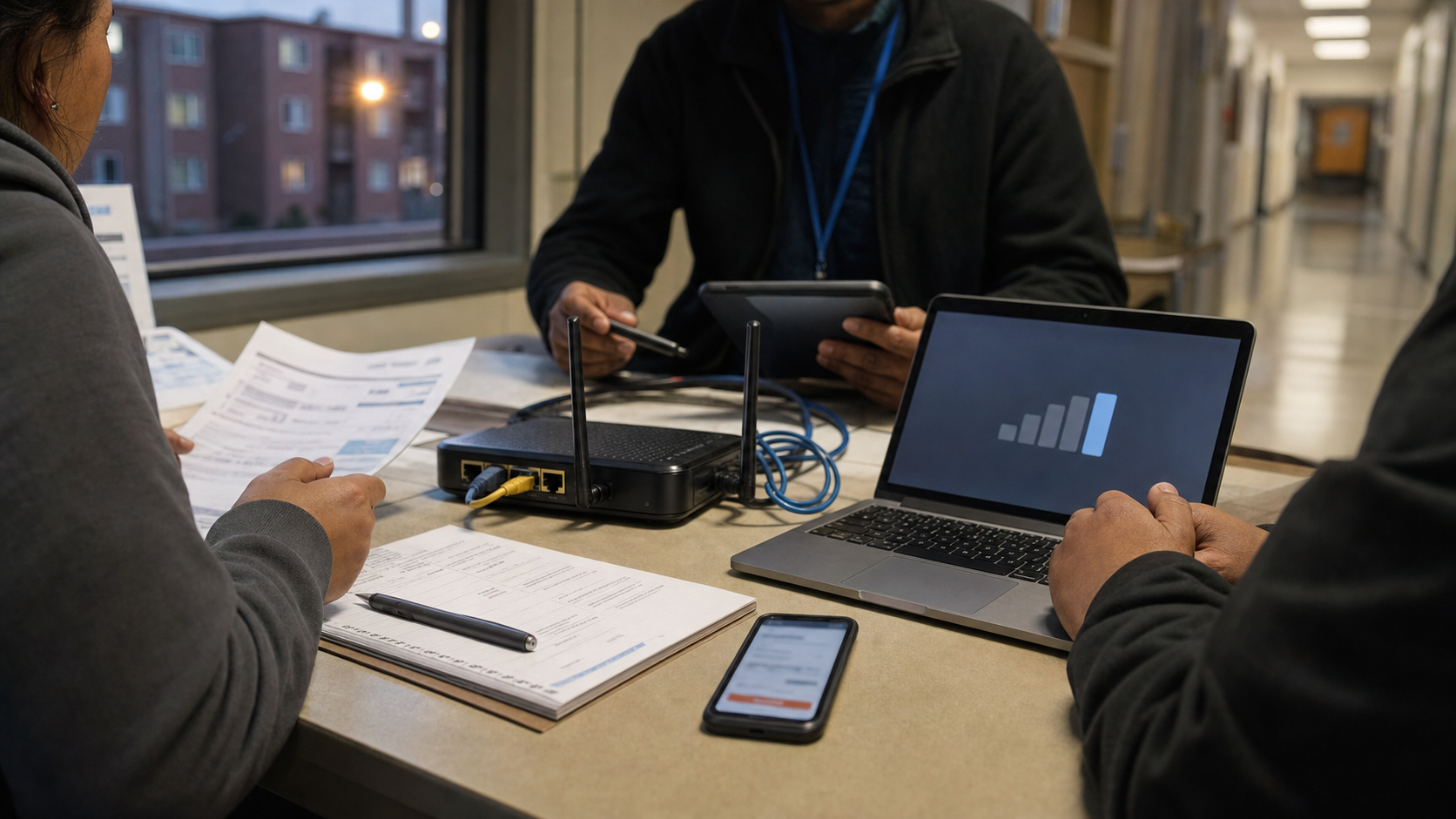
The useful starting point is a low-income apartment building, not a boardroom and not a fiber route map. A family on the third floor has a budget plan that is marketed as broadband. The building has coverage. The speed on the flyer is respectable. The monthly bill, after a discount or promotional rate, may look affordable against a policy target. Yet the household still faces a different price from the one printed in the plan table.
There may be an installation fee that arrives at the wrong week of the month, a modem rental that was not salient at signup, a deposit tied to thin credit history, a service call fee after a wiring fault, a low-end gateway that drops under load, or a data cap that punishes a child doing homework over video while a parent applies for jobs. The service may work well enough for streaming but fail at the margins where welfare is highest: a benefits portal timing out, a remote medical visit freezing, a school upload failing, a public-housing repair form refusing a login, or a small side business being unable to keep a payment device connected.
The economics of low-income burden is therefore not a single price. It is an incidence problem. Who bears the cost of scarce public IPv4 numbers, volatile subsidy revenue, weak local competition, support queues, customer-acquisition churn and complex network workarounds? Higher-income users can buy a business tier, pay for static addressing, replace equipment, keep a backup mobile plan, tolerate a surprise charge, or spend an hour with support. Low-income users often cannot. When service quality is rationed through optional add-ons, higher tiers and account history, the cheapest plan is not merely cheaper. It is a different product.
It can be broadband without dependable identity, connectivity without enough support, and access without resilience.
This distinction matters because public policy still tends to sort broadband gaps into neat buckets: availability, affordability and adoption. Those buckets are useful, but they can hide the fourth variable: address posture and public-number evidence. A household does not need a static public IPv4 address to read the news. A community clinic, a neighborhood legal-aid office, a small merchant payment endpoint, a low-income housing authority help desk, a school homework kiosk or a local telehealth partner may need predictable reachability, clean reputation and technical traceability.
If scarce public numbers are priced or rationed in ways that push such users into heavily shared address pools, the harm appears as friction rather than as disconnection. The premise is "served"; the person is not fully served.
Research on broadband plans supports the broader point that price alone is an incomplete measure. A 2023 paper, Decoding the Divide: Analyzing Disparities in Broadband Plans Offered by Major US ISPs, found that plan value can vary sharply across and within cities, and that income in a block group helps predict access to better-value fiber options. That evidence is not an ARIN story in itself. It is a market-structure story. But address scarcity adds a hidden layer to the same geography. Where low-income neighborhoods receive weaker plan value, the allocation of scarce public addressing is unlikely to become more generous by accident. The cost pressure travels downstream, and the weakest accounts are least able to resist.
The result is a quiet welfare loss. It is not always visible in headline coverage maps because the household may be counted as connected. It is not always visible in monthly price comparisons because the advertised fee omits the extra cost of reliability, support and clean identity. It is not always visible in speed tests because the line can be fast when it works. The loss appears in missed appointments, unfinished forms, failed authentication challenges, frozen online classes, locked accounts triggered by shared-address reputation, and merchants pushed toward expensive cellular backup.
Consumer welfare is diminished not only when people lack broadband, but when the affordable version of broadband carries more fragility than the applications of modern life can tolerate.
That is why the ARIN layer belongs in an economics piece about low-income markets. ARIN is not a retailer, a subsidy designer or a municipal planner. Yet the registry layer defines the public evidence around numbers, the official records needed for transfers and dispute resolution, and the portability conditions that can keep a network from being trapped by one administrative gatekeeper. The burden on low-income markets is amplified when the scarce input is opaque, sticky and costly to move. The burden is mitigated when the ledger is clean, transfers are workable, public evidence is trustworthy and portability acts as a safety valve.
Scarcity makes address quality a rationed good
ARIN's own public material makes the core scarcity fact straightforward. Its IPv4 addressing options page says the ARIN free pool of IPv4 address space was depleted on September 24, 2015, and that ordinary requests cannot be fulfilled unless they fit narrow reserved-use categories. The practical options are a waiting list, transfers to specified recipients, or IPv6 adoption. That is not a retail-broadband policy statement. It is a factual exhibit: the public IPv4 input is no longer abundant in the ARIN region.
Once a scarce input is required to deliver differentiated service, markets allocate it. They allocate it through transfer prices, internal capital budgeting, service tiers, static-address charges, business-class packaging, technical workarounds and customer support rules. A large operator can spread the cost over millions of accounts and reserve public IPv4 for higher-yield products. A small access provider serving lower-income areas has fewer margins to absorb transfer costs and fewer profitable enterprise lines to subsidize residential service.
A building owner negotiating a bulk agreement may care about monthly headline price rather than address quality. A community clinic may discover only later that a low-cost connection sits behind sharing that complicates remote access, logging or reputation.
This is the incidence question. IPv4 scarcity does not have to be billed as an "IPv4 scarcity surcharge" to become regressive. If scarce public addresses are reserved for business accounts, premium support, static-address add-ons and higher-priced managed service, the cost of scarcity is partly paid by those who cannot buy out of shared addressing. In tax language, it is a burden shifted away from the visible invoice and into quality. The invoice may say the plan is affordable; the service may still carry lower priority, weaker reachability, more reputation contamination and fewer repair paths.
Network engineers often describe public IPv4 scarcity as an operational problem. Economists would add that it is a distribution problem. The address is a scarce complement to certain forms of service. When a complement becomes expensive, sellers redesign the bundle. Some users receive full public reachability; others receive address sharing. Some institutions receive named technical contacts; others receive a call center. Some accounts receive clean reverse DNS; others inherit generic hostnames. Some can buy a block, sign the agreements, create records and maintain routing-security data; others can only accept what the upstream assigns.
The scarce input sorts customers by willingness and ability to pay.
The low-income market is especially exposed because the use cases are increasingly public-service heavy. Broadband is the channel for benefits, schoolwork, job applications, immigration filings, court notices, health appointments, banking, tax records and remote work. A plan that works for entertainment may not perform equally well for all those tasks.
The address layer may matter indirectly: shared reputation can trigger fraud controls; geolocation tied to a carrier-grade device can misplace users; port restrictions can block small-office functions; reverse lookups can affect mail delivery and trust checks; abuse reports tied to a shared public address can spread consequences across unrelated households.
The scarcity also changes the operator's incentives. In a world of abundant public IPv4, giving a public address to a low-price account might have been the default. In a depleted world, every public address has an opportunity cost. If it can support a business static-address product, an enterprise VPN, a hosted service, a payment provider, or a transfer value, allocating it to a low-margin plan looks costly. The provider may be technically right to conserve public space and operationally right to accelerate IPv6. But the distributional result is that the low-price tier absorbs more translation and more ambiguity.
IPv6 is the long-run escape from this rationing, and ARIN's IPv4 options page points users toward IPv6. Yet the transition has been uneven enough that IPv4 remains a live input for consumer welfare. Many public services, private portals, payment networks, remote-access tools and legacy devices still depend on IPv4 reachability or on IPv4 reputation signals. Even when an access line has IPv6, the household or clinic may still be judged by IPv4 behavior at the application edge. Thus IPv4 scarcity persists as a welfare issue during the transition, not as a nostalgic engineering complaint.
The policy error is to call the market "served" when only the physical line is counted. Scarcity changes service quality. Address quality becomes a rationed good. Low-income households and low-margin institutions are often at the back of the rationing queue.
Public-number evidence is a welfare input, not an engineer's luxury
Public-number evidence sounds technical until it fails. A community clinic that sends appointment reminders, a small shop that processes card payments, a public-housing office that hosts a tenant portal, a library job-search room, or a workforce nonprofit that maintains a remote-training platform all rely on more than raw bandwidth. They rely on the ability to show who is responsible for a number resource, how abuse contacts can be reached, whether routing claims are plausible, whether reverse DNS is maintained, and whether the service can be traced without turning every incident into a household-level accusation.
The public record is part of the trust fabric that lets small institutions operate cheaply.
ARIN's Whois/RDAP page describes public access to registration data for IP number resources, organizations, points of contact, customers and related records. ARIN also explains that RDAP provides standardized, machine-readable responses. Again, the point here is not to adopt ARIN's own framing as a conclusion. The factual exhibit is enough: there is a public record layer, and that layer helps outsiders interpret address use. For a low-income-serving institution, clean public-number evidence can be the difference between a problem that is quickly resolved and a problem that becomes a multi-day outage.
Consider a neighborhood clinic using a low-cost access line and a cloud medical platform. If its upstream changes addressing, if mail reputation collapses, if remote-access controls flag the connection as suspicious, or if a payment or benefits partner sees activity from a shared address with unrelated abuse history, the clinic's staff may not know the vocabulary of registry records. But they will feel the cost. Patients miss video appointments. Staff lose time with help desks. The clinic may be told to upgrade to a business plan, buy a static address, or change provider.
If the clinic is grant-funded or operating on thin margins, that upgrade is not a small matter. It is a recurring claim on its service budget.
Reverse DNS shows the same pattern. ARIN's reverse DNS material notes that reverse resolution is used for troubleshooting, spam checks, logging and analysis, and that organizations maintain PTR records for associated networks. For a high-margin firm, reverse DNS is a routine administrative task. For a low-income-serving office on a cheap connection, it can be invisible until a mail server rejects messages or a remote platform distrusts the connection. If the account sits deep inside consumer-grade address sharing, the institution may have no direct control and little leverage to get a clean delegation or useful naming.
RPKI is another public-evidence layer. ARIN's RPKI page explains that resource holders can obtain certificates and make cryptographically verifiable statements about which ASN should originate a prefix, allowing operators to compare routing announcements with validity data. Most households will never touch RPKI. Yet a local access provider serving them may depend on it for routing credibility. A nonprofit, clinic or small access network with public resources can face higher operational risk if routing-security evidence is weak or unaffordable to maintain. In low-income markets, where outages have fewer backups, routing confidence is a welfare input.
Public-number evidence also matters because low-income users are more likely to share reputational space. A luxury apartment's residents may each have better equipment, higher tiers, or cleaner address pools. A public-housing building may place many households behind shared translation with generic naming. If an abuse or fraud-control mechanism treats the shared public address as a proxy for the user, innocent users can inherit suspicion. The harm is not theoretical. Shared reputation can mean extra verification, account locks, blocked signups, denied transactions, or service throttling.
Those frictions have a higher cost for people who cannot take paid time off to retry a form or call support.
This is why the ledger-vs-gatekeeper distinction matters. Public registry writing has argued that continuity should protect the ledger and the customers who depend on it, not grant institutional immunity to whoever operates the registry at a given moment; see the public note on protecting the ledger, not the gatekeeper. The low-income market version of that argument is practical. The ledger is not a ceremonial database. It is the public evidence by which networks, platforms, public agencies, clinics and businesses decide whether a connection is accountable and trustworthy. When a monopoly ledger controls that evidence, monopoly creates duty, not sovereignty.
ARIN's duty in this market is therefore not to decide which household deserves a cheaper bill. It is to keep evidence clean, accessible and portable enough that scarce numbers do not become a private toll booth. Public-number evidence is not an engineer's luxury. It is part of the minimum viable trust needed for low-income households and low-margin institutions to participate in ordinary digital life.
CGNAT and tiering turn scarcity into a quiet queue
Carrier-grade NAT is often described as a transition tool. In low-income markets it also becomes a sorting device. When public IPv4 addresses are scarce and valuable, an operator can place many residential customers behind shared addressing while reserving public or static addresses for higher tiers. The result is a quiet queue for public reachability. Customers who can pay move toward the front. Customers on discounted or entry-level plans remain behind translation.
The technical reason is well documented. RFC 6598 reserved shared IPv4 space for service-provider use with carrier-grade NAT, acknowledging that providers needed a way to continue IPv4 growth while IPv6 deployment remained incomplete. The same RFC also noted impacts associated with CGN environments, including trouble for peer-to-peer applications, some streaming and gaming patterns, geolocation, simultaneous logins and applications that expect incoming connectivity. Those examples may sound consumer-oriented, but the underlying issue is broader: address sharing changes the user's relation to the public Internet. It can make a connection less reachable, less traceable, less stable in reputation and less useful for some small-office functions.
CGNAT is not inherently bad. It is a rational adaptation to scarcity. The problem is opacity and incidence. If a low-cost plan is marketed only by download speed and monthly price, the customer may not know that it carries address-sharing limits until a needed service fails. A family may discover it when a console cannot host a session, but a clinic or job center may discover it when a portal, camera, remote desktop, payment device, VoIP function or fraud-control process behaves oddly. At that point the remedy is often not a configuration checkbox.
It may be an upgrade, a static address fee, a business account, a different provider or a paid support visit.
Tiering then converts scarcity into a regressive service ladder. The high-tier customer pays more and receives cleaner address treatment, better support and sometimes better outage response. The low-tier customer pays less but receives more sharing, more ambiguity and less ability to escalate. The provider may not be discriminating in a legal sense. It may simply be pricing scarce inputs. But consumer welfare does not care whether the harm arrives through intentional exclusion or through a technically rational bundle. If the cheap tier is the only tier the household can afford, then the hidden constraints are part of the burden.
The greatest harm comes when CGNAT interacts with public-service dependency. A student may submit homework through a platform that flags unusual logins. A benefits applicant may be asked to prove identity after repeated traffic from a shared address. A tenant may lose access to a housing portal because too many users appear to come from the same point. A small merchant in a low-income neighborhood may be told by a payment provider to use a different network. A home health aide may rely on remote scheduling and documentation tools that treat shared address behavior as suspicious.
Each case looks like an application problem, but the address layer contributes to the friction.
The policy response should not be to ban CGNAT. That would misunderstand both scarcity and the transition to IPv6. The response should be disclosure, fit-for-purpose tier design and a path to public addressing for customers who have real public-facing needs. A low-income plan can be cheap and still honest about address sharing. A community institution plan can be subsidized and still include a public address or a clean alternative. A provider can use CGNAT for ordinary browsing while maintaining a clear exception process for clinics, libraries, public-housing offices and small merchants.
Public grants can ask whether the service supports the public functions that low-income communities actually use.
IPv6 should reduce the scarcity pressure, but only if deployed as a real service quality improvement rather than as a marketing checkbox. A household with IPv6 plus poor support, broken customer equipment or IPv4-only public services still faces friction. A small institution with IPv6 but no usable public IPv4 path may still be blocked by partners that have not modernized. The transition therefore needs dual attention: accelerate IPv6 while making the remaining IPv4 scarcity transparent and less regressive.
CGNAT is the place where the economics becomes visible. Scarcity is translated into architecture; architecture is translated into service tiers; service tiers are translated into daily friction. The people least able to buy their way out of the queue are often the people most dependent on the connection for public services, work and school.
Subsidy cliffs move risk from public budgets to households
Subsidies can lower the monthly price of broadband, but they also create cliffs. When a discount is stable, a household can budget around it and a provider can treat low-income demand as predictable revenue. When a discount shrinks, ends or changes eligibility, the risk moves quickly from public budgets to households. Some customers disconnect. Others downgrade. Some keep service but fall behind on bills. Operators serving low-income areas face churn, bad debt, support cost and uncertainty about how many discounted customers can remain on the network without the subsidy.
The US Affordable Connectivity Program is the clearest recent exhibit. USAC's ACP page states that the program offered up to $30 per month for eligible broadband consumers, up to $75 on qualifying Tribal lands, and a one-time device discount of up to $100, and that ACP ended on June 1, 2024 due to a lack of additional Congressional funding. That episode should be read carefully. It is not proof that all subsidy programs fail. It is proof that a large affordability intervention can become a cliff if its funding is not durable enough for households and providers to plan around.
The remaining federal Lifeline benefit is narrower. USAC's Lifeline page describes an ongoing monthly support mechanism for qualifying phone or internet service, with additional support on Tribal lands and eligibility tied to income or participation in programs such as SNAP or Medicaid. Lifeline matters, but it is not a full substitute for a larger broadband affordability discount. A household that built its budget around a larger monthly credit faces a real change when the credit disappears. If the price increase forces a downgrade, the household may move to a plan with more address sharing, lower speeds, stricter data limits or weaker support.
Subsidy cliffs also affect address scarcity. During a subsidy period, providers may acquire customers on low-price plans without changing the underlying scarcity economics. If the subsidy ends, the provider must decide whether to absorb revenue loss, raise prices, move customers to cheaper bundles, reduce support intensity, or steer them toward plans that rely more heavily on shared addressing. Each response is understandable from a business perspective. Each can lower service quality for the poorest customers. The cost of scarce public numbers, customer equipment and support does not disappear when the public discount ends.
It is reallocated.
The cliff is sharper in thin-margin access settings. A large operator can smooth revenue shocks across a broad base, use promotional retention offers, and reserve address resources for profitable segments. A provider serving apartment buildings, low-income neighborhoods or community anchors has fewer buffers. If many customers lose a subsidy at once, the provider may lose the cash flow needed to buy upstream capacity, lease or transfer address space, maintain support staff or upgrade equipment. The low-income market then faces a double shock: households lose purchasing power and the local provider loses predictable revenue.
This is why affordability policy should measure more than signup counts. A subsidy that briefly increases subscriptions but leaves customers on fragile tiers may be politically attractive and economically weak. A better design would ask whether the supported plan has durable service quality: adequate speeds, usable upload, reasonable latency, no punitive data limits, clear device costs, transparent CGNAT status, support obligations, and a path for public-service users to obtain appropriate public-number treatment. The subsidy should buy a service, not merely reduce an invoice.
There is a temptation to treat public money as a cure for address scarcity. It is not. A subsidy can help households afford service; it cannot create IPv4 abundance. If the supported plan is built on address sharing, the subsidy may preserve access while leaving hidden friction intact. If the subsidy is large enough to support better tiers, it should specify what better means. Otherwise scarce public numbers will still be allocated to the customers and institutions most able to pay, while low-income accounts remain behind opaque workarounds.
Subsidies need continuity, portability and quality definitions. Continuity means a household is not repeatedly pushed across a cliff. Portability means support follows the user and does not lock the user into a poor provider. Quality means the supported plan is not just a nominal broadband connection but a service adequate for school, work, health and public benefits. Without those elements, affordability spending can mask the regressive pass-through of scarcity rather than reduce it.
BEAD can help only if it buys durable quality
The Broadband Equity, Access, and Deployment program is often discussed as an infrastructure program, but its low-income relevance is broader. NTIA's BEAD overview describes a $42.45 billion grant program intended to connect every American to high-speed Internet, including deployment in unserved and underserved areas, improvements for community anchor institutions, Internet and Wi-Fi service in multi-unit residential buildings, adoption and use programs, and workforce readiness. The BEAD NOFO is more detailed, but the important economic point is simple: public funding can shape the quality of low-income access if it buys the right bundle.
The wrong bundle is coverage without durable quality. A grant can make a map look better while leaving low-income users with fragile plans, opaque address sharing, weak support and unaffordable add-ons. The premise becomes served. The public-housing office still cannot maintain a dependable tenant portal. The clinic still struggles with remote access. The small merchant still needs a separate cellular plan for payments. The household still downgrades after a promotional rate ends. The school child still loses upload reliability at peak hours.
Coverage alone does not solve the burden if the supported service lacks the attributes that low-income users actually need.
The better bundle separates four questions. Is a service available at the location? Is it affordable over time? Is its quality sufficient for modern use? Does it provide adequate identity and reachability for the use case? A residential household may need affordability and reliability more than a public address. A clinic may need both affordability and stronger public-number treatment. A multi-unit building may need building-wide Wi-Fi, tenant-level support rules and clear handling of shared addressing. A small business in a low-income corridor may need a low-cost plan with payment-device reliability, not a consumer entertainment tier.
BEAD and similar adoption programs can therefore reduce scarcity's regressive effect if they set expectations around address posture. They need not require public IPv4 for every supported household. That would be wasteful and unrealistic.
But they can require disclosure of CGNAT and public-address options; they can require IPv6 support; they can require exception paths for community anchors and low-income-serving small institutions; they can include support metrics; they can treat multi-unit residential service as more than a bulk pipe; and they can ask how providers will protect customers from reputation spillovers in shared-address pools.
Community anchor institutions deserve special attention. Libraries, schools, clinics, job centers, public-housing offices, shelters and local nonprofits often serve as the digital edge for people without stable home access. If those institutions receive weak service, the burden is multiplied across many users. A public grant that improves a clinic's connection may have welfare effects larger than a single household subscription because it supports appointments, benefits navigation, health records, staff coordination and emergency communication. Yet such institutions can be too small to command enterprise terms.
They need policy to recognize that public-number evidence and dependable reachability are part of service quality.
The arXiv broadband-plan study cited earlier found that plan value varies within cities and that income correlates with access to better-value fiber. That finding should shape how BEAD-style programs evaluate success. If public money builds infrastructure but the resulting retail plans still segment high-quality service away from lower-income blocks, the program has improved capital availability without fixing consumer welfare. If public money reaches multi-unit buildings but tenants face device fees, address-sharing opacity and weak support, the policy has paid for access but not for use.
There is also a portability dimension. Public funds should avoid creating captive low-income markets. If a provider receives support to serve a building or neighborhood, customers should not be trapped by data lock-in, address lock-in, equipment lock-in or administrative friction that makes switching impractical. Number-resource portability, in the broader governance sense, is relevant because the provider's ability to move resources, maintain records and avoid registry-level capture affects continuity. Public registry writing on number-resource portability treats portability as a safety valve for networks. Low-income users experience the absence of safety valves as higher fragility.
BEAD can help low-income markets if it buys durable quality rather than decorative availability. It should not turn ARIN into an affordability regulator. It should, however, recognize that registry-layer evidence, public-address planning, IPv6 deployment and transparent address sharing are part of the service bundle that public money is purchasing.
Cost transmission reaches the cheapest plans first
Low-income burden often runs through thin-margin retail settings before it shows up in any registry debate. The relevant actors may be national carriers selling discounted tiers, building-focused operators, wireless access firms, local cable providers, municipal partners, nonprofits, or small commercial networks serving dense affordable housing. They are not the protagonists of this article; the burden falls on households and community institutions.
Their economics matters because it explains how a scarce registry-layer input becomes a higher deposit, a weaker support promise, a shared-address pool, or a static-address charge that the poorest users cannot absorb.
An operator serving low-income customers has a difficult cost stack. Revenue per account is low. Churn can be high when subsidies expire, leases change or jobs are lost. Collection costs are real. Truck rolls are expensive. Customer equipment is often older, shared between rooms, moved between households, damaged by crowded wiring closets, or paid for through installments. Support demand can be high because the connection is used for essential services by people with few alternatives. Into that cost stack comes public IPv4 scarcity.
If the operator needs more public addresses, it may face transfer costs, annual registry fees, broker fees, legal review, configuration work and record maintenance. If it cannot justify or afford enough public addressing, it turns to CGNAT, stricter tiering and a narrower exception path for public reachability.
ARIN's transfer page shows the formal path: transfers of IP addresses and ASNs are governed by policy, can occur through mergers, specified recipients within the region, or inter-regional transfers subject to recipient-region policy, and require accounts, authority, fees and agreements. ARIN's fee schedule lists annual Registration Services Plan categories, transaction fees and recipient transfer processing fees. The details matter less here than the structure: public-number access is administratively real and financially real. It is not just "asking for addresses."
For a large operator, those costs may be ordinary overhead. For a low-margin service channel, they are distribution choices. Should scarce public addresses be assigned to residential customers, small businesses, building gateways, wireless backhaul, management functions, hosted services, or higher-paying accounts? Should the provider buy more address space, invest in IPv6, deploy CGNAT, lease upstream resources, or steer public-reachability needs toward business plans? Each choice affects the low-income market. If addresses go to higher-margin accounts, low-price households receive more sharing.
If addresses are conserved through CGNAT, some applications fail. If the provider buys more public space, costs may show up in monthly bills, device charges, installation fees, deposits, or fewer service improvements.
Shared-address reputation adds another channel of cost transmission. A large carrier may have dedicated abuse teams and enough address inventory to isolate problems. A low-margin access pool may have a few shared public addresses carrying many unrelated users from an apartment block, a job center, a clinic waiting room or a group of small merchants. If one compromised device or one abusive customer damages reputation, the whole pool may suffer. The provider then spends time on remediation rather than service improvement, and users experience blocks or added verification.
Low-income customers are less able to complain effectively and less able to switch.
Registry-layer pricing interacts with this distribution choice. If annual fees, transfer fees or administrative obligations are perceived as fixed overhead, they weigh more heavily on small providers. If the smallest categories and IPv6 incentives are calibrated well, they can reduce friction for operators trying to serve low-income customers responsibly. If transfer processes are slow, expensive or uncertain, they can push providers toward more sharing and weaker quality. The public ledger does not decide retail prices, but it affects the cost and confidence with which operators can obtain, maintain and move number resources.
This is where "registry continuity" becomes concrete. Continuity is not merely the survival of an institution. It is continuity of records, services and customer reliance. A public note on registry-layer structural risk argues that the registry layer itself can become a structural risk when control over number resources is too concentrated. For low-income access markets, the relevant lesson is not a corporate claim. It is the monopoly principle: when a registry function is unavoidable, its pricing, records and portability rules should reduce avoidable downstream harm.
Local and low-margin providers should not be romanticized. Some are inefficient. Some provide poor support. Some overpromise. But the low-income market cannot be analyzed only through national averages and headline carrier plans. Many households, public-housing buildings and community institutions encounter broadband through local arrangements. If those arrangements face scarce public-number costs and weak portability, the burden appears in the cheapest plans first.
Public-service dependency raises the cost of weak identity
Broadband has become the front door to public and quasi-public services. A low-income household uses it for Medicaid paperwork, school portals, unemployment claims, immigration forms, housing applications, court notices, telehealth, banking, tax filing, job interviews and workforce training. A public-housing office uses it to communicate repairs and rent notices. A community clinic uses it for scheduling and patient contact. A small merchant uses it for payments and inventory. A library uses it as a job center. A nonprofit uses it to coordinate food, shelter and benefits support.
In each case, the cost of weak digital identity is higher than the cost of slower entertainment.
Weak identity in this context does not mean a person lacks official ID. It means the connection lacks clean technical identity. The address may be shared by many households. The public record may point only to an upstream provider. Reverse DNS may be generic. Geolocation may be wrong. Abuse history may be mixed. The user may be unable to receive inbound connections. A remote service may treat a shared address as suspicious. A support desk may see only a carrier-grade device rather than a specific building or institution. The consequence is not a philosophical debate over addressing. It is denial, delay or added proof burden.
Low-income households are less able to absorb those frictions. A professional with a private office can switch networks, use a corporate VPN, tether to a second plan, or ask IT staff for help. A family in public housing may have one cheap connection and a phone with limited data. If a benefits portal locks an account or a telehealth platform flags a login, the household may lose wages, miss a deadline or travel to an office. Digital friction is a tax on time, and low-income households have less disposable time.
Institutions face a similar problem. A clinic or legal-aid office that serves low-income users may operate with thin administrative capacity. It cannot spend days proving that its connection is legitimate after a shared-address reputation problem. A small merchant may not understand why a payment terminal fails after a provider network change. A public-housing office may not know how to ask for reverse DNS or public addressing. A school homework center may not have staff who can distinguish Wi-Fi congestion from upstream translation. When the technical identity is weak, institutional capacity is consumed by troubleshooting.
This is why public-number evidence should be treated as part of public-service resilience. ARIN's factual role in Whois/RDAP, reverse DNS and RPKI does not make ARIN responsible for every application failure. But it does mean that clean records and reachable support contacts reduce the cost of failure. When a clinic's provider has accurate registry records and a credible abuse contact, a platform can escalate appropriately. When reverse DNS is maintained, some trust checks become easier. When routing-security data is valid, routing incidents are less likely to become prolonged confusion.
When records are portable and transfers are clear, a provider or institution can change arrangements without losing continuity.
There is a danger in overcorrecting. Not every low-income household needs a unique public IPv4 address. Requiring one would increase costs and waste scarce resources. The aim should be proportionality. A household plan should disclose address sharing and provide remedies for real harms. A community anchor or low-income-serving small business should have a low-cost path to public reachability when needed. A subsidized building network should include support and identity planning. Public programs should distinguish ordinary browsing from public-facing service dependency.
This proportional view aligns with a broader decentralization argument. The public note on decentralising the Internet's governance criticizes concentrated control over identifiers and calls for models that protect network autonomy. In low-income markets, autonomy is not a slogan. It means a clinic can maintain service when changing providers; a small access network can move resources if a gatekeeper fails; a public-housing network can preserve customer continuity; and households are not locked into a weak service merely because the address layer is sticky.
Public-service dependency changes the welfare calculation. The harm of weak identity is not limited to hobby servers or gaming. It touches schooling, health, benefits, employment and payments. The address layer is therefore part of low-income policy, even when it is invisible to the user.
Registry pricing, transfers and portability shape incidence
A registry does not have to set retail prices to affect market incidence. It can do so through fee categories, transfer processes, record rules, service continuity, portability and the credibility of public evidence. ARIN's fee schedule and transfer materials show that obtaining and maintaining resources involves recurring and transactional costs. Those costs are not the largest cost in broadband, but they are not zero. In low-margin markets, non-zero costs at a scarce layer can influence who receives the better service bundle.
The registry-layer question should be framed narrowly. ARIN should not become a social-pricing agency. It should not decide household eligibility for broadband discounts. It should not override retail competition with affordability mandates. Those jobs belong to legislatures, regulators, subsidy administrators and market participants. But ARIN should recognize that monopoly registry functions create duties: accurate records, transparent fees, workable transfers, nondiscriminatory service, reliable RDAP, reverse DNS, routing-security services and portability-friendly policy.
A monopoly ledger is a public coordination function, not a sovereignty claim.
Portability is the key safety valve. If a network is trapped in one registry relationship, one administrative interpretation or one brittle transfer path, the cost of failure is borne downstream. Public writing on number-resource portability and the ICP-2 revision argues that networks should have an enforceable ability to move number resources across RIR boundaries as a protection against governance failure and operational breakdown. In low-income markets, the point is not abstract governance elegance. It is continuity. If a provider serving public housing or clinics cannot move resources when a registry-layer problem appears, customers become collateral damage.
Portability also disciplines pricing and service quality. If exit is credible, a registry has stronger incentive to maintain neutrality, competence and fair treatment. If exit is impossible or discretionary, the registry's monopoly power can be passed downstream through delay, uncertainty and cost. The low-income household never sees the registry invoice, but may feel the consequence when a provider cannot obtain resources, cannot transfer them efficiently, or cannot preserve service during a business change.
Transfers likewise matter because IPv4 scarcity has created a secondary market. ARIN's transfer page describes specified-recipient and inter-regional transfer paths. The existence of a transfer path can reduce waste by moving unused resources toward current use. But transfer friction can still shape incidence. If transfer fees and review time are manageable, a small provider may be more willing to acquire enough public space for community institutions. If transfer rules are unpredictable or burdensome, the provider may choose more aggressive sharing. If records after transfer are clean, public-number evidence improves.
If records are messy, trust costs rise.
Fee design has similar distributional effects. A tiered annual fee can be administratively simple, but the thresholds matter. A small operator near a boundary may face a jump in annual cost after acquiring resources. A legacy holder may enjoy caps that a new low-income-serving entrant does not. A provider may avoid resource acquisition to stay in a lower category, then conserve public addresses by placing low-price users behind translation. None of these choices requires bad intent. They are ordinary responses to price schedules.
The public-policy question is whether fee design unintentionally taxes the growth of low-income-serving networks more heavily than it should.
IPv6 incentives are part of the answer. ARIN's fee schedule includes a temporary IPv6 waiver for the smallest service category, allowing more IPv6 resources while remaining in that category until the end of 2026. Such incentives can matter if they reduce the cost of doing the right thing. But IPv6 incentives do not eliminate the need for IPv4 transparency during the transition. The poorest users should not be told to wait for a future technical equilibrium while today's services, portals and devices still rely on IPv4 behavior.
The registry-continuity doctrine is useful here because it separates the function from the institution. The ledger must continue. Records must remain accurate. RDAP, reverse DNS and routing-security services must be reliable. Customers should not be destabilized. But none of that requires treating a registry operator as immune from accountability. The correct rule for low-income markets is modest and strict: protect the ledger, protect continuity, preserve portability, and keep the scarce-number layer from becoming a hidden regressive tax.
Separate availability, affordability, quality and identity
The policy vocabulary for broadband needs cleaner separation. Availability asks whether service can be bought at a location. Affordability asks whether the user can pay for it over time. Quality asks whether the service performs for modern work, school, health, benefits and commerce. Identity asks whether the service has the public-number posture, reputation, records and reachability required for the user's real tasks. Collapsing those four questions into a single coverage claim produces bad economics.
The household test is the full cost of useful service. That includes the monthly fee, installation, deposits, device costs, modem rental, data limits, customer support, outage tolerance, address sharing, fraud-control friction and the cost of upgrading when a public-facing need appears. A cheap plan that requires a later business-tier upgrade for essential use is not truly cheap. It is a two-part tariff in disguise: low entry price, high price for reliability and identity.
The institutional test is public-service continuity. A clinic, library, public-housing office, school support room or job center should not be evaluated only by download speed. It needs dependable upload, stable addressing arrangements, support escalation, public-number evidence, clean reverse DNS where relevant, IPv6, and a plan for what happens if addressing changes. These requirements should be proportional; they need not mimic large enterprise service. But they should be explicit enough that public money does not buy a fragile consumer plan for a public-service function.
The provider test is transparent tiering. If a low-cost plan uses CGNAT, say so in ordinary language. If a public IPv4 address is unavailable or costs extra, say so before the customer discovers it during a crisis. If IPv6 is provided, state what equipment and support are included. If a community institution can request public reachability, publish the path. If shared-address reputation problems occur, provide a remedy that does not require the user to buy an unrelated premium bundle. Transparency will not abolish scarcity, but it reduces surprise and makes subsidy design more honest.
ARIN's test is ledger discipline. Maintain accurate public records. Keep RDAP reliable and usable. Keep transfer processes clear. Keep reverse DNS and routing-security services dependable. Make fees transparent and predictable. Support IPv6 adoption without pretending IPv4 friction has vanished. Treat portability as a market-safety valve, not as a discretionary favor. Do not become an affordability regulator, but do not hide behind institutional neutrality when registry-layer choices affect downstream burdens.
Subsidy designers should buy durable service, not nominal access. ACP's end in 2024 showed the risk of cliffs. Lifeline's narrower ongoing benefit shows the limits of small recurring discounts. BEAD shows the possibility of capital, adoption and affordability support. The next affordability design should avoid the old mistake of paying for a line while ignoring quality and identity. It should support households and community institutions through stable discounts, low device burden, transparent address posture, support obligations and portability.
The program should buy a connection that works for the tasks low-income users actually perform.
For the market, the measure is consumer welfare, not engineering purity. CGNAT may be efficient. IPv6 may be the correct long-term path. Transfer markets may move scarce resources to higher-value uses. Registry fees may recover legitimate costs. But if the combined effect is that low-income households, public-housing offices, clinics, schools and small merchants receive the most fragile service while higher-income users buy clean identity, then scarcity has become regressive. That is a policy concern even when each individual step is technically defensible.
The ARIN-region burden is therefore best understood as an interaction between scarcity, subsidy design, service tiering and public evidence. IPv4 depletion raises the opportunity cost of public addresses. Operators respond with CGNAT, business tiers and address add-ons. Subsidy cliffs weaken low-income purchasing power and provider revenue certainty. Public-number evidence determines how failures are traced and repaired. Registry-layer pricing and portability shape whether providers can obtain, maintain and move resources without passing excessive cost to weak payers. The household sees only the bill and the broken portal.
The economics sits underneath.
The remedy is not a grand new bureaucracy at the registry layer. It is a clearer division of labor. Legislatures and regulators handle affordability policy. Grant programs buy durable service. Providers disclose and design tiers honestly. IPv6 deployment reduces scarcity pressure. Public institutions receive address planning that matches their role. ARIN keeps the ledger clean, transfer paths credible, evidence reliable and portability real. If that division holds, low-income users will still face hard broadband economics.
But the apartment building, the clinic, the job center and the small merchant will be less likely to pay for address scarcity through a hidden tax on time, dignity and continuity.