
Summary
- ARD Teleport LTD. is visible in public infrastructure records as a Russian RIPE NCC local internet registry and routed-network holder. The RIPE organisation record at https://rest.db.ripe.net/ripe/organisation/ORG-ATL37-RIPE lists
ARD Teleport LTD., countryRU, registry number1087746170380, LIR status, a Moscow address and 2013 creation; RIPE's autonomous-system record at https://rest.db.ripe.net/ripe/aut-num/AS60569 namesAS60569asARD-Teleport. - The commercial question is not whether ARD can advertise raw Mbps. A teleport-style account is priced by the hard inputs around continuity: antenna and RF equipment, site power, monitoring labour, licensing, weather fade, redundancy, sanctions-era replacement routes, terrestrial interconnection and the customer's alternatives.
- Public network evidence is useful but bounded. RIPEstat's AS overview at https://stat.ripe.net/data/as-overview/data.json?resource=AS60569 says the AS holder is
ARD-Teleport ARD Teleport LTD.and that it is announced; RIPEstat's announced-prefixes view at https://stat.ripe.net/data/announced-prefixes/data.json?resource=AS60569 showed visible announcements including185.29.56.0/22and93.158.240.0/20for the period ending 2026-07-07. Those records map routing surface, not uptime, customers or revenue. - The market around ARD is shaped by satellite and terrestrial substitutes. GEO broadcast and backhaul operators, LEO services, fibre circuits, cellular uplinks and delayed delivery can all replace part of a teleport account, but each substitute changes the economics of latency, coverage, support, sovereignty, resilience and compliance.
The first invoice is for continuity
Imagine a buyer in a Russian regional operation choosing a satellite path for a site that cannot depend on ordinary fibre alone. The buyer may be a broadcaster that needs a feed to reach a head-end, a field site that needs basic IP backhaul, an integrator that must keep a customer online through bad terrestrial coverage, or a network manager holding a backup route for a facility that cannot wait for a trench repair. The line item may say capacity, uplink, satellite channel, internet access or managed link. The actual purchase is narrower and more demanding: "When the scheduled use arrives, will this path work?"
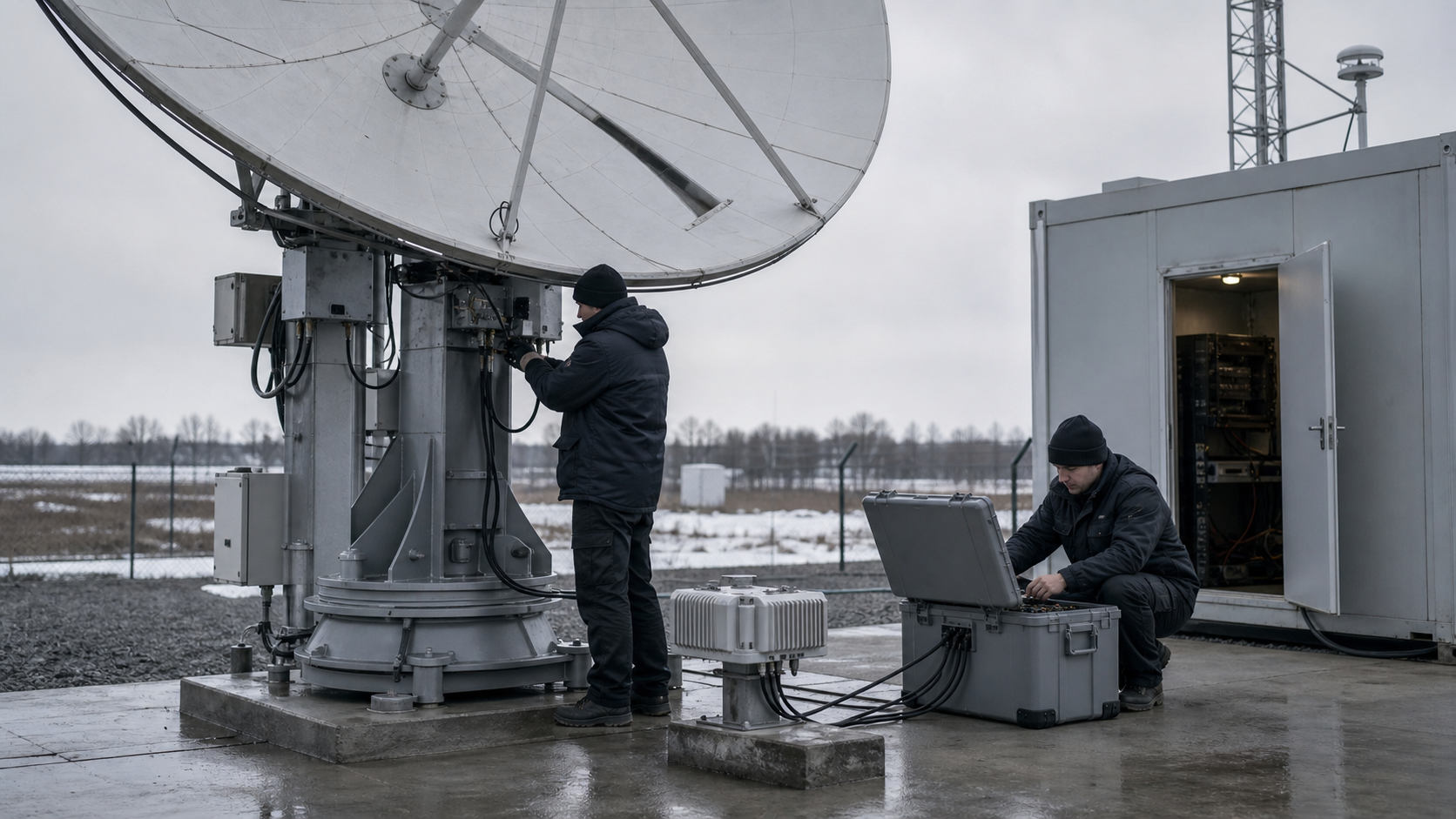
That question starts with the ground. A teleport is not a celestial abstraction. It is a collection of antennas, RF chains, baseband equipment, modems, routers, cabling, racks, climate control, power systems, security, licensed radio parameters and staff. The satellite segment may be leased from another operator. The customer may never see the dish. Yet the customer pays for a very physical promise. The antenna must point accurately. The feed must be accepted by the satellite. The downlink or onward terrestrial connection must be available.
The help desk must know whether a fault sits in the customer terminal, the uplink, the satellite segment, the receiving site, the internet route or a power event.
ARD Teleport's public footprint is thin, so this article does not claim a detailed service catalogue that is not publicly visible. The strongest direct record is the RIPE identity and routing layer. ARD's BTW directory entry at https://btw.media/en/directory/ard-teleport-ltd-ru identifies the company page that this article links to. RIPE's organisation record gives a Moscow-based Russian local internet registry identity. RIPE's inverse lookup at https://rest.db.ripe.net/search.json?query-string=ORG-ATL37-RIPE&inverse-attribute=org shows the associated IPv4, IPv6 and AS records. That is enough to say ARD has a public number-resource and routed-network footprint. It is not enough to say how many satellite customers it has, what services are live, or how well any customer link performs.
The economic lens still matters. A company called ARD Teleport, holding LIR status and routed resources, sits in a market where satellite connectivity is never only about the satellite. Russian geography, broadcast distribution, remote industrial sites, sanctions-era equipment sourcing and terrestrial alternatives make continuity the paid unit. If a customer only wants cheap Mbps in a well-served city, fibre and mobile broadband are brutal substitutes.
A teleport account becomes interesting when the customer values coverage, failover, sovereignty, controlled transmission, broadcast reach or a specific link that terrestrial networks cannot provide at the required time and place.
What ARD's public records prove, and what they do not
The RIPE organisation record is precise about identity. It lists ORG-ATL37-RIPE, ARD Teleport LTD., country RU, registry number 1087746170380, LIR type, a Moscow address at Partizanskaya, phone and fax fields, and maintainers including MNT-ARD-Teleport. The record was created on 2013-06-03 and last modified on 2026-05-13. That date pattern is useful because it shows a long-lived registry presence and a recently updated public entry. It does not prove a current customer list, satellite licences, staff count or revenue.
The RIPE autonomous-system record is also specific. AS60569 has the AS name ARD-Teleport, is linked to the same organisation record, and includes import statements from AS43727 and AS20485 with exports to those same upstreams. The record was created on 2013-07-01. In plain English, this shows a routed-network boundary attached to ARD, with declared upstream routing relationships in the RIPE database. It does not make the upstreams customers, owners, partners or guarantees of resilience. It simply says how the public routing record is described.
The allocation records widen the picture. The RIPE inverse lookup includes 185.29.56.0 - 185.29.59.255 with the netname RU-ARD-TELEPORT-20130701, an assigned block 185.29.56.0 - 185.29.56.255 described as Ard Teleport infrastructure, a PPPoE-ARD-TEleport block for users, and the IPv6 allocation 2a00:aae0::/32. RIPEstat's announced-prefixes endpoint showed visible announcements in late June and early July 2026, including 185.29.56.0/22, 93.158.240.0/20, 185.29.56.0/24 and 93.158.240.0/21. The right reading is cautious: ARD has public resource and route evidence consistent with an operator running network services around its teleport identity.
That caution is important. Network-resource evidence is often overread. An AS number is not a business model. A prefix is not a customer. A route record is not a service-level guarantee. A registry contact is not a management team. For ARD, the records support a boundary map: Moscow registration, LIR status, routed resources, upstream routing entries and user-facing naming in one RIPE block. They do not certify satellite uptime, antenna size, spectrum rights, satellite capacity, broadcast relationships, enterprise contracts, sanctions exposure, liquidity or customer retention.
The absence of a rich public commercial site makes the report more dependent on market structure. That does not weaken the paid-unit thesis; it narrows the confidence. A teleport account's economics are visible even when the operator's own marketing is sparse because the cost stack is common across the sector. The buyer pays for ground infrastructure, skilled staff, licences, power, spares, interconnection and backup options. The particular question for ARD is how much of that stack it can control, how much it resells, and how much it must repair under Russian procurement constraints.
The antenna is a capital asset and a failure point
The antenna gives a teleport its visible shape, but economically it is a compound asset. A dish has civil works, mount, tracking or pointing gear, feed assembly, waveguide, block upconverter, low-noise block or amplifier chain, cables, shelter, grounding, heating or de-icing where needed, lightning protection and periodic alignment. The customer may see one capacity price. The provider sees a fixed asset that must be kept available across many contracts or justified by a few high-value accounts.
This matters for pricing because utilisation is everything. A dish that supports high-value broadcast windows, enterprise backhaul or managed backup can earn a continuity premium. A dish that sits idle between occasional uses has to recover costs from short events or be carried by a broader service base. A teleport operator therefore wants accounts that smooth demand: recurring satellite internet, broadcast distribution, maintenance retainers, managed network backup, occasional-use uplinks and interconnection services. The more predictable the load, the easier it is to maintain redundancy without pricing each customer into a substitute.
Pointing discipline is not a decorative skill. Geostationary satellites occupy orbital slots that require careful coordination; a poorly aligned earth station can degrade its own link and create interference risk. The International Telecommunication Union's Radio Regulations, published at https://www.itu.int/pub/R-REG-RR, matter here because satellite communications sit inside a global regime of allocations, coordination and interference management. The customer does not need to read those volumes to buy a link, but the provider's price must reflect the burden of operating inside that regime.
The same is true for the radio chain. A cheap capacity quote means little if the RF chain is old, underpowered, hard to replace or missing backup paths. High-power amplifiers, modems and antenna-control systems age in different ways. Some failures are graceful; others stop a carrier immediately. A provider selling uptime must keep spares, know which parts are still obtainable, know which substitutions require retuning or customer changes, and maintain enough engineering memory to fix a fault during an active window.
For ARD, public evidence does not show the size or location of its antennas, the satellites it uses, or whether it owns or leases all ground equipment. That is the point: the pricing logic has to be separated from unsupported asset claims. The defensible statement is that any ARD customer buying a teleport-style link is buying into the economics of capital equipment and failure points. The question for diligence is not whether satellite bandwidth exists somewhere. It is whether the specific ground chain behind the paid account can survive the likely faults.
Power and weather put uptime on the balance sheet
Satellite links are often sold as resilient because they bypass damaged or unavailable terrestrial routes. That is only half true. They bypass some routes and inherit other risks. The ground site still needs electricity, cooling, access control, generator fuel, batteries, spare cabling, weather readiness and staff. If the site cannot maintain those basics, the satellite path becomes a fragile premium product.
Energy is the least glamorous cost. Antennas and RF equipment use power; amplifiers, climate systems, monitoring racks and network equipment add more. Backup power requires batteries, generators, fuel, maintenance, test runs and physical security. In a market under sanctions and supply pressure, energy resilience also competes with the cost of imported parts and local substitutes. A teleport account that includes credible backup power is not the same product as a best-effort link that works until the site power fails.
Weather is the other hidden price. Ku-band and Ka-band links can be affected by rain fade, snow, ice and pointing drift. ITU-R Recommendation P.618 at https://www.itu.int/rec/R-REC-P.618/en is a standard reference for propagation data and prediction methods used for earth-space telecommunication systems. A customer does not pay for a recommendation document; it pays for the practical effects: fade margins, modulation and coding choices, uplink power control, alternate carriers, backup routes, larger antennas, service terms and support decisions during bad weather.
Russia's geographic spread amplifies the issue. A Moscow-linked resource holder can be serving or supporting customers whose useful satellite path is determined by very different climate and terrestrial conditions. Northern, remote, industrial and regional locations may value satellite not because it is faster, but because the alternatives are worse or more fragile. Weather and power planning decide whether the satellite path is a serious continuity account or just a last resort that fails under the same stress as everything else.
The strongest buyer question is therefore practical: what is the assumed failure mode? If the primary terrestrial path fails, is the satellite route already installed and monitored, or does it require manual dispatch? If heavy rain degrades the satellite link, is there an automatic lower-rate profile, a backup carrier, a second dish, a second site or a temporary fibre or cellular fallback? If power fails, how long can the site run at the contracted service level? ARD's public records do not answer these questions, so they become the core due-diligence gap.
Licensing and compliance become part of the margin
Satellite communications are licensed commerce. Frequencies, earth stations, telecom services, broadcast carriage and cross-border traffic may all carry legal and administrative requirements depending on the service. In Russia, communications oversight sits within a state-heavy regulatory system involving communications law, spectrum management and Roskomnadzor's supervisory role; Roskomnadzor's public English entry point is https://eng.rkn.gov.ru/. The existence of a regulator does not prove any specific ARD licence, but it explains why a teleport account has a compliance cost.
Licensing shapes margin because it imposes time, paperwork, engineering discipline and constraints on change. A customer may ask for a different bandwidth, frequency, satellite, destination, encryption arrangement, receiving site or service term. Some changes are ordinary commercial amendments. Others can require technical coordination, rights checks or fresh approvals. A provider that can handle those frictions earns part of its fee by reducing the customer's administrative burden.
Sanctions and export controls add another layer. The UK maintains Russia sanctions industry guidance at https://www.gov.uk/government/collections/russia-sanctions-regime-industry-and-specialist-guidance. EU sanctions against Russia are grounded in measures such as Council Regulation 833/2014, available at https://eur-lex.europa.eu/legal-content/EN/TXT/?uri=CELEX:32014R0833. The U.S. Export Administration Regulations include Russia and Belarus controls under 15 CFR 746.8, accessible at https://www.ecfr.gov/current/title-15/subtitle-B/chapter-VII/subchapter-C/part-746/section-746.8. These sources do not say ARD breached anything. They show why Russian telecom and satellite equipment buyers face a more expensive replacement environment.
The most direct business effect is not always a formal ban on a particular box. It can be uncertainty, delayed shipping, distributor risk, bank friction, warranty limits, firmware access, software licensing, service refusal, end-user screening or a need to find alternative parts through less efficient channels. For a teleport operator, that raises the cost of maintaining older equipment and makes inventory planning more valuable. A spare amplifier in the cabinet may be worth more than its invoice because replacement time is uncertain.
Compliance can also change customer mix. Some international clients may avoid Russian providers altogether. Some domestic clients may prefer local providers for payment, documentation or sovereignty reasons. Some customers may use satellite as a backup because cross-border terrestrial options are politically or commercially sensitive. ARD's public record does not show which customer class dominates. The evidence supports only a market conclusion: sanctions-era replacement and compliance pressure turn continuity from an engineering claim into a margin question.
Interconnection decides whether the satellite path reaches the customer
A teleport does not stop at the dish. The signal must reach a terrestrial network, a broadcaster, a customer site, a data centre, a head-end, a cloud environment, a corporate WAN, a NOC or an internet upstream. The interconnection half is where ARD's RIPE evidence becomes economically relevant. AS60569 and the visible announced prefixes show a routed boundary that can connect satellite-facing services to terrestrial IP networks.
The RIPE AS record lists imports from AS43727 and AS20485 and exports to those networks. That tells the buyer one thing: ARD's public routing entry declares upstream paths. It does not say those paths are physically diverse, contractually resilient, congestion-free or adequate for any particular service. A buyer of continuity should ask whether the satellite link and terrestrial handoff share a single facility, single router, single upstream or single maintenance window. The more common points they share, the less valuable the backup story becomes.
Interconnection also determines whether satellite bandwidth is useful after landing. A remote site may have a satellite link with enough raw capacity, but if the teleport's onward IP route is congested, filtered, unstable or too far from the customer's real application, the account disappoints. Broadcast customers face a similar issue. A feed can be uplinked successfully and still fail commercially if it is not handed to the right head-end, fibre path, CDN, playout system or receiving partner in time.
The industry comparators show why this matters. Eutelsat's video-distribution page at https://www.eutelsat.com/satellite-services/broadcast-video/video-distribution describes satellite distribution to DTH, DTT, cable and IP network feeds, managed platforms, contribution and round-the-clock support. Its telecom page at https://www.eutelsat.com/satellite-services/telecom describes backhaul, service levels, user terminals, support and maintenance for telecom operators. These are not ARD facts. They are market evidence for how satellite providers package capacity with ground services and support.
For ARD, the interconnection test is simple. If the company is selling a continuity account, the customer should be able to understand the route from customer equipment to satellite, from satellite to ground, from ground to IP network or broadcast handoff, and back through support. If any part is opaque, the price should reflect that uncertainty. Raw Mbps becomes the least interesting number on the page.
Broadcast, backhaul and backup are different businesses
The word "teleport" can cover several paid units that look similar from a distance. Broadcast distribution values scheduled availability, clean handoff, low tolerance for visible interruption and coordination with content owners or carriers. Enterprise backhaul values coverage, throughput, latency, VPN or routing integration, support and predictable service levels. Backup connectivity values readiness, failover testing and enough capacity to keep essential work alive when the primary path fails.
Those businesses share antennas and staff, but they do not share the same economics. Broadcast can justify premium support for scheduled windows, sports, news or channel carriage because a missed window can destroy the value of the event. Backhaul may be more recurring, but customers can be highly price-sensitive if mobile or fibre alternatives improve. Backup may look high-margin because it is idle much of the time, yet it becomes reputationally dangerous if it fails during the very outage it was bought to handle.
ARD's public network records do not reveal which mix is present. The PPPoE-ARD-TEleport RIPE naming hints at user access or broadband-style service in at least one public allocation, but it does not prove present active customers or technology. The company name points toward teleport activity, but a name alone cannot determine whether satellite uplink, IP access, broadcast carriage, local wireless, managed backup or a combination drives revenue.
The distinction matters because substitutes differ. A broadcaster can compare a teleport uplink with terrestrial IP delivery, another satellite operator, an OTT platform or delayed publication. A remote enterprise can compare satellite backhaul with fibre, microwave, cellular, LEO terminals or moving the application closer to a connected site. A backup buyer can compare a managed satellite standby account with a second fibre route, 4G/5G router, fixed wireless or a lower service level during outages.
This is why bandwidth-first selling is weak. A broadcast customer may accept lower bandwidth if the signal is reliable and support is competent. A backup customer may need only critical traffic, not full normal load. A rural broadband customer may value availability and payment terms over peak speed. The provider that knows which job is being bought can price the right bundle; the provider that sells all accounts as capacity risks competing against cheaper substitutes.
Sanctions-era replacement raises the value of old engineering knowledge
In a frictionless supply chain, ageing equipment is a manageable cost. Order the replacement, schedule the maintenance, update firmware, swap a module, call vendor support. In Russia's post-2022 environment, that easy assumption is weaker. Western export controls, EU and UK sanctions, bank caution, logistics changes and vendor exits can make replacement slower or less predictable even where a particular item is not directly prohibited.
That changes the value of engineering knowledge. A team that understands older modems, amplifiers, antenna controllers, routers and monitoring systems can extend asset life without pretending old equipment is new. It can cannibalise parts, maintain spares, choose compatible alternatives, document quirks, and decide when a degraded mode is acceptable. For a teleport operator, this knowledge becomes part of the continuity account.
It also creates a strategic tension. Local substitution can reduce import dependence, but it can introduce compatibility, performance, certification and support questions. Grey-market sourcing may solve an urgent need but can create warranty, legal and security risk. Hoarding spares ties up cash. Running equipment longer can preserve service but raise outage risk. Passing all costs to customers may encourage substitution. Absorbing costs may erode margin.
ARD's direct records do not show its equipment vendors, spare inventory or replacement channels. The article therefore cannot claim that ARD is advantaged or impaired relative to other Russian operators. The defensible conclusion is broader: any Russian teleport or satellite-connectivity provider is now priced partly by replacement uncertainty. A customer buying continuity should ask not only "what satellite capacity do I receive?" but "what happens when a key part fails and the normal supplier path is unavailable?"
This can help smaller operators in some niches. If customers already trust a local team that can repair known equipment, negotiate domestic paperwork and keep modest links alive, a small provider may hold accounts that would otherwise move to a larger international satellite platform. It can also hurt them because larger operators may have deeper spare pools, more legal support, more satellite options and better bargaining power. Sanctions pressure does not choose a single winner; it raises the importance of execution.
Substitutes keep the price honest
The main substitute for a teleport account is not always another teleport. In a city, fibre may be cheaper, faster and easier to monitor. For a mobile or temporary site, cellular may be good enough. For a remote site, a LEO terminal may offer easier installation and lower latency than a traditional GEO path. For broadcast, IP contribution and OTT distribution may reach an audience without a satellite uplink. For a non-urgent transfer, delayed delivery may be cheaper than live continuity.
LEO competition matters because it changes customer expectations. Starlink's business site at https://starlink.com/business positions satellite broadband as a business connectivity option, even though access, legality and payment conditions vary by country. Eutelsat's multi-orbit network page at https://www.eutelsat.com/satellite-network/geo-leo-multi-orbit-satellite-network and its OneWeb LEO page at https://www.eutelsat.com/satellite-network/oneweb-leo-constellation show another version of the same strategic shift: satellite buyers are no longer choosing only between terrestrial networks and classic GEO capacity. They can compare orbit, latency, terminal cost, coverage, support model and regulatory permission.
That does not make traditional teleports obsolete. LEO services still need gateways, terminals, licences, payments, service availability, customer support and local legality. GEO remains strong for many broadcast and wide-area uses. A managed teleport can integrate satellite paths into terrestrial networks, provide broadcast know-how, support specialised terminals, and handle local customer relationships. The substitute set reduces pricing power but does not remove the need for ground expertise.
Terrestrial substitutes are equally important. Rostelecom's official corporate site at https://www.company.rt.ru/en/ reflects the scale of Russia's national fixed and digital-services incumbent; large mobile operators and regional fibre providers are constant alternatives wherever coverage exists. A buyer will not pay a teleport premium if a second fibre route or robust cellular router solves the same risk. The teleport account has to win where geography, resilience, broadcast distribution, sovereignty or controlled support make the terrestrial answer incomplete.
The right price is therefore the avoided-cost price. What does interruption cost? What does a failed broadcast window cost? What does a remote outage cost? What does a sanctions-related part delay cost? What does it cost to dispatch staff to a site that could have stayed online through satellite? ARD's market value, if it has durable customer accounts, rests on answering those questions more convincingly than the substitutes.
What would make ARD more important
ARD becomes more important if customers face locations or use cases where ordinary terrestrial networks remain thin, politically constrained or operationally fragile. Remote industrial sites, temporary construction, emergency communications, regional media distribution, backup for critical facilities and hard-to-reach communities can all support a continuity premium. The key is not remoteness alone. The key is willingness to pay for a link that is ready when needed.
The company also becomes more important if its routed-network footprint is tied to credible interconnection and support. The AS and prefix records show the possibility of an IP service boundary. If that boundary is backed by monitored upstreams, sensible routing, competent abuse handling, customer support and physical diversity, it can make satellite capacity easier to consume. If it is merely a small routed island with limited redundancy, the value is more modest.
Broadcast could be a distinct opportunity, but public evidence is not enough to prove it. Satellite distribution remains relevant in regions where cable, DTT, IPTV and direct-to-home systems need reliable feed delivery. Eutelsat's broadcast pages show the industry logic: content distribution depends on ground services, managed uplink, transmission, support and delivery to many network types. A Russian teleport provider can matter in that chain if it controls a useful local handoff or solves a compliance and support problem for broadcasters or carriers.
The sanctions environment can also increase local stickiness. If international procurement and payments are harder, domestic customers may value a local provider that can invoice, support and maintain continuity inside Russian constraints. Yet the same pressure can reduce equipment quality, slow upgrades and limit access to newer satellite ecosystems. ARD's upside depends on whether it can use local knowledge to reduce risk faster than supply friction raises it.
Finally, ARD becomes more important if customers need hybrid design. A good continuity account is not purely satellite or purely terrestrial. It may use fibre as primary, satellite as backup, cellular for management, a second uplink for critical traffic, and routing rules that shift only essential applications during an outage. That design requires a provider that understands the whole path. The public records show ARD has at least a routed-network presence; they do not prove hybrid design quality.
What could shrink the opportunity
The first threat is better terrestrial coverage. Every new fibre route, reliable fixed wireless service or stronger mobile network reduces the number of locations where satellite can command a premium. Satellite remains useful for resilience and remote reach, but the ordinary customer will choose the cheaper route if it meets the need. A teleport account must therefore sell reliability, coverage or service integration that cheaper networks cannot match.
The second threat is LEO commoditisation. If customers can buy terminals easily, install them quickly and receive adequate service without local integration, some traditional managed satellite accounts lose appeal. The threat is strongest for simple broadband and backup use cases. It is weaker for broadcast, specialised enterprise networks, regulated customers or buyers who need local support and formal service terms.
The third threat is equipment ageing. A provider can live on installed assets for a long time, but eventually spares, skills, firmware, security and efficiency become constraints. Sanctions-era replacement friction makes that harder. If a provider cannot refresh equipment, maintain stable power, document support or secure compatible parts, customers with alternatives will migrate.
The fourth threat is opaque proof. Customers may tolerate limited public disclosure for security or commercial reasons, but serious continuity buyers still need evidence. They need service histories, incident handling, escalation contacts, backup tests, site power details, antenna and satellite options, routing diagrams, maintenance windows and contractual remedies. If ARD cannot provide that privately, public registry evidence will not carry the sale.
The fifth threat is regulatory and payment friction. Satellite services can cross sensitive boundaries: spectrum, media carriage, encryption, data routing, sanctions, foreign suppliers and government oversight. If paperwork becomes slow, payments become difficult, or counterparties avoid Russian exposure, the addressable market narrows. Domestic demand may offset some of that, but it may be less profitable or more price-sensitive.
Network-resource evidence should guide questions, not conclusions
The value of ARD's RIPE footprint is that it tells an analyst where to ask better questions. ORG-ATL37-RIPE gives the legal-network identity. AS60569 gives a routed boundary. The IPv4 and IPv6 records show allocated resources and user or infrastructure naming. RIPEstat confirms current announcement visibility for several prefixes. Together, these facts support the view that ARD is not merely a name in a directory; it has a public internet-resource surface.
They do not identify a teleport site, an antenna, a satellite, a customer, a broadcast feed, a revenue stream or an outage history. That distinction is central to responsible company research. The resource records are evidence of network operation. They are not evidence of every service implied by the company name. A route announcement can support satellite backhaul, ordinary ISP service, internal connectivity, customer access or a mix of uses. It cannot by itself say which revenue line matters most.
For a customer, the registry evidence should trigger operational questions. Which prefixes are used for customer service? Which are used for infrastructure? Which upstreams are active and contractually backed? Are routes monitored? Is there abuse handling? Does satellite traffic land into the same AS? Are backup routes tested? Are there separate facilities or merely logical alternatives on the same site? Is IPv6 used in real service or only held as an allocation?
For an investor or creditor, the same records guide different questions. How much revenue is recurring? How many accounts depend on satellite rather than ordinary internet access? How much capital expenditure is deferred? How much equipment is imported? How sensitive is the customer base to sanctions, payment channels and terrestrial substitutes? Is the company a niche continuity provider or a small access network with a teleport brand?
For a public-interest analyst, the important point is not to create false entities from technical artifacts. AS numbers, prefixes, route records, satellites, frequencies and datasets are evidence. They are not people or companies. In ARD's case, the real company is ARD Teleport LTD.; the network artifacts help describe its operating surface and uncertainty.
The conclusion is a priced risk-transfer account
ARD Teleport LTD. should be read as a company whose visible public record supports a narrow but meaningful thesis. It is a Russian RIPE NCC LIR with a routed-network footprint, a Moscow registry identity and public resources attached to the ARD Teleport name. The public record does not show enough to rank it against Russian satellite operators, identify customers or certify service quality. But the economic unit implied by the name and records is clear: satellite uptime before bandwidth.
The buyer is transferring a specific risk. It wants the provider to absorb some of the burden of antennas, pointing, RF equipment, site power, weather planning, licensing, interconnection, monitoring, spare parts and support. It may also want the provider to absorb Russian procurement friction and keep older or alternative equipment usable. Mbps is the easiest part to compare. Continuity is the harder part to prove and the part that justifies a premium.
That premium is fragile. Fibre, mobile broadband, LEO terminals, alternate teleports, larger satellite operators and delayed transmission all compete with the account. If any substitute can deliver the same practical continuity at lower cost, ARD's price weakens. If the customer needs local support, a regulated handoff, a known network boundary, a backup path or a satellite route that has already been integrated into its operations, a smaller provider can remain relevant.
The public evidence supports a measured conclusion rather than a promotional one. ARD matters where a customer is not buying bandwidth as a commodity, but buying a continuity account whose value appears only during stress: a weather event, a power loss, a failed fibre route, a broadcast deadline, a remote-site outage, a part shortage or a compliance delay. In those moments, the contract is judged by whether the link stays usable, not by the headline capacity number.
That is also why ARD's modest public footprint should not be mistaken for a modest risk surface. A small provider can sit on a narrow but important dependency if it is the party that knows the terminal, the uplink, the router, the upstream, the payment channel and the local maintenance path. Conversely, a company can hold a visible AS and still offer little differentiated value if customers can replace the account with a terminal kit, a mobile router or a second terrestrial circuit. The paid question is always comparative: how expensive is interruption, and how quickly can a substitute be made real under stress?
The answer decides whether ARD's teleport identity is a premium continuity claim or merely a small network resource holder with a satellite-flavoured name.
The next useful public signals would be practical rather than grand. A dated licence reference, a maintained service page, a customer case with the customer named, an uptime statement tied to a real service level, a fresh satellite or ground-equipment reference, or visible routing diversity would each improve confidence. So would evidence that customers keep ARD for backup or broadcast work after testing alternatives. Until those signals appear, the strongest view is disciplined and bounded: ARD's public footprint supports interest in the company, while the economics of continuity explain why that footprint could matter.
Missing proof: economics, reliability and retention
Economics. Public sources do not show ARD Teleport LTD.'s revenue, margins, capital expenditure, satellite-capacity costs, antenna ownership, lease terms, customer mix, average contract value, price lists, debt, cash position or spare-parts inventory. The RIPE records prove identity and network-resource footprint; they do not show whether the company earns most revenue from satellite uplink, local access, broadcast, enterprise backup, ordinary ISP service or another line.
Reliability. Public sources do not show ARD's uptime, outage history, mean time to repair, power-backup duration, weather-fade performance, antenna redundancy, satellite diversity, upstream diversity, site diversity, support staffing, monitoring coverage, failover-test history or current equipment health. RIPEstat announcement visibility shows that routes were visible to public collectors; it does not prove customer service quality or satellite-link resilience.
Retention. Public sources do not show churn, renewal rates, active customer names, broadcaster carriage accounts, enterprise references, complaint history, support satisfaction, migration losses to fibre/cellular/LEO substitutes or recent wins. Without customer and renewal proof, the responsible conclusion is that ARD has a verifiable public resource footprint and a plausible teleport-continuity economic role, while the durability of its accounts remains unproven.