
This article is not yet available in Spanish. Displaying the English version.

Company Profiling / Network infrastructure operator

AFRINIC

AFRINIC is tracked as a network infrastructure operator within the internet infrastructure ecosystem.

AFRINIC
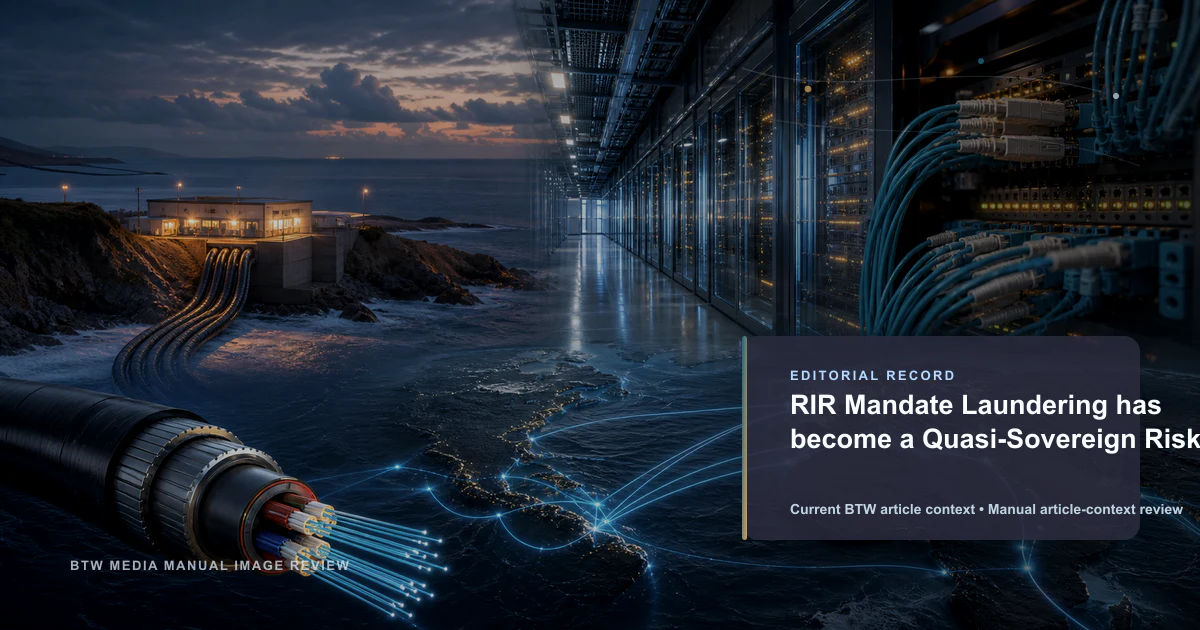
Caption: AFRINIC visual context for BTW intelligence coverage. · Source context: Existing article media was retained or restored as the subject-specific visual basis. · Relevance reason: AFRINIC is the primary subject or event subject; the image supports the article's governance reading. · Image provenance: Existing curated article image retained because it is subject- or event-specific and not a generic pool placeholder.

Sources

Public references used for this article.

CategoryCompany

AFRINIC is tracked as a network infrastructure operator within the internet infrastructure ecosystem.

RegionAfrica

AFRINIC has public-source relevance to network operations, governance, dependency mapping, or market structure.

Content TypeProfile

AFRINIC is tracked as a network infrastructure operator within the internet infrastructure ecosystem.

Primary DomainSecurity

Public-source signals support medium-impact monitoring for infrastructure visibility and dependency analysis.

TopicNetwork infrastructure operator

AFRINIC is profiled by BTW Media because published evidence links it to internet infrastructure, governance, operational dependencies, or market visibility.

ImpactMedium

Public-source signals support medium-impact monitoring for infrastructure visibility and dependency analysis.

Confidence?Confidence Grade
0.90–1.00AHigh — direct sources
0.75–0.89A/BStrong
0.55–0.74B/CMedium
0.35–0.54C/DWeak–medium
0.10–0.34DWeak signal
0.00–0.09DInternal monitoring
Limited confidence (80%)

Several public sources

AFRINIC is profiled by BTW Media because published evidence links it to internet infrastructure, governance, operational dependencies, or market visibility.

  • The RIR system has evolved from technical coordination into a quasi-sovereign structure through “mandate laundering”.
  • Structural risks now demand a multi-stakeholder transition architecture rather than incremental internal reform.

From coordination to mandate laundering

The Regional Internet Registry (RIR) system was designed to coordinate IP address allocation across five geographic regions. It relied on bottom-up policy development and technical consensus. Over time, however, this mandate has stretched far beyond its original scope. What began as operational stewardship now resembles delegated authority without a clear legal basis.

The concept of “mandate laundering” captures this shift. Authority appears to flow from the community through open processes and consensus, yet it becomes institutionalised and self-reinforcing. Internet governance scholars have long noted that bodies like ICANN and the RIRs derive their authority from community participation rather than formal democratic mandates—creating ambiguity when disputes move beyond the policy room into the courtroom.

This ambiguity matters more in today’s IPv4 market. Scarcity has turned addresses into tradable assets with real economic value. RIRs now influence property-like rights through transfer restrictions, revocation powers and territorial claims—even though they were never designed as legal regulators.

Case studies expose structural limits

Recent disputes highlight the risks. The AFRINIC crisis is the most extreme example. When the registry for Africa attempted to reclaim 6.3 million IPv4 addresses from Cloud Innovation Ltd—a Hong Kong-based company that had received the allocations between 2013 and 2016—a Mauritian court intervened repeatedly. In July 2021, the court granted a freezing order attaching up to USD 50 million in AFRINIC’s bank accounts.

By September 2023, AFRINIC was placed under receivership, leaving the organisation effectively paralysed and unable to issue new IP addresses for extended periods.

The crisis exposed a core weakness: RIR authority collapses when confronted with national legal systems that do not recognise registry policy as binding law.

Similarly, the relationship between RIRs and legacy IPv4 address holders in North America has been a source of tension. Legacy resources—address blocks assigned before ARIN was formed in December 1997—were originally administered without requiring a formal agreement. ARIN later introduced the Legacy Registration Services Agreement (LRSA) in 2007 to bring these resources under a contractual framework.

Organisations that declined to sign found certain services, such as Resource Public Key Infrastructure (RPKI) and Internet Routing Registry access, withheld. The tension is not about courtroom battles but about leverage: the registry controls access to critical security infrastructure, and legacy holders who resist the contractual framework are gradually excluded from the ecosystem they helped build.

A third example lies in the secondary IPv4 market. Brokers and leasing platforms now operate at scale, facilitating transactions and rental arrangements that often fall outside direct RIR oversight. This weakens the idea that registries maintain effective control over allocation and usage—and raises the question of who ultimately governs the market.

Why a transition architecture is now necessary

These cases point to a deeper issue. The RIR system no longer fits its original role. It acts like a governance authority—making policy, enforcing rules, controlling access—but lacks sovereign legitimacy. This creates systemic risk: policy decisions can trigger legal conflict, market distortion, or fragmentation of the global address space.

Internal reform is unlikely to resolve this. The structure itself embeds the problem. Governance still depends on institutional continuity rather than external accountability. Each RIR operates as a private legal entity in its own jurisdiction, with no overarching framework for cross-regional disputes or systemic failure.

A transition architecture offers a more realistic path. This would involve governments, industry stakeholders, and technical actors working together to establish clear boundaries between coordination functions and governance authority. It would also align IP resource governance with the legal and economic realities that have emerged since the system was first designed.

The shift will not be simple. But without it, mandate laundering will continue to expand risk across the global IP ecosystem.

Also read: How to price your IPv4 addresses for maximum ROI


At A Glance

  • Name: AFRINIC
  • Type: Network infrastructure operator
  • Base: Africa
  • Profile focus: Company

What It Does

  • Public records support monitoring of its role, services, and key relationships.

Why It Matters

  • Public-source signals support medium-impact monitoring for infrastructure visibility and dependency analysis.
  • Operational criticality: Medium
  • Time horizon: Next quarter

What To Watch

  • Monitoring focuses on verified service continuity, governance changes, and relationship signals.
NowMedium priority

Track verified source updates, role changes, and current public evidence.

QuarterMedium policy sensitivity

Public-source signals support medium-impact monitoring for infrastructure visibility and dependency analysis.

YearNext quarter outlook

Longer-term relevance depends on verified operating, policy, and relationship changes.

Member Briefing

Deeper Profile Context

Login is required to unlock the full profile briefing and source notes.

Only for Strategy Circle

Strategic Circle Access

Open to all readers. Unlock profile briefings after joining and logging in.

Join Strategic Circle

Only for Leadership Alliance

Leadership Alliance Access

For owners and management of IP-holding companies. Login required to unlock.

Join Leadership Alliance

Public Sources and Linked Organizations

4 linked-organization notes require member access.

OrganizationLinkRelated organizationConfidenceWhy it mattersSourceCaveat
Mauritiuslinked toAFRINICGoodMauritius declared-company intervention in AFRINIC affairsL'Express reports that AFRINIC's legal disputes with Cloud Innovation led to receivership and that Mauritius used declared-company powers amid reputational concerns.Low risk
Smart Africa Alliancenamed inAFRINICGoodSmart Africa supports AFRINIC 2025 board-candidate slateSmart Africa said consultations in the African internet-governance ecosystem led to support for an eight-candidate slate for the 2025 AFRINIC board election.Low risk
Tanzanian Internet Service Providers Associationlitigates withAFRINICGoodTISPA interim order makes AFRINIC election a member-rights testTISPA states that a 13 June 2025 interim order restrained AFRINIC e-voting and the 23 June board election, and explains the member-rights concerns behind the application.Low risk, public source
Gowtamsingh Dabeereceiver role tied toAFRINICGoodTISPA statement identifies AFRINIC in receivership and Dabee as receiver managerStates that a 13 June 2025 interim order in SC/COM/WRT/000435/2025 named AFRINIC in receivership and Receiver Manager Gowtamsingh Dabee as respondents and restrained election steps.Low risk
Gowtamsingh Dabeeoperator ofAFRINICGoodICANN receiver update anchors AFRINIC's court-supervised board resetThe archived ICANN announcement records the 12 February 2025 Mauritius court order naming Gowtamsingh Dabee receiver over AFRINIC and setting an election-restoration timetable.Low risk, public source
Cloud Innovation Ltd.linked toAFRINICGoodCloud Innovation application leads to AFRINIC receiver judgmentCloud Innovation states that the Supreme Court of Mauritius appointed an official receiver for AFRINIC after Cloud Innovation's application and ordered elections to be organised.Low risk
Supreme Court of Mauritiusnamed inAFRINICGoodSupreme Court of Mauritius appoints receiver for AFRINICCloud Innovation states that the Supreme Court of Mauritius appointed an official receiver for AFRINIC after Cloud Innovation's application and ordered elections to be organised.Low risk
Fiona Asongaboard memberAFRINICGoodFiona Asonga named in contested AFRINIC board-seat signalNRS frames the AFRINIC 2025 election process as disputed and names the announced board-seat outcome in that contested context.Low risk, public source
Kaleem Ahmed Usmaniboard memberAFRINICGoodKaleem Ahmed Usmani named in contested AFRINIC governance signalNRS frames the AFRINIC 2025 election process as disputed and names the announced board-seat outcome in that contested setting.Low risk, public source
Abdelaziz Hilaliboard memberAFRINICHighAbdelaziz Hilali AFRINIC vice-chairman role observedAFRINIC lists Prof Abdelaziz Hilali as Seat 1, Morocco, Northern Africa, Vice-Chairman, with a three-year term.Low risk, public source
Ajao Adewole Davidboard memberAFRINICHighAdewole David Ajao AFRINIC Seat 8 profile observedAFRINIC's election portal lists Ajao Adewole David as the elected candidate for Board Seat 8, a non-regional seat.Low risk, public source
Carla Sofia Fernandes Sandersonboard memberAFRINICHighCarla Sanderson AFRINIC Finance Committee role observedAFRINIC's board and receiver statement says the Finance Committee is chaired by Carla Sanderson and frames the board's work around restoring governance, financial reports, legal matters, policy development and institutional reform.Low risk, public source
← BackAll Companies