
This article is not yet available in Spanish. Displaying the English version.

Event Briefing / 6G cooperation agreement

Telefonaktiebolaget LM Ericsson; SK Telecom Co., Ltd.

Ericsson and SK Telecom created a cooperation frame for AI-RAN, open autonomous networks, zero-trust security and 6G standardization.

Telefonaktiebolaget LM Ericsson; SK Telecom Co., Ltd.
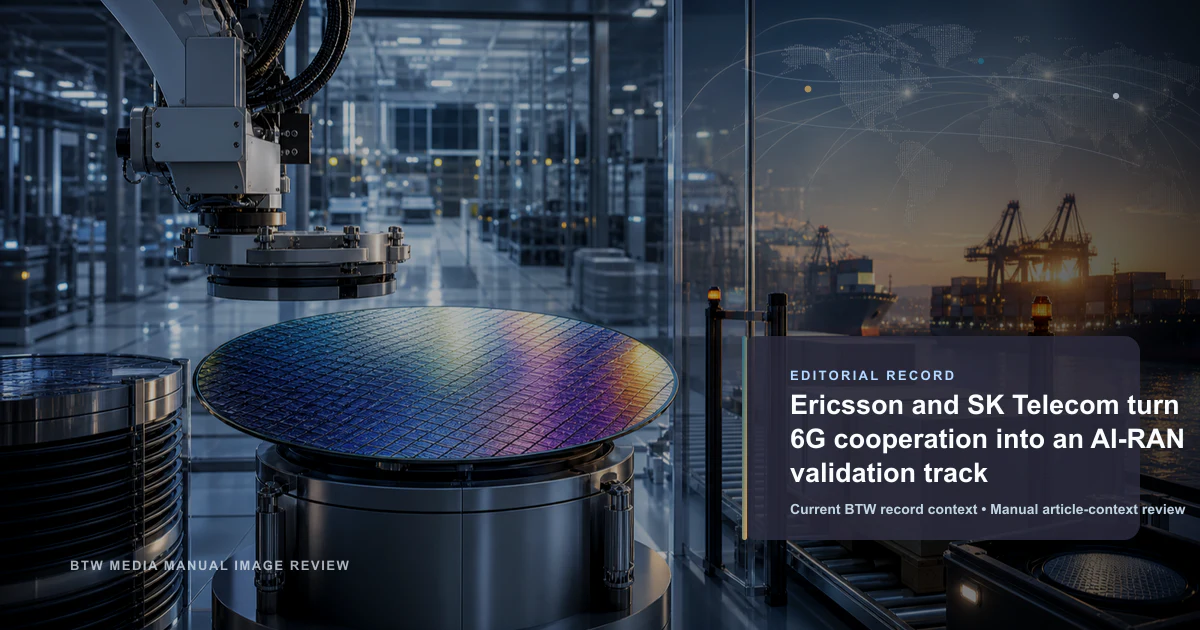
Caption: A generated editorial scene frames the Ericsson-SK Telecom MoU as a long-cycle AI-RAN and 6G validation agreement. · Source context: Ericsson and SK Telecom MoU announcements, Ericsson 6G overview, SK Telecom ATHENA 6G white paper announcement and Computer Weekly industry reporting. · Relevance reason: The article is about Ericsson and SK Telecom's 6G cooperation agreement, so the visual uses an abstract telecom lab, network lattice and city-scale radio context rather than a generic handshake or logo image. · Image provenance: Generated by Codex imagegen from Ericsson, SK Telecom, Ericsson 6G, SK Telecom ATHENA and Computer Weekly source context; no logos, readable text, content-card layout, dashboard UI, flags, handshake imagery or copied third-party artwork.

Sources

Public references used for this article.

  • Ericsson announcement of SK Telecom 6G MoUEricsson announced an MoU with SK Telecom covering AI-powered RAN, 5G monetization, open autonomous networks, zero-trust security and 6G standardization, with joint R&D, trials and potential commercialization through 2031. (source risk: low)
  • SK Telecom announcement of Ericsson 6G MoUSK Telecom announced the same MoU with Ericsson, describing a collaboration on mobile network technologies from 5G to future 6G and an effective period through March 2, 2031. (source risk: low)
  • SK Telecom corporate press detail on Ericsson 6G MoUSK Telecom's corporate press page lists the agreement focus areas, including AI-RAN, open autonomous networks, zero-trust architecture, 6G standardization, spectrum strategy, extreme MIMO, energy efficiency and ISAC. (source risk: low)
  • Ericsson 6G technology overviewEricsson's 6G overview describes standardization, concept validation, AI-native architecture, network sensing, resilience and trustworthiness as part of the 6G technology direction. (source risk: low)
  • SK Telecom 6G white paper ATHENA announcementSK Telecom's ATHENA white paper announcement sets its 6G direction around AI, trust, hyper-connectivity, experience, openness and agility. (source risk: low)
  • Computer Weekly report on Ericsson-SK Telecom 6G MoUComputer Weekly independently reported the MoU as a joint R&D effort on AI-powered RAN, 5G monetization, open autonomous networks, zero-trust security and 6G standardization. (source risk: low)
CategoryEvent

Ericsson and SK Telecom created a cooperation frame for AI-RAN, open autonomous networks, zero-trust security and 6G standardization.

RegionSweden / South Korea

The MoU links vendor standardization influence with operator validation capacity before 6G architectures and procurement assumptions harden.

Signal Focus6G cooperation agreement

The MoU links vendor standardization influence with operator validation capacity before 6G architectures and procurement assumptions harden.

Content TypeSignal Briefing

Ericsson and SK Telecom created a cooperation frame for AI-RAN, open autonomous networks, zero-trust security and 6G standardization.

Primary DomainInfrastructure

The agreement could shape AI-native RAN validation, zero-trust network operations, ISAC demonstrations and standards-facing 6G architecture choices.

Topic6G cooperation agreement

Ericsson and SK Telecom's 6G agreement is best read as a long-cycle validation pact, not a commercial 6G launch. The March 2026 MoU runs through March 2031 and spans AI-powered RAN, 5G monetization, open autonomous networks, zero-trust security and 6G standardization. Its value is in the operating bridge between an equipment vendor shaping pre-standard radio systems and a Korean mobile operator trying to turn AI-native network ideas into trials, security controls and eventual commercial options.

ImpactHigh

The agreement could shape AI-native RAN validation, zero-trust network operations, ISAC demonstrations and standards-facing 6G architecture choices.

Confidence?Confidence Grade
0.90–1.00AHigh — direct sources
0.75–0.89A/BStrong
0.55–0.74B/CMedium
0.35–0.54C/DWeak–medium
0.10–0.34DWeak signal
0.00–0.09DInternal monitoring
High confidence (93%)

Direct public sources

Ericsson and SK Telecom's 6G agreement is best read as a long-cycle validation pact, not a commercial 6G launch. The March 2026 MoU runs through March 2031 and spans AI-powered RAN, 5G monetization, open autonomous networks, zero-trust security and 6G standardization. Its value is in the operating bridge between an equipment vendor shaping pre-standard radio systems and a Korean mobile operator trying to turn AI-native network ideas into trials, security controls and eventual commercial options.

Ericsson and SK Telecom announced the MoU in March 2026. Both companies describe the agreement as a collaboration on mobile network technologies from 5G to future 6G, with joint R&D, trials and potential commercialization through 2031. That timing matters: the agreement is meant to carry work from 5G Advanced execution into the early 6G standardization and validation cycle, not to announce a deployed 6G network.

The cooperation agenda is unusually specific for a 6G headline. It includes AI-powered radio access networks, 5G monetization, open and autonomous networks, zero-trust security, spectrum strategy, extreme MIMO evolution, energy efficiency and integrated sensing and communication. Those are not marketing side notes; they are the control surfaces that will determine whether 6G becomes an AI-native network architecture or only a faster radio standard.

Ericsson brings the vendor and standards-facing side of the bargain. Its 6G material emphasizes standardization, concept validation, AI-native architecture, sensing, resilience and trustworthiness. SK Telecom brings the operator laboratory and market-pressure side: its ATHENA white paper already frames future telecom infrastructure around AI, trust, hyper-connectivity, experience, openness and agility.

The strategic test is whether the two companies can convert a broad cooperation frame into repeatable evidence. Useful signals would include public AI-RAN trial results, zero-trust network operations evidence, multi-vendor autonomy tests, contributions into 3GPP work, spectrum or ISAC demonstrations and any credible path from standards work to SK Telecom network operations before 2031.

Event Brief

  • Event: Telefonaktiebolaget LM Ericsson; SK Telecom Co., Ltd.
  • Signal Type: 6G cooperation agreement
  • Region: Sweden / South Korea
  • Classification: Signal

Affected Area

  • AI-powered radio access network validation
  • 5G Advanced monetization path
  • open autonomous network operations
  • zero-trust security architecture
  • 6G spectrum and standardization work
  • integrated sensing and communication demonstrations

Legal and Market Context

  • The agreement could shape AI-native RAN validation, zero-trust network operations, ISAC demonstrations and standards-facing 6G architecture choices.
  • Operational relevance: High
  • Time horizon: Multi-year

What To Watch

  • joint trial execution
  • 3GPP standardization timing
  • SK Telecom validation environments
  • Ericsson pre-standard radio and RAN software capabilities
  • commercial relevance before the 2031 MoU horizon

Member Briefing

Deeper Event Context

Login is required to unlock the full event briefing and source notes.

Only for Strategy Circle

Strategic Circle Access

Open to all readers. Unlock event briefings after joining and logging in.

Join Strategic Circle

Only for Leadership Alliance

Leadership Alliance Access

For operators, investors, and policy teams that need relationship evidence, failure paths, and source notes. Login required to unlock.

Join Leadership Alliance

Public Sources and Linked Organizations

3 linked-organization notes require member access.

← BackAll Events