
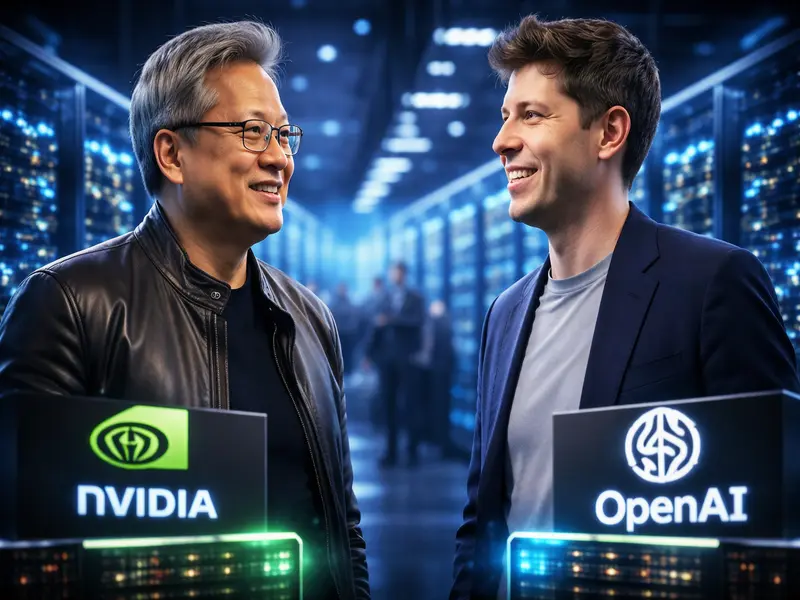
- Jensen Huang said reports he was unhappy with OpenAI were “completely untrue”, according to CNBC.
- The remarks aim to reassure markets about the stability of Nvidia’s role at the centre of the AI ecosystem.
What happened: Public reassurance amid speculation
Speaking on 31 January 2026, Jensen Huang, the co-founder and chief executive of Nvidia, denied suggestions that he was dissatisfied with his company’s relationship with OpenAI. The comments followed days of market chatter after OpenAI executives discussed the long-term need for more computing options, remarks that some investors interpreted as a signal of frustration with reliance on Nvidia chips.
According to CNBC, Huang said the idea that Nvidia was unhappy with OpenAI was “nonsense”, adding that the two companies continue to work closely together. Nvidia is the dominant supplier of the graphics processing units (GPUs) that power OpenAI’s large-scale AI models, including systems used by Microsoft-backed platforms and enterprise customers worldwide.
Founded in California in 1993, Nvidia has become the most valuable semiconductor company in the world on the back of explosive demand for AI hardware. OpenAI, meanwhile, has emerged as one of the most influential developers of generative AI models, with its technology widely deployed across consumer and corporate applications. Their partnership sits at the heart of today’s AI boom.
Huang’s intervention came against a backdrop of heightened sensitivity in markets, where even small hints of strategic divergence can move valuations sharply. Nvidia shares have been closely tied to expectations that OpenAI and similar groups will continue to scale their use of its chips at pace.
Also Read: SoftBank’s $30B talk with OpenAI raise concerns
Also Read: Amazon eyes $50B OpenAI investment
Why it’s important
The episode underlines how critical confidence is in the AI supply chain. Nvidia’s close relationship with OpenAI is not just a commercial arrangement but a signal to the wider market about the direction of AI infrastructure investment. Any perception that leading model builders might pivot away from Nvidia risks unsettling expectations across cloud providers, data centre operators and investors.
From a financial perspective, Nvidia’s premium valuation rests on the assumption of sustained, concentrated demand for its accelerators. By publicly reaffirming alignment with OpenAI, Huang is seeking to dampen speculation and reinforce the idea that the current AI stack remains intact. In a sector defined by long-term capital commitments, stability among its central players matters almost as much as technical performance.
