
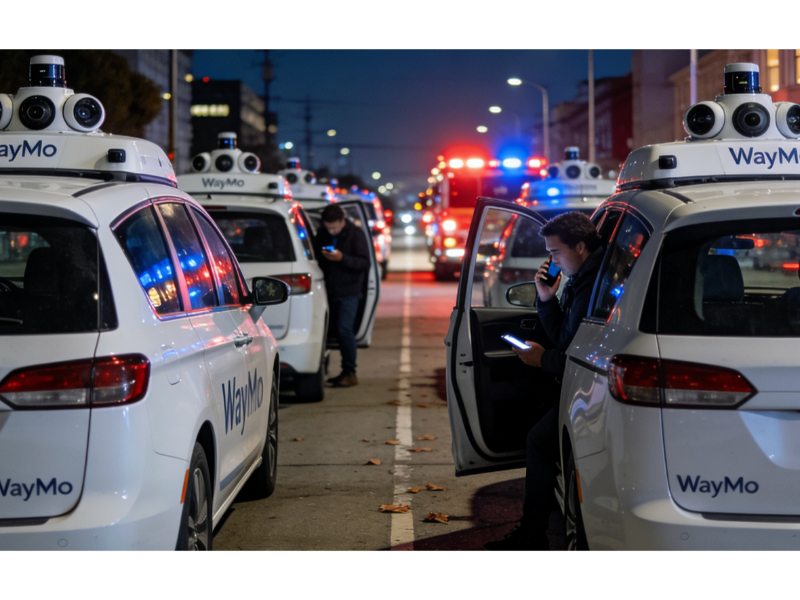
• Alphabet unit Waymo said it will update software and emergency response protocols for its robotaxis after a major San Francisco power outage left vehicles stalled and snarled traffic.
• California regulators have opened reviews of the incident, underscoring growing scrutiny of autonomous vehicle safety in real-world infrastructure failures.
What happened: Robotaxis stalled amid blackout spark software and response changes
Alphabet Inc unit Waymo said it will expand engagement with first responders, improve its emergency response protocols and issue fleet-wide software updates after incidents in which its self-driving robotaxis stalled in parts of San Francisco during a widespread power outage on Saturday. The outage, triggered by a fire at a Pacific Gas & Electric Company (PG&E) substation, knocked out electricity to roughly one-third of the city, affecting about 130,000 residents and disabling traffic signals across large parts of the urban grid.
Videos posted on social media showed multiple Waymo vehicles stopped with hazard lights illuminated at intersections where traffic lights had gone dark, contributing to traffic congestion and confusion on already busy streets. Waymo acknowledged that its existing confirmation protocols — which sometimes require remote human support to verify how a robotaxi should proceed when signals fail — became overwhelmed by the scale of the outage, leading to delays as requests for confirmation spiked.
The company, which operates a fleet of more than 2,500 vehicles in cities including the San Francisco Bay Area, Los Angeles, Metro Phoenix, Arizona, Austin, Texas and Atlanta, Georgia, paused its robotaxi service in San Francisco on Saturday evening and resumed operations on Sunday after power restoration and operational adjustments.
Waymo’s planned software updates are intended to give its autonomous vehicles “specific power outage context”, enabling them to navigate intersections more decisively without excessive requests for remote confirmation. The enhancements are also expected to refine how the system behaves during unexpected infrastructure failures and to broaden training and coordination with emergency services.
Also Read: Expert: Cyber retaliation is real and threatens US systems
Also Read: Optus outage in Australia sparks fury, calls for overhaul
Why it’s important
The incident highlights a significant challenge in the deployment of autonomous vehicles: their dependence on functioning infrastructure and remote support systems. Urban grid failures such as the blackout expose limitations in the way current self-driving systems interpret and respond to complex, citywide anomalies. Although Waymo said its vehicles successfully traversed more than 7,000 dark traffic signals on Saturday, the concentrated spike in confirmation requests revealed bottlenecks in both technology and operational protocols.
California regulators, including the California Public Utilities Commission (CPUC) and the state’s Department of Motor Vehicles (DMV), have said they are reviewing the incident, underscoring how closely autonomous vehicle operations are tied to regulatory oversight in safety-critical scenarios. The CPUC, which oversees utility infrastructure resilience, and the DMV, which regulates autonomous vehicle deployment permits, both play roles in determining whether existing protocols sufficiently protect public safety.
Critics of large-scale autonomous deployments argue that events like the San Francisco outage reveal gaps in preparedness for widespread infrastructure disruptions. Transportation safety experts have questioned whether systems that depend on external confirmations and remote human interaction can scale reliably in cities prone to emergencies such as power failures or natural disasters. Others warn that expanded first responder training and emergency protocols, while necessary, may not fully address emergent edge cases without substantial revisions to autonomous logic and human-machine interaction frameworks.
Waymo’s commitment to updates and responder coordination represents a response to these concerns, but the balance between innovative mobility services and robust safety under extreme conditions remains an evolving challenge. This incident may influence wider industry practices and regulatory standards as autonomous vehicles become more prevalent in complex urban environments.
