
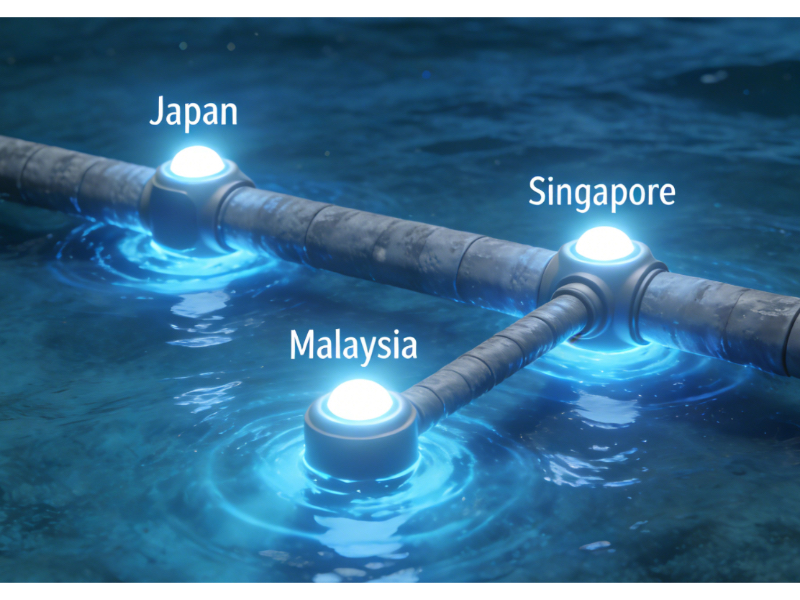
- Japanese tech firm NTT Data and partners have launched a joint venture to build the Intra-Asia Marine Cable, a US$1 billion system linking Japan with Malaysia and Singapore, avoiding congested waters near the South China Sea.
- The project highlights rising geopolitical and infrastructure concerns, including the implications of routing around areas of strategic influence and the future of regional network security.
What happened: New subsea cable venture connects Asia while steering clear of sensitive waters
NTT Data, in partnership with Sumitomo Corporation and JA Mitsui Leasing, has announced the creation of a new company, Intra-Asia Marine Networks (I-AM NW), to construct and operate a major submarine communications cable linking Japan, Malaysia and Singapore.
The Intra-Asia Marine Cable (I-AM Cable) is expected to span around 8,100 kilometres, connecting three Japanese landing points — Chiba, Mie and Fukuoka — with Malaysia and Singapore, and with planned connectivity to South Korea, the Philippines and Taiwan. The system will have a design capacity of about 320 terabits per second, enabled by advanced technologies such as Space Division Multiplexing (SDM) and Wavelength Selective Switch (WSS).
The partners estimate the project will cost roughly US$1 billion and aim for service commencement in fiscal 2029.
Industry observers have noted that the proposed route keeps the cable well clear of the South China Sea, a geopolitical hotspot that has seen increased regulator scrutiny and is heavily congested with existing infrastructure. This approach aligns with a recent trend among subsea cable developers seeking to avoid politically sensitive waters while balancing economic demands for robust connectivity.
Also Read: Lenovo appoints Tareq Alangari to lead META operations as digital ambitions expand
Also Read: Meta to acquire Chinese-Founded AI startup manus in strategic move on advanced artificial intelligence
Why it’s important
Subsea fibre-optic cables are critical infrastructure, carrying nearly all intercontinental data traffic and underpinning everything from cloud services to financial markets. The decision by I-AM NW to avoid routing through the South China Sea reflects wider industry concerns over geopolitical tensions, regulatory complexity and security risks associated with that body of water — where rival claims and strategic control by regional powers, including China, have triggered delays and apprehension for past projects.
By establishing alternative paths, stakeholders hope to improve network resilience against both natural disasters and political risks, while reinforcing Japan’s position as a key regional data hub. However, critics argue that the focus on avoidance underscores growing anxieties over digital infrastructure sovereignty, and raises questions about whether fragmented routing strategies may ultimately lead to inefficiencies or reduced redundancy if broader cooperative frameworks are not strengthened.
Moreover, while the technology promises high capacity and flexible bandwidth management, experts caution that subsea projects frequently face delays due to complex permitting regimes, environmental factors and the challenge of coordinating multinational deployments — meaning the 2029 target could slip.
The I-AM Cable project thus highlights the nexus between technology planning and geopolitical strategy in Asia’s infrastructure landscape. As demand for data and AI-driven services rises across the region, the balance between connectivity, security and geopolitical risk will remain a defining challenge for subsea networks in the coming decade.
