
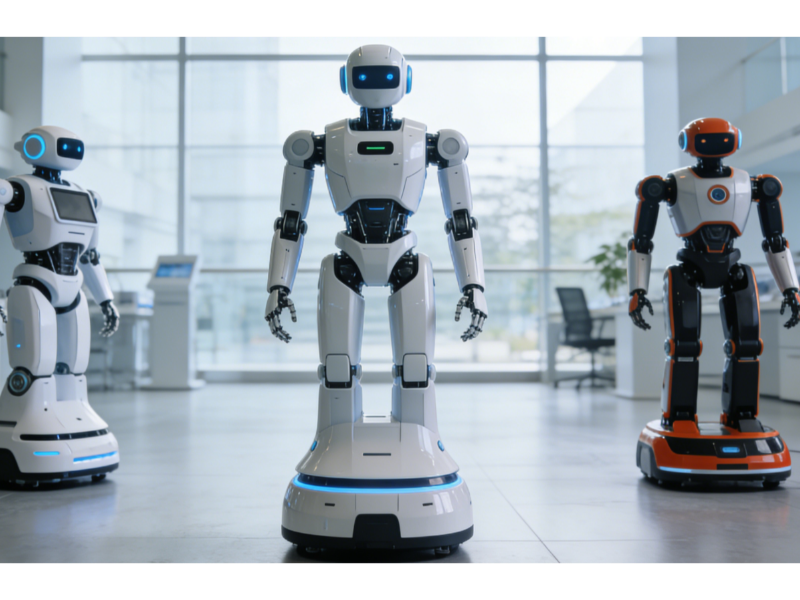
• Chinese firms accounted for the largest share of global humanoid robot shipments in 2025, with companies such as AgiBot, Unitree Robotics and UBTECH Robotics leading volume output.
• Rapid expansion raises questions about domestic demand, export competitiveness and the practical integration of robots in real-world industrial or consumer settings.
What happened: production jump driven by Chinese makers
In 2025, Chinese humanoid robot manufacturers surged ahead of global rivals in production and shipments, according to industry reports. Data released by Omdia indicates that Shanghai-based AgiBot Innovation Technology shipped an estimated 5,168 units last year, claiming the largest share — roughly 39 % — of the global humanoid robot market. AgiBot was followed by Unitree Robotics and UBTECH Robotics, with 4,200 and 1,000 units shipped respectively.
Industry estimates suggest that total global humanoid robot shipments reached approximately 13,000 units in 2025, with Chinese companies dominating the segment and outpacing US rivals such as Figure AI and Tesla, whose Optimus robots have yet to enter mass production.
Chinese firms are not only manufacturing at higher volumes but also targeting a wide range of market segments. AgiBot and Unitree, for example, focus on both industrial and commercial use cases, while UBTECH’s offerings span educational, research and enterprise applications.
The growth reflects a broader ecosystem supported by government policy, manufacturing scale and supply chain integration. According to analysts, China has a complete industrial chain for humanoid robotics, ranging from component production to final assembly, which firms have leveraged to accelerate iteration and scale output.
Industry data suggests that the global market could expand dramatically in the coming decade. Research forecasts by firms such as RBC Capital Markets project that the humanoid robotics industry could reach a $9 trillion total addressable market by 2050, with China accounting for more than 60 % of that figure.
In addition to shipment volumes, China has hosted events such as the World Humanoid Robot Games, which debuted in Beijing in 2025 and featured over 500 robots in multi-event competitions, illustrating both technical progress and growing public interest.
Also Read: Arm makes a big bet on physical AI as it targets the robotics market
Also Read: Mobileye’s bold robotics push: $900M bet on humanoid AI
Why it’s important
The acceleration of humanoid robot production in China highlights the country’s growing leadership in an emerging technology sector that intersects artificial intelligence, advanced manufacturing and embodied intelligence — an AI paradigm that integrates perception, decision-making and physical action in the real world.
China’s dominance in shipment volume raises questions about export competitiveness, since many Western companies have struggled to move beyond prototype and demonstration stages. The fact that Chinese firms are shipping thousands of units annually — while US competitors such as Tesla and Figure AI have more limited production — illustrates differing industrial strategies and market focus.
However, critics caution that high shipment numbers do not necessarily equate to meaningful adoption. Humanoid robots are often priced and configured for specialised use cases, and significant barriers remain for widespread deployment in everyday industrial, service or household roles. Observers note that the transition from volume output to practical integration will require not just robotics hardware but robust software, safety validation, maintenance ecosystems and clear cost-benefit cases for users.
The rapid pace of development also highlights skills and workforce implications. A surge in robot production could strain supply chains for specialised components such as actuators and sensors, and may require expanded training for engineers and technicians familiar with advanced robotics systems. This is particularly pertinent as companies such as AgiBot expand manufacturing capacity and seek larger export markets.
There are broader economic and policy considerations, too. As Chinese companies scale humanoid outputs, competition with global peers could intensify patent races, standards negotiations and supply chain dependencies on specialised semiconductors and AI processors. Ensuring that production growth translates into sustainable commercial ecosystems rather than purely volume statistics remains a key challenge for industry stakeholders.
