
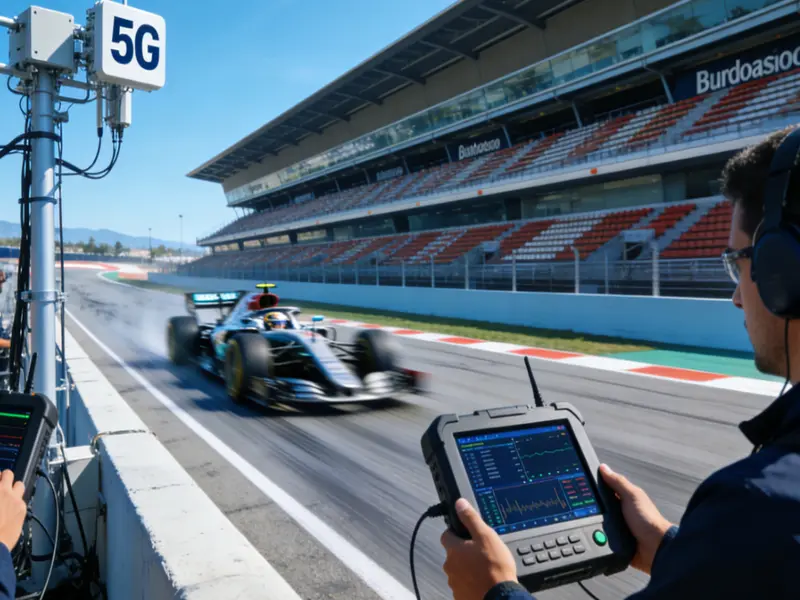
- CircuitX is using the Barcelona Formula One circuit as a live environment to test 5G connectivity for motorsport data and communications.
- The project explores how private 5G networks could support real-time telemetry, broadcast feeds and race-day operations.
What happened: Racing-speed connectivity tests
Network innovation company CircuitX has turned the Circuit de Barcelona‑Catalunya into a live testing ground for advanced 5G connectivity, experimenting with how next-generation mobile networks could support high-speed motorsport environments.
According to reporting by Capacity Media, the initiative transforms the Formula One track into a working laboratory where engineers can trial ultra-low latency wireless infrastructure under realistic racing conditions. The trials focus on how 5G can transmit telemetry, video and operational data across the circuit with minimal delay.
Motorsport already relies heavily on real-time data flows. Modern racing cars generate large volumes of telemetry, while teams, broadcasters and race organisers depend on continuous connectivity across the track. CircuitX is exploring whether private 5G networks can replace or complement existing communications systems used during events.
The Barcelona circuit provides a controlled yet demanding environment for experimentation. High vehicle speeds, large crowds, complex broadcast operations and extensive trackside infrastructure create conditions that mirror the communication challenges faced at global racing events such as those run by Formula One.
Engineers are testing how network slicing, edge computing and high-bandwidth wireless links perform when supporting real-time applications including live video feeds, vehicle telemetry and operational coordination.
Also Read: Ghana launches shared 5G network amid uncertainty
Also Read: BT and Ericsson strengthen UK 5G partnership
Why it’s important
The experiment reflects a wider shift in how telecoms companies view large venues and live events. Sports arenas, festivals and racing circuits are increasingly being treated as test environments for advanced networking technologies.
Private 5G networks are emerging as a potential alternative to traditional trackside radio and wired systems, offering greater flexibility and faster deployment. For broadcasters, lower latency could enable more immersive camera angles and real-time analytics during live races.
From a telecoms perspective, motorsport provides an unusually demanding proving ground. Networks must handle dense device connectivity, rapid mobility and high data throughput simultaneously.
There is also a commercial incentive. If 5G can reliably support motorsport operations, similar architectures could be applied to other high-performance environments such as logistics hubs, smart factories and large public venues. Investors increasingly view these sectors as early revenue opportunities for private 5G deployments.
In that sense, the Barcelona trials illustrate a broader industry effort to demonstrate practical use cases for advanced mobile networks beyond consumer smartphones.
As telecom operators continue to search for profitable enterprise applications, racetracks may become an unexpected testing ground for the future of high-performance connectivity.
