
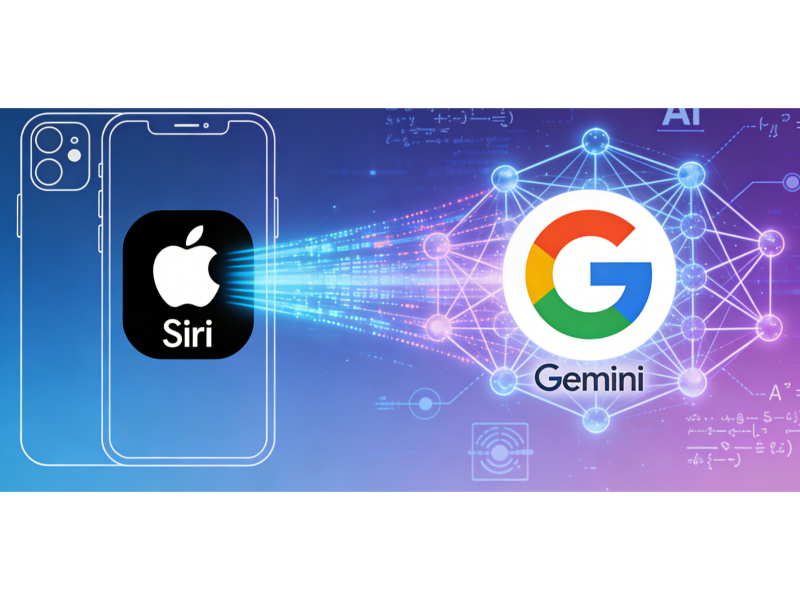
• Apple and Google have announced a multi-year agreement under which Google’s Gemini AI models will underpin the upcoming upgrade to Apple’s Siri and broader Apple Intelligence features, according to CNBC reporting.
• The deal reflects a strategic shift for Apple after delays in its own AI development and raises questions about competition, data privacy and the reliance of ecosystem rivals on one another.
What happened: AI collaboration on Siri
Apple Inc. and Google LLC have confirmed a multi-year collaboration that will see Google’s Gemini artificial intelligence models power a revamped version of Apple’s voice assistant Siri and other advanced Apple Intelligence features expected in 2026.
In a joint announcement, both companies said Apple selected Google’s AI after careful evaluation, determining that Gemini technology offered a highly capable foundation for Apple’s next-generation AI ambitions, including personalisation and advanced contextual understanding within its ecosystem. Apple and Google reaffirmed that Siri’s underlying privacy protections will remain intact, with AI processing occurring through Apple’s device-level and Private Cloud Compute infrastructure rather than exposing user data directly to Google systems.
The partnership extends beyond a simple licensing arrangement. Google’s cloud technology will help power Apple Foundation Models, which are at the core of Apple Intelligence — a suite of generative AI features Apple has been developing for its devices. Previous reports suggested Apple also evaluated alternatives from rivals such as OpenAI and Anthropic before choosing Gemini.
The new AI-enhanced Siri is anticipated with the release of iOS 26.4 in Spring 2026, and will include deeper personalisation features, on-screen awareness and advanced reasoning across apps and services. Apple did not disclose the financial terms, though earlier reporting indicated it could involve significant annual payments to Google — potentially in the region of about $1 billion per year.
The announcement has already influenced market sentiment. Google’s parent company Alphabet Inc. saw its market value exceed $4 trillion, reflecting investor confidence linked to the expanded role of Gemini across major platforms.
Also Read: Apple tops global smartphone market in 2025 with 20 % share, Counterpoint says
Also Read: Apple and Google deepen AI ties with multi‑year gemini deal
Why it’s important
The Apple-Google AI agreement marks a significant shift in the competitive dynamics of large tech firms that have historically been rivals, especially in smartphone operating systems where Apple’s iOS competes with Google’s Android. By choosing to adopt Google’s advanced AI models rather than build its own from scratch, Apple acknowledges the technical and commercial challenges involved in developing generative AI at scale — even for one of the world’s most valuable technology companies.
The move underscores broader trends in the AI landscape: deep learning models require immense processing power, data and specialised expertise, leading even leading firms to seek partnerships that blend strengths. For Google, integration into Apple’s global installed base — more than two billion active devices — significantly broadens the reach of Gemini and reinforces its position against rivals such as OpenAI.
However, the collaboration also raises questions about competition and concentration in tech. Critics — including Elon Musk, CEO of xAI, which develops rival models — warned that the deal could entrench Google’s influence in AI and diminish competitive diversity. The partnership might attract regulatory scrutiny in jurisdictions concerned about market power, data use and interoperability of AI services.
From a privacy perspective, Apple maintains that user data will not be directly exposed to Google, preserving its longstanding emphasis on on-device and private cloud processing. Nonetheless, reliance on a competitor’s models is a notable departure from Apple’s usual self-reliant approach to core technologies, prompting debate about long-term strategy and technical independence.
For consumers, the collaboration promises a more capable AI assistant with richer context awareness and personalised responses. Yet, success will depend on execution, consistent performance across regions and clear communication about privacy safeguards — factors that will shape adoption and trust among users in an era where generative AI assistants are rapidly becoming central to everyday digital experiences.
