
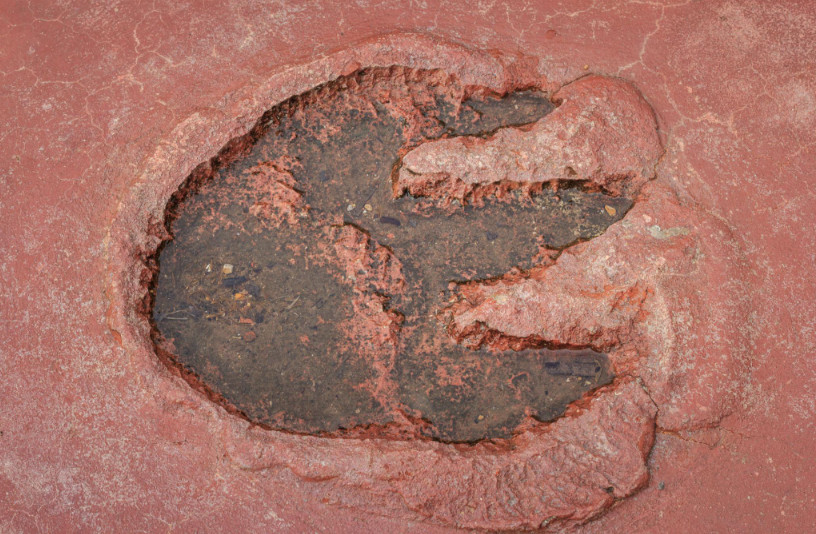
- A machine-learning model can analyze shape and motion patterns in fossil footprints to suggest the most likely trackmaker.
- The approach could improve identification accuracy, though it depends on quality data and raises questions about AI limitations.
What Happened
Scientists have created a new AI-based method that helps identify which dinosaur species produced specific fossilized footprints, according to a study published in the journal Scientific Reports. The technique uses a combination of machine learning and biomechanical modelling to compare footprint shapes and footprints’ inferred motion patterns with known anatomical and locomotion traits of different dinosaurs.
Traditionally, paleontologists have relied on manual comparison of track morphology—an approach that can be subjective and limited by preservation quality. The AI model, trained on thousands of footprint measurements and skeletal data, evaluates subtle variations in footprint geometry that might correspond to size, gait, and foot anatomy. In initial tests, the system has shown promise in matching tracks with known fossilized foot bones from specific dinosaur groups.
The study’s authors emphasize that the AI method does not replace traditional paleontological expertise but serves as a tool to enhance interpretation, particularly in ambiguous cases where footprints could belong to multiple similar species. They also note that the model’s accuracy depends heavily on the quality and completeness of input data, which remains variable across the fossil record.
Also Read: https://btw.media/it-infrastructure/nebius-enters-uk-market-with-nvidia-backed-ai-infrastructure/
Why It’s Important
The development represents a novel intersection of artificial intelligence and paleontology, extending data science into Earth’s deep history. By refining the ability to associate footprints with specific trackmakers, researchers can build more accurate reconstructions of dinosaur behavior, ecology, and movement patterns. Understanding which species made particular tracks can inform studies of herd dynamics, predator-prey interactions, and habitat use during the Mesozoic era—insights that were previously speculative when direct body fossils are absent.
Yet the method has limitations. Because machine learning models are only as good as their training datasets, gaps in dinosaur skeletal records could bias results or overfit to well-represented groups. AI pattern recognition also risks “false confidence” in cases where footprints were distorted by erosion, sediment compression, or post-depositional deformation, factors that paleontologists have long grappled with.
Additionally, the approach raises broader questions about the role of AI in scientific inference. While computational tools can process complex datasets quickly, their outputs require careful verification. Critics caution that an over-reliance on algorithmic suggestions might dilute the domain knowledge that has guided decades of field-based paleontological research.
In sum, the AI technique offers a promising supplemental tool for track analysis, but its utility will hinge on ongoing refinement, expanded datasets, and integration with established scientific methods.
Also Read: https://btw.media/all/it-infrastructure/globalconnect-invests-in-ai-technology/
