
Close Menu
  • Home
  • Leadership Alliance
  • Exclusives
  • History of the Internet
  • AFRINIC News
  • Internet Governance
    • Regulations
    • Governance Bodies
    • Emerging Tech
  • Others
    • IT Infrastructure
      • Networking
      • Cloud
      • Data Centres
    • Company Stories
      • Profile
      • Startups
      • Tech Titans
      • Partner Content
    • Fintech
      • Blockchain
      • Payments
      • Regulations
    • Tech Trends
      • AI
      • AR / VR
      • IoT
    • Video / Podcast
  • Country News
    • Africa
    • Asia Pacific
    • North America
    • Lat Am/Caribbean
    • Europe/Middle East
Facebook LinkedIn YouTube Instagram X (Twitter)
Blue Tech Wave Media
Facebook LinkedIn YouTube Instagram X (Twitter)
  • Home
  • Leadership Alliance
  • Exclusives
  • History of the Internet
  • AFRINIC News
  • Internet Governance
    • Regulation
    • Governance Bodies
    • Emerging Tech
  • Others
    • IT Infrastructure
      • Networking
      • Cloud
      • Data Centres
    • Company Stories
      • Profiles
      • Startups
      • Tech Titans
      • Partner Content
    • Fintech
      • Blockchain
      • Payments
      • Regulation
    • Tech Trends
      • AI
      • AR/VR
      • IoT
    • Video / Podcast
  • Africa
  • Asia-Pacific
  • North America
  • Lat Am/Caribbean
  • Europe/Middle East
Blue Tech Wave Media
Home » SoftBank 5G HAPS test connects smartphones from sky
5G-SoftBank-HAPS
5G-SoftBank-HAPS
IT Infrastructure

SoftBank 5G HAPS test connects smartphones from sky

By Jessie ChenSeptember 23, 2025No Comments2 Mins Read
Share
Facebook Twitter LinkedIn Pinterest Email

• SoftBank’s trial used a 3,000-metre aircraft to deliver 5G to standard smartphones

• The technology relies on High-Altitude Platform Stations (HAPS), not satellites


What happened:The trial setup

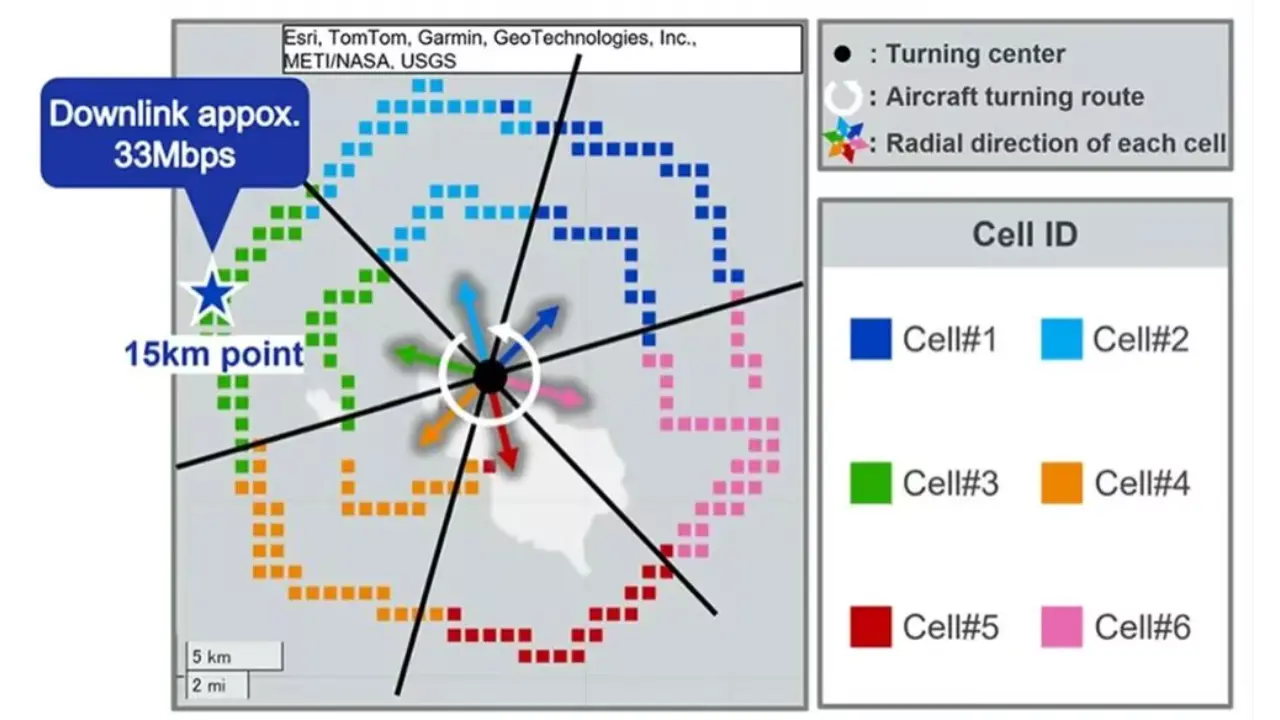
SoftBank has successfully demonstrated 5G connectivity to everyday smartphones using an airborne base station circling above Japan’s Hachijō Island. The June field trial employed a light aircraft flying at 3,000 metres to simulate a High-Altitude Platform Station (HAPS). Signals were transmitted via a 26 GHz feeder link from the ground and a 1.7 GHz service link to devices, a band already supported by most 5G handsets worldwide (Tom’s Hardware).

Unlike satellite-based “direct-to-device” systems, HAPS platforms hover in the stratosphere around 20 km up, reducing latency and avoiding Doppler and power challenges common in Low Earth Orbit. The aircraft-mounted array created six fixed ground cells, dynamically adjusting coverage as the plane circled. SoftBank also validated Doppler correction, adaptive beam tracking and automatic power control—core requirements for future commercial deployment. The International Telecommunication Union (ITU) recently approved spectrum allocations for HAPS at WRC-23, allowing operators to use terrestrial mobile bands such as 700 MHz, 850 MHz, 1.7 GHz and 2.5 GHz .

Also Read: Synapxe: Powering Singapore’s public healthcare transformation
Also Read: 
BBIX Singapore: Building Asia’s interconnection future

Why it’s important

The trial signals a potential breakthrough for delivering 5G in places where traditional cell towers are impractical. Rural communities, disaster zones and offshore regions could all benefit from stratospheric connectivity. SoftBank’s approach also offers spectrum reuse advantages over Low Earth Orbit (LEO) constellations, which face higher path loss and orbital drift issues.

Industry observers note that HAPS could complement—not compete with—initiatives like AST SpaceMobile’s LEO-based 5G trials. By providing coverage from nearer the Earth’s surface, SoftBank’s technology may deliver lower-latency services at scale. Although no commercial rollout timeline has been confirmed, the test underscores Japan’s growing role in pioneering non-terrestrial 5G. As Professor Rahim Tafazolli, head of the 5G Innovation Centre at the University of Surrey, has argued in related research, non-terrestrial networks are critical to achieving true global coverage. For now, SoftBank’s experiment offers a glimpse of how everyday smartphones could one day stay connected far beyond the reach of traditional networks.

5G HAPS connectivity SoftBank
Jessie Chen

Jessie is a community engagement specialist at BTW Media, having studied Integrated Marketing Communication at the Universiti Sains Malaysia. Contact her at jessie.chen@btw.media.

Related Posts

Could Smart Africa’s CAIGA lead to centralised internet control in Africa?

December 3, 2025

AT&T ditches DEI: Telecom giant ends diversity, equity and inclusion programmes to win regulatory approval

December 3, 2025

Poste Italiane set to acquire Vivendi’s remaining TIM stake for €200m

December 3, 2025
Add A Comment
Leave A Reply Cancel Reply

CATEGORIES
Archives
  • December 2025
  • November 2025
  • October 2025
  • September 2025
  • August 2025
  • July 2025
  • June 2025
  • May 2025
  • April 2025
  • March 2025
  • February 2025
  • January 2025
  • December 2024
  • November 2024
  • October 2024
  • September 2024
  • August 2024
  • July 2024
  • June 2024
  • May 2024
  • April 2024
  • March 2024
  • February 2024
  • January 2024
  • December 2023
  • November 2023
  • October 2023
  • September 2023
  • August 2023
  • July 2023

Blue Tech Wave (BTW.Media) is a future-facing tech media brand delivering sharp insights, trendspotting, and bold storytelling across digital, social, and video. We translate complexity into clarity—so you’re always ahead of the curve.

BTW
  • About BTW
  • Contact Us
  • Join Our Team
  • About AFRINIC
  • History of the Internet
TERMS
  • Privacy Policy
  • Cookie Policy
  • Terms of Use
Facebook X (Twitter) Instagram YouTube LinkedIn
BTW.MEDIA is proudly owned by LARUS Ltd.

Type above and press Enter to search. Press Esc to cancel.