
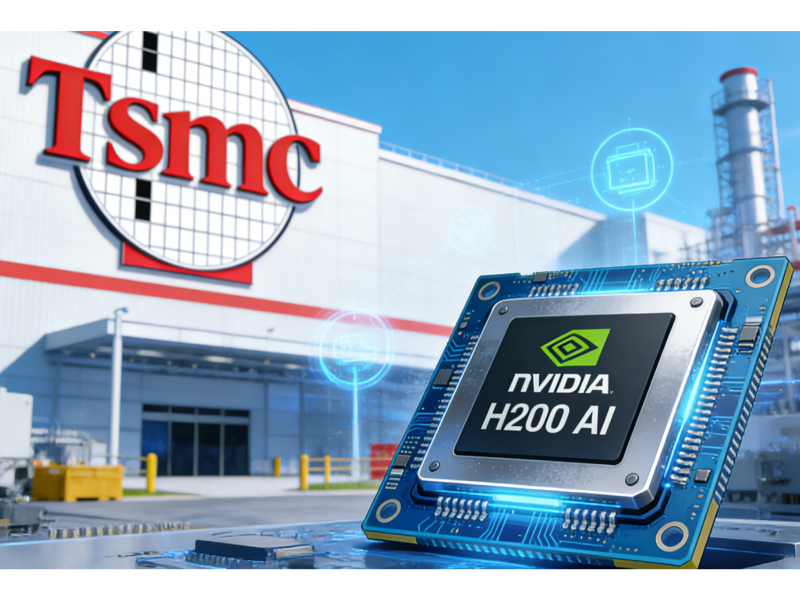
• Nvidia has approached Taiwan Semiconductor Manufacturing Company (TSMC) to increase production of its H200 artificial intelligence chips amid orders exceeding current stock levels for 2026.
• The situation raises questions about global AI chip supply balance and regulatory uncertainty over Chinese approval of H200 imports.
What happened: Nvidia boosts chip output plan
Nvidia is scrambling to meet unexpectedly strong demand for its H200 artificial intelligence processors by reaching out to its main manufacturing partner, Taiwan Semiconductor Manufacturing Company, known as TSMC, to expand production capacity.
Chinese technology companies have reportedly placed orders for more than two million H200 units for delivery in 2026, far exceeding Nvidia’s current inventory of roughly 700,000 chips. To fulfil this demand, Nvidia has asked TSMC to begin producing additional H200 chips, with work expected to start in the second quarter of 2026.
The H200 chips, part of Nvidia’s prior-generation Hopper architecture and built on TSMC’s 4-nanometre process, are seen as a performance upgrade over the earlier H20 chips, which were tailored for specific markets and later blocked from shipment into China under previous export restrictions.
Nvidia plans to fulfil initial orders from existing stock with the first shipments expected to arrive before the Lunar New Year holiday in mid-February, according to Reuters reporting.
Sources said Nvidia has indicated to Chinese customers that it will supply both H200 chips and GH200 Grace Hopper superchips, which combine Nvidia’s Grace CPU with the Hopper GPU architecture, but that final production volumes and pricing arrangements remain subject to negotiation.
The company has priced the chips at around $27,000 per unit, with eight-chip modules costing about 1.5 million yuan, slightly above the cost of the now-unavailable H20 modules. Chinese internet firms reportedly view this pricing favourably, in part because the H200 offers roughly six times the performance of the older H20 design.
Even as Nvidia negotiates with TSMC to increase production, regulatory uncertainty persists: Beijing has not yet approved H200 imports, despite the U.S. administration’s relatively recent decision to allow exports of the chip to authorised Chinese buyers.
Also Read: Nvidia completes $5 billion stake acquisition in Intel
Also Read: Nvidia moves to acquire AI chip startup groq for $20B in asset deal
Why it’s important
Nvidia’s move to ask TSMC for additional H200 chip production highlights the ongoing tension between surging global demand for large-scale AI hardware and finite manufacturing capacity. Powerful AI processors like the H200 are critical for training and running advanced models, but they depend on sophisticated fabrication at leading foundries such as TSMC, which also serves many other major technology firms.
The scale of Chinese orders suggests that the world’s second-largest economy is seeking to accelerate its access to high-performance AI infrastructure. However, the lack of formal approval from Chinese regulators creates ambiguity about when and whether these chips can be widely deployed in mainland data centres. This regulatory uncertainty could delay shipments and alter Nvidia’s supply chain planning, particularly if Beijing imposes conditions that tie foreign chip purchases to domestic semiconductor development goals.
The situation also raises questions about how Nvidia balances its commitments across global markets. Supplying large volumes of H200 chips to China might strain availability in other regions, and observers have already expressed concerns that strong demand there could tighten worldwide AI chip supplies. Nvidia has said in response to media queries that licensed sales to authorised customers in China will not impact its ability to supply customers in the United States, but geopolitical tensions and shifting export policies could complicate these assurances.
There are broader implications for the semiconductor industry. Foundries such as TSMC must manage production schedules across multiple advanced chip lines, including Nvidia’s newer Blackwell and upcoming Rubin architectures, which compete for limited fabrication and packaging capacity. If H200 production is prioritised to meet Chinese demand, it could delay or constrain output of those next-generation products, potentially affecting global AI deployments and enterprise planning.
For Chinese technology firms, access to H200 chips could provide significant performance advantages in AI research and commercial applications. Yet reliance on foreign silicon also exposes them to regulatory and supply chain risks. Meanwhile, Nvidia’s strategy of scaling up production through TSMC underscores the interconnected nature of geopolitical, commercial and technological pressures shaping the AI hardware landscape.
