
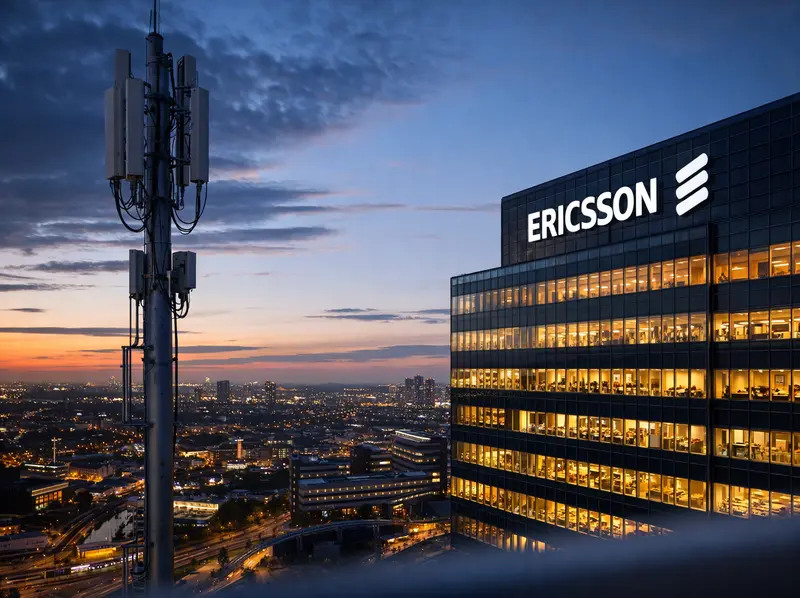
- Ericsson reported a stronger-than-expected finish to 2025, led by its core networks division
- Cost control and regional demand helped offset slower growth in enterprise and cloud segments
What happened: Stability after turbulence
Ericsson said it had delivered a “solid conclusion” to its 2025 financial year, marking a period of relative stability after several quarters of uneven performance. According to Telecoms.com, the improvement was driven primarily by its mobile networks business, which benefited from steadier operator spending in key markets.
Ericsson, founded in Sweden in 1876 and now one of the world’s largest telecoms equipment vendors, has spent much of the past two years navigating volatile 5G investment cycles. After a slowdown in operator capex during 2023 and early 2024, demand appeared to level out in parts of North America and Europe towards the end of 2025.
The company pointed to disciplined cost management and operational focus as factors supporting its end-of-year performance. While Ericsson did not frame the result as a return to growth, it emphasised resilience in its core radio access and mobile core portfolio.
Not all areas moved in the same direction. Enterprise wireless and cloud-adjacent activities continued to lag behind expectations, reflecting slower uptake of private networks and broader caution among corporate customers. That divergence echoes challenges faced by rivals such as Nokia, as vendors attempt to diversify beyond traditional operator sales.
Also Read: Orange and Ericsson launch 5G slice for emergencies
Also Read: Ericsson job cuts spotlight tech sector turbulence
Why it’s important
Ericsson’s tone matters as much as its numbers. After a prolonged period of warnings about market contraction, a message of stability suggests the worst of the 5G spending correction may be over, at least in mature markets. For investors, predictability can be as valuable as growth, particularly in capital-intensive industries.
From a strategic perspective, the update reinforces how dependent Ericsson remains on mobile networks, despite years of messaging around enterprise expansion. According to Ericsson’s own industry forecasts, global mobile data traffic continues to rise sharply, but monetisation remains uneven, limiting operators’ willingness to invest aggressively.
There is also a regional dimension. Europe’s network vendors have faced growing competition from Asian suppliers and political scrutiny over supply chains. A steadier financial footing gives Ericsson more room to invest selectively in 5G evolution and early 6G research, rather than focusing solely on defensive restructuring.
Financially, the result suggests margins may be stabilising, even if top-line growth remains elusive. In a cautious market, that balance could prove enough to keep Ericsson competitive while it waits for the next technology-driven investment cycle to emerge.
