
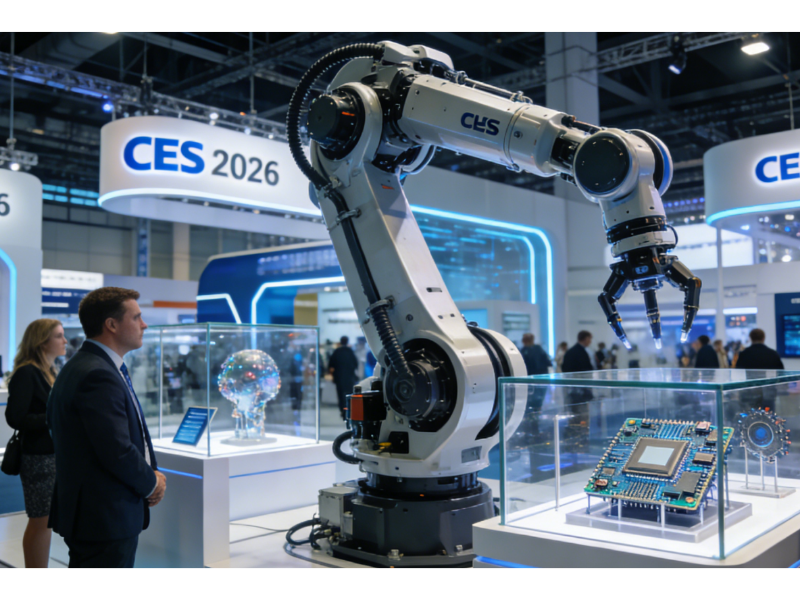
• Major technology companies highlighted new AI-enabled industrial robotics platforms at the CES 2026 tech show in Las Vegas, emphasising applications beyond the lab.
• The focus on “physical AI” and autonomous robotic systems raises questions about real-world deployment challenges and economic value outside demonstration environments.
What happened: robotics on show
The first day of CES 2026, held in Las Vegas, saw significant industry attention on industrial robotics, particularly where artificial intelligence is being paired with automation to tackle real-world tasks. According to reporting by Telecoms, a number of major vendors used the event to outline new tools, frameworks and collaborations aimed at accelerating the development of autonomous machines and robots that can operate outside controlled laboratory settings.
Among the announcements was Nvidia’s launch of open models and systems described as enabling “physical AI”. These include Nvidia Cosmos Transfer 2.5 and Nvidia Cosmos Predict 2.5, designed to help generate robot simulation data and support reasoning in simulated environments for AI-powered robots and autonomous machines. Nvidia also introduced Cosmos Reason 2 and Isaac GR00T N1.6, its latest vision language models intended for humanoid robotics applications.
Chipmaker Qualcomm revealed the Dragonwing IQ10 Series, a robotics-oriented processor architecture that integrates hardware, software and artificial intelligence functions. The company described this as a step toward moving advanced autonomous systems from research prototypes into industrial and commercial environments.
On the robot-making side, Boston Dynamics — now part of Hyundai Motor Group’s broader robotics strategy — showcased its humanoid robot Atlas. According to reporting, this version of Atlas can perform a variety of industrial tasks and has capabilities such as autonomous battery recharge and task replication across a fleet of machines.
Other organisations also demonstrated innovations that reflect the intersection of digital and physical AI. Collaborations between Universal Robots with Robotiq and Siemens featured next-generation palletising systems that combine robotic arms and real-time digital twin simulations to optimise handling and automation tasks.
The emphasis at CES was unmistakably toward building systems that promise to handle dynamic industrial environments with less direct human control, reflecting growing industry investment in applied robotics and automation.
Why it’s important
The developments at CES highlight a shift in the robotics industry towards what is being termed “physical AI” — the application of artificial intelligence in machines that sense, plan, and act in the physical world. In principle, such systems could transform manufacturing, logistics and other sectors by automating complex tasks and complementing human labour.
However, questions remain about how soon these technologies will deliver measurable operational impact outside controlled demonstrations. Many of the models and processors unveiled are tools and frameworks that require significant integration, testing and certification before widespread deployment. The gap between demonstration stage — bright lights on a show floor — and reliability in an industrial setting can be large, especially when safety, interoperability and cost are considered.
There is also debate about the economic value of ambitious robotics strategies. High-performance robotics platforms often come with high development and deployment costs, and organisations must decide whether increased automation yields net gains over labour costs, particularly in regions where both are in flux. Efficiency gains touted on exhibition stages do not always translate into competitive advantage in global markets.
The collaboration between hardware makers, AI developers and traditional industrial players reflects another challenge: aligning digital innovation with established manufacturing processes and supply chains. Success will depend on how well these players can integrate advanced AI models with physical machines that operate safely and effectively in real-world conditions.
In this context, CES serves as a bellwether of industry direction, but it also highlights the distance between technological potential and everyday industrial adoption. Stakeholders will be watching implementation and commercial uptake closely in the coming months and years.
Also Read: Power outage in San Francisco sparks fresh questions over robotaxi reliability
Also Read: NVIDIA rolls out new Omniverse tools for robotics
