
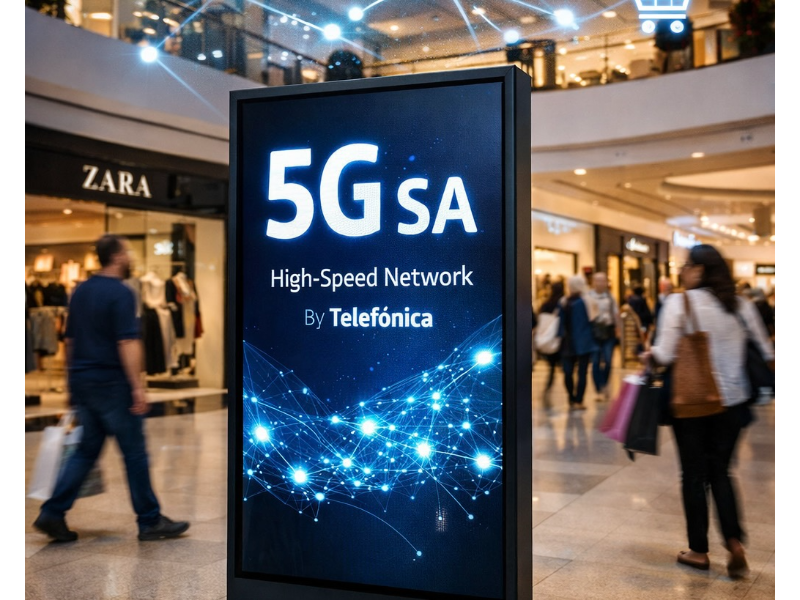
- Telefónica and Vantage Towers deploy indoor 5G Standalone using a distributed antenna system in Madrid’s Plaza Norte 2 mall.
- The rollout aims to improve connectivity in crowded indoor venues and support future digital retail services.
What happened: Telefónica launches Spain’s first indoor 5G SA mall network
Telefónica has introduced 5G Standalone (SA) coverage inside the Plaza Norte 2 shopping centre in northern Madrid, marking the first indoor commercial deployment of the technology in a Spanish mall. The network was built with infrastructure provider Vantage Towers, which installed a distributed antenna system (DAS) to deliver coverage across the complex.
The project aims to ensure strong mobile connectivity in crowded indoor environments where network congestion often affects performance. Shopping centres attract heavy footprints, making them frequent pressure points for mobile networks.
According to Telefónica Spain, the rollout should provide visitors and retailers with faster browsing speeds, lower latency and more stable connections. The companies say the network could enable services such as seamless streaming, instant mobile payments and interactive digital applications.
While advanced features like augmented reality or network-sliced services are possible with 5G SA, there is currently no confirmation that these capabilities will be launched at the shopping centre immediately.
Also read: Telefónica chief warns Europe on cyber autonomy at Davos
Also read: Telefónica cuts debt with Colombia sale
Why this is important
The Madrid deployment highlights a gradual shift from basic 5G coverage to fully standalone networks that support next-generation services. Unlike early 5G rollouts that relied on 4G cores, 5G SA operates on a dedicated architecture, enabling lower latency and more reliable connections.
Indoor deployments are particularly significant. Large venues such as malls, stadiums and transport hubs often suffer from signal congestion because thousands of devices compete for capacity. Distributed antenna systems help operators extend coverage indoors and maintain consistent performance in high-density spaces.
The move also reflects broader momentum behind 5G SA. Industry group GSA reported that 181 operators in 73 countries had invested in public standalone networks by late 2025, accounting for nearly 28% of operators deploying 5G.
For Telefónica, the project builds on its wider push to expand standalone 5G across Spain after launching the service commercially in 2023. The operator’s SA network can deliver speeds of up to around 1.6 Gbps and significantly lower latency than earlier 5G deployments.
Although many operators still use 5G SA primarily to improve signal quality, indoor projects like this could eventually support new retail experiences, from immersive shopping apps to connected logistics systems. As standalone networks mature, venues with dense connectivity needs may become early proving grounds for these services.Telefónica launches Spain’s first indoor 5G Standalone network in a Madrid shopping centre, highlighting the growing role of dense-venue connectivity.
