
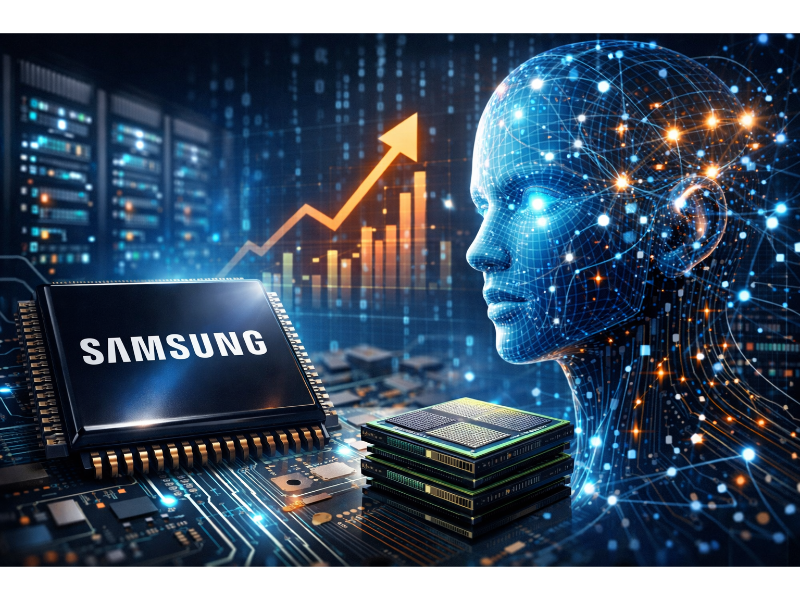
- AI-driven memory demand lifts Samsung’s outlook for strong earnings recovery
- Company signals continued investment amid global semiconductor competition
What happened
Samsung Electronics has pointed to artificial intelligence as a key driver behind its improving financial outlook, signalling a strong recovery in its semiconductor division. The company expects demand for high-performance memory chips, particularly those used in AI systems, to remain robust throughout the year.
Recent guidance suggests earnings are rebounding after a prolonged downturn in the global chip market. Demand for high-bandwidth memory (HBM), which is critical for AI workloads, has accelerated sharply. Samsung is expanding production capacity to meet this surge.
The company also indicated that server demand linked to AI infrastructure continues to outpace traditional consumer electronics segments. While smartphone and PC markets remain subdued, AI-related orders are helping offset weakness elsewhere.
Also read: Samsung Galaxy S26 leans heavily on AI and custom Qualcomm chip
Also read: Samsung Says 6G May Avoid Costly ‘Rip-and-Replace’ Upgrades
Why this is important
Samsung’s outlook reflects broader industry trends, as reported by Yahoo Finance, where artificial intelligence demand continues to drive chip market recovery. This marks a shift in how semiconductor growth is generated.
Memory chips were once closely tied to cyclical consumer demand. Now, they are increasingly linked to data centres and AI systems. This transition benefits companies that can deliver advanced memory such as high-bandwidth solutions.
Samsung faces strong competition from rivals including SK hynix and Micron, both expanding AI-focussed output. The race to dominate AI memory is accelerating as global technology firms invest heavily in infrastructure.
The trend also reshapes supply chains. Demand is concentrating on specialised components rather than general-purpose chips. This could stabilise revenues for leading manufacturers even during consumer downturns.
For readers, the implications extend beyond the chip sector. Sustained AI investment signals growth in cloud computing, automation, and digital services. These shifts are likely to influence business spending and the pace of innovation across industries.
