
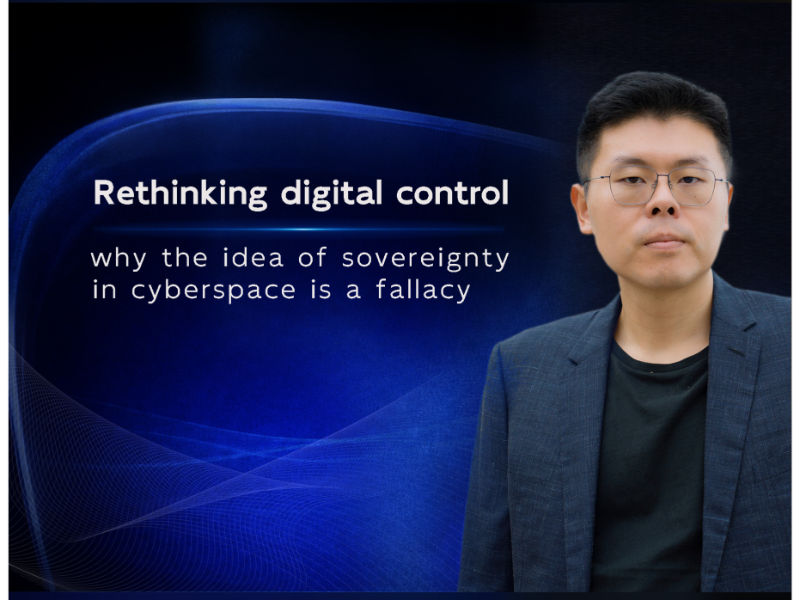
- The concept of digital sovereignty, as often invoked by states and regional blocs, is fundamentally flawed because cyberspace lacks enforceable authority and unified jurisdiction.
- Misunderstanding digital sovereignty can deepen governance conflicts over infrastructure such as IP resources and regional Internet registries.
“Sovereignty is not a feeling, a slogan, or a narrative. It is a structural property. Where enforcement and final authority do not exist, sovereignty does not exist. Everything else is branding.”
——Lu Heng, CEO at Cloud Innovation, CEO at LARUS Ltd, Founder of LARUS Foundation.
Lu Heng challenges digital sovereignty narratives
In a recent essay titled On The Sovereignty Fallacy, technology policy expert Lu Heng argued that commonly used notions of digital sovereignty are deeply misleading. Heng, CEO of LARUS Limited and founder of the LARUS Foundation, draws on direct experience with core internet governance institutions to suggest that sovereignty is not an abstract narrative of power or control but a structural property that emerges only where enforcement and final authority exist. He asserts that much of what is labelled digital sovereignty is in fact an illusion — a branding exercise that obscures deeper governance problems. The essay was published on 31 December 2025 on Heng’s personal blog, where he examines structural misunderstandings about how internet infrastructure is governed.
One of his central claims is that collective entities such as “African digital sovereignty” do not constitute sovereign authority because they lack unified jurisdiction, shared enforcement mechanisms, or a final decision-maker. According to Heng, attempts to treat centralised systems — such as the way internet number resources are managed by Regional Internet Registries (RIRs) — as political authority points miss a fundamental point about how the internet operates. Decisions at registries, he argues, are coordination records that exist only because network participants voluntarily recognise them; they are not commands enforced by sovereign power.
Heng warns that framing registry authority as political control turns cooperative systems into battlegrounds for litigation, sanctions and paralysis because it invites competing assertions of power that the internet’s architecture cannot support. His suggested alternative is to decouple the registration layer from political gravity altogether, potentially through fully distributed systems that align more closely with how internet cooperation has historically functioned.
Also Read: Why IPv4 scarcity highlights wealth, value and capital in the digital era
Also Read: Why IPv4 could be worth $60 trillion: Evaluating the debate over digital asset value
The governance implications of the sovereignty fallacy
The debate over digital sovereignty has broader implications for global governance, technology policy and geopolitical competition. As states increasingly seek to assert control over data flows, digital infrastructure and platform governance, the notion of sovereignty in cyberspace has become a rallying point for policy initiatives in many jurisdictions — including the European Union’s push for “digital sovereignty” in areas like cloud computing, artificial intelligence and data protection.
Yet academic research cautions that applying traditional territorial concepts to cyberspace creates paradoxes. Critics have noted that territorial sovereignty is tied to physical geography and legal jurisdiction, whereas the internet’s architecture is designed for global interoperability and non-territorial connectivity. Attempts to align the two may increase “friction” in cross-border connections, complicating business models without necessarily delivering the promised political control.
Another academic perspective highlights that claims to digital sovereignty often emphasise control over data, infrastructure and regulatory prerogatives without acknowledging that multiple actors — states, corporations, technical bodies and civil society — exercise overlapping influence in cyberspace. This networked reality means that no single entity holds exclusive authority, complicating efforts to impose comprehensive sovereign control.
Heng’s critique intersects with these broader debates by questioning the assumptions behind many national or regional strategies for digital autonomy. If digital sovereignty is mistakenly treated as a matter of asserting political control over technology, policymakers may overlook the cooperative and distributed mechanisms that make the internet function. That could lead to governance models that are ill-fitted to the digital domain, increase fragmentation, and hamper both innovation and international cooperation.
Moreover, the sovereignty fallacy emphasises the difference between symbolic rhetoric and structural reality. Policies framed around taking back control or asserting digital independence may attract political support, but without addressing the underlying governance structures they risk perpetuating misconceptions about power and control in cyberspace. This misalignment can have practical consequences for issues ranging from cross-border data flows and infrastructure security to competition and civil liberties.
