
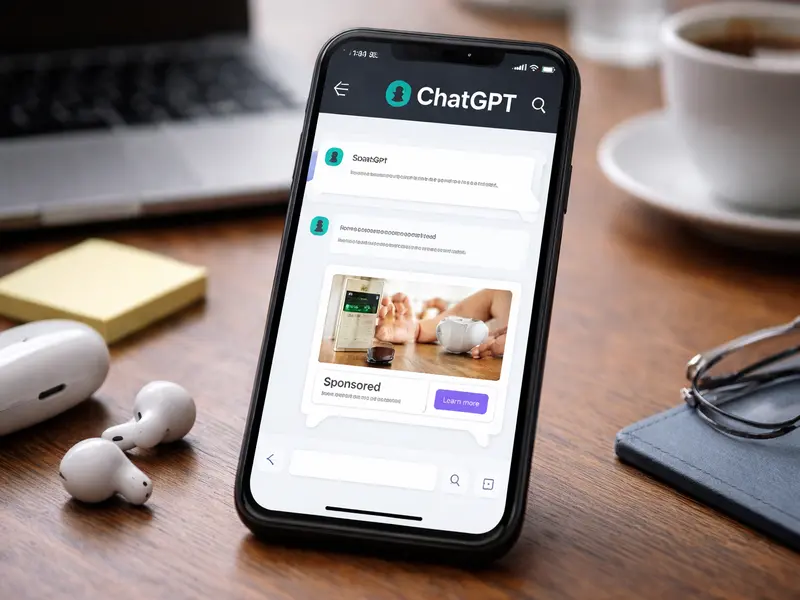
- OpenAI will start trialling advertisements in ChatGPT’s free and Go plans for some US users, part of efforts to boost revenue amid rising AI infrastructure costs.
- Ads will remain separate from ChatGPT’s responses and won’t be shown to paid-tier subscribers or in sensitive contexts such as health or politics.
What happened: Ads arrive in ChatGPT tests
OpenAI announced on 16 January 2026 that it will begin testing advertisements in its generative AI chatbot, ChatGPT, initially for users in the United States on the free and newly expanded ChatGPT Go subscription plans.
The ads are scheduled to appear in the coming weeks and will be displayed in clearly labelled slots separate from the bot’s main replies, meaning they will not affect the chatbot’s outputs or how it responds to users. OpenAI has emphasised that users’ conversation data will not be shared with advertisers as part of this rollout.
Under the company’s plan, users on premium tiers — including Plus, Pro, Business and Enterprise — will remain ad-free. Ads will also be withheld from accounts belonging to people under 18, and will not appear in discussions involving sensitive domains such as health, politics or mental health.
Under the company’s plan, users on premium tiers — including Plus, Pro, Business and Enterprise — will remain ad-free, while advertising will be limited to the free tier and the lower-priced ChatGPT Go plan. Go, which costs about $8 a month in the US, offers higher usage limits and access to newer models than the free service, positioning it as a mid-tier product for more active users. The structure reflects OpenAI’s effort to broaden its revenue base at a time when computing costs are rising sharply, allowing the company to monetise its large non-paying audience without diluting the premium subscription experience.
Also Read: OpenAI bets big on custom compute with Cerebras partnership
Also Read: SoftBank and OpenAI commit $1B to AI infrastructure expansion
Why it’s important
This move reflects OpenAI’s broader effort to diversify its revenue model beyond subscriptions, as it faces the immense costs of developing and running large-scale AI systems and prepares for a potential initial public offering in the years ahead. Analysts note that advertising could unlock significant income from ChatGPT’s vast user base, which is estimated at hundreds of millions of weekly active users, the majority of whom use free or lower-cost plans.
However, some technology observers caution that poorly executed advertising might erode user trust, prompting users to explore rival chatbots such as Google’s Gemini or Anthropic’s Claude.
By keeping ads distinct from chatbot answers and excluding them from sensitive topics, OpenAI is attempting to balance monetisation with user experience and trust — an ongoing tension in the AI industry as companies seek sustainable business models without compromising perceived neutrality.
