
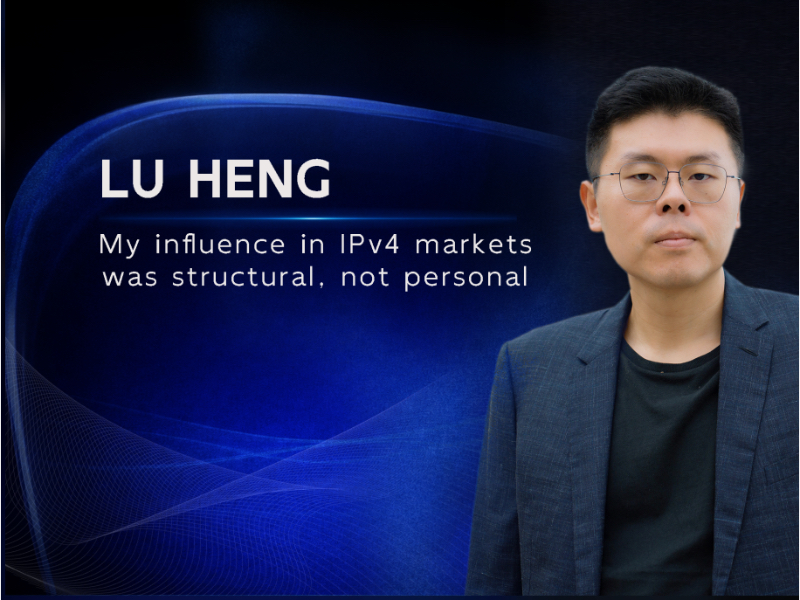
- Lu Heng frames his prominence in IPv4 markets as the outcome of structural scarcity and market forces, not individual ambition.
- The transition highlights the irreversible need for decentralised governance of critical Internet resources.
“For the past few years, I have been placed at the center of global attention in Internet governance and the IPv4 market. Media, communities, institutions, and governments — from national leaders to global press — have tried to turn this into a story about a villain.”
——Lu Heng, CEO at Cloud Innovation, CEO at LARUS Ltd, Founder of LARUS Foundation.
IPv4 scarcity drives inevitable market dynamics
Lu Heng, CEO of LARUS Limited and founder of the LARUS Foundation, has reflected on his central role in the global IPv4 market, emphasising that his prominence was historically inevitable rather than personally engineered. In a detailed post, he explained that the depletion of IPv4 addresses created scarcity, which in turn generated value and naturally formed markets.
According to Heng, institutions tasked with managing IP addresses—previously neutral registries—became gatekeepers to this valuable digital capital. He asserts that responses to this structural change, including legal enforcement and institutional resistance, were driven by system-wide incentives rather than individual actions.
Heng critiques narratives framing the situation as a personality conflict, noting that it obscures the deeper systemic transitions at play. The governance model that worked when the Internet was a small, trust-based network could not scale to manage a global utility with scarce resources. In his view, IPv4 addresses are productive capital—the “land layer” of the digital economy—and markets, contracts, and credit naturally emerge to allocate them.
Also Read: IPv4 as an investment asset: upper potential
Also Read: How much do regional internet registries really cost and who pays?
Decentralisation becomes mandatory
The post underscores that as critical Internet resources grow in value and scarcity, decentralisation is no longer optional. Heng argues that centralised registries reliant on universal trust or goodwill are inherently fragile, exposed to geopolitical pressures, litigation, and regulatory capture.
He notes that this structural reality ensures that governance must professionalise and decentralise to remain functional. Parallel systems, leasing platforms, and enforceable rights arise to bypass bottlenecks, illustrating that market-driven solutions can emerge even amid institutional inertia.
The implications extend beyond individual actors. Heng highlights that the Internet cannot depend on any single jurisdiction, institution, or actor to maintain stability. The historical convergence he describes suggests that global coordination failures naturally produce decentralised, resilient systems rather than collapses.
While Heng frames his experience in terms of inevitability, observers may question whether current governance mechanisms are adequate to balance market efficiency with equitable access and regulatory oversight. The evolution of IPv4 markets reflects broader tensions between private capital, public utility, and global governance in critical digital infrastructure.
Heng’s perspective provides insight into why conflicts over IP allocation are less about individuals and more about structural pressures that shape the modern Internet, pointing to an irreversible shift toward decentralised management of essential resources.
