
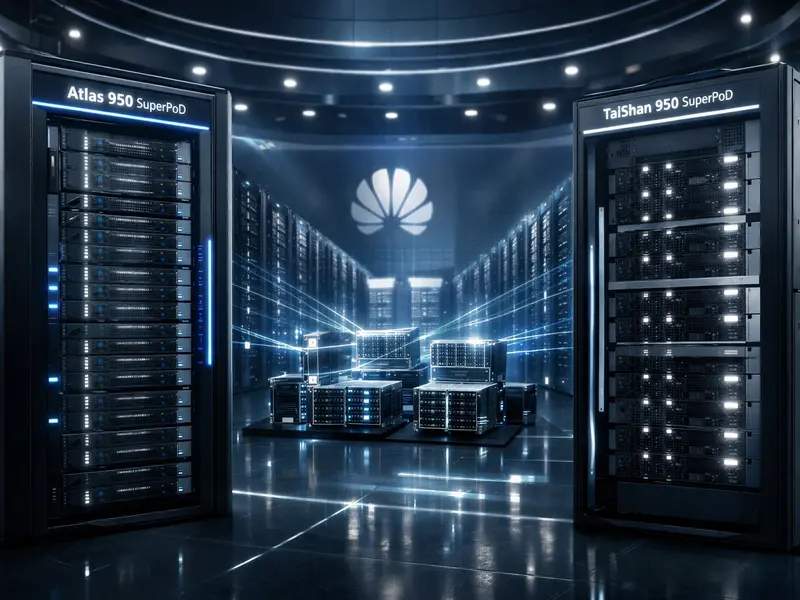
- Huawei launches SuperPoD portfolio at MWC Barcelona 2026 targeting hyperscale AI demand
- New architecture positions the company as an alternative supplier in the accelerating global data centre upgrade cycle
What happened: Scaling compute for AI
At Mobile World Congress in Barcelona in late February 2026, Huawei unveiled a new portfolio of SuperPoD computing systems designed to support rapidly expanding artificial intelligence workloads, according to the company’s announcement at MWC Barcelona 2026.
The launch centres on the Atlas 950 SuperPoD and TaiShan 950 SuperPoD platforms, which Huawei says are built to provide a “resilient computing foundation” as AI models grow larger and demand higher bandwidth and lower latency. The systems rely on Huawei’s UnifiedBus interconnect, allowing clusters of up to 8,192 neural processing units to operate as a single logical computer.
According to Huawei, conventional horizontal scaling increasingly struggles with utilisation inefficiencies and training interruptions when handling trillion-parameter AI models. The SuperPoD architecture instead combines clustered computing with tightly integrated interconnection technology to improve stability across large training environments.
Alongside hardware, Huawei emphasised open ecosystem development, highlighting support for openEuler and its open-sourced CANN heterogeneous computing architecture, intended to lower barriers for developers working across AI frameworks.
The announcement comes as telecom operators, cloud providers and sovereign infrastructure programmes expand investment in national computing capacity — turning MWC into a showcase not just for networks, but for data centre infrastructure competition.
Also Read: Planzer boosts logistics efficiency with Huawei network solutions
Also Read: Huawei and the growing threat to regional technology autonomy
Why it’s important
Huawei’s SuperPoD strategy reflects a broader shift in the global cloud and data centre market: compute infrastructure itself is becoming a geopolitical and financial asset.
As AI deployment accelerates, hyperscale operators and governments are seeking alternatives to established US-centric supply chains. Huawei’s positioning of SuperPoD as a modular “new option” for global computing suggests an attempt to capture upgrade cycles now unfolding across enterprise and sovereign data centres.
From a financial perspective, infrastructure vendors capable of delivering integrated compute stacks — chips, interconnects and software ecosystems — may capture longer-term recurring investment tied to AI capacity expansion rather than traditional telecom refresh cycles.
In effect, Huawei is moving deeper into the capital-intensive layer of AI infrastructure, where competition increasingly revolves around total system efficiency rather than individual processor performance.
The result is intensifying competition over how next-generation data centres are built — and who supplies the computing backbone of the AI economy.
