
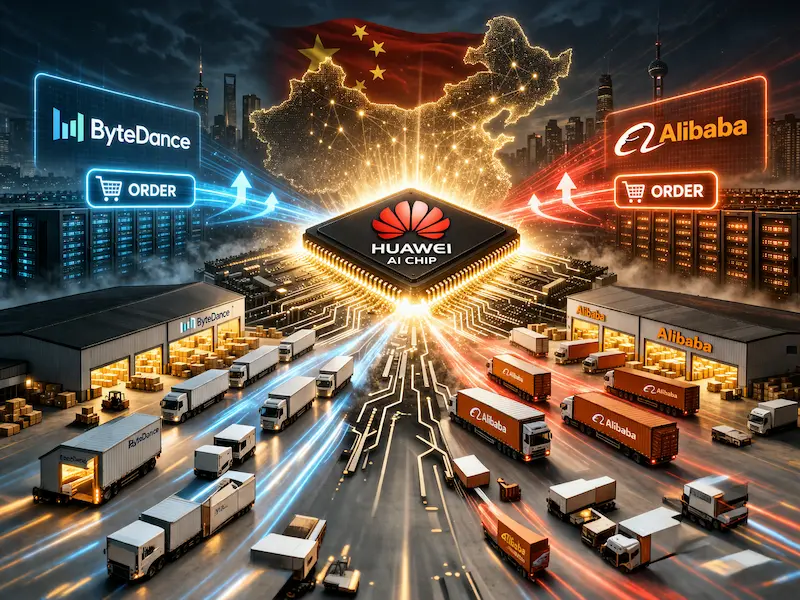
- ByteDance and Alibaba are planning to place orders for Huawei’s new AI chips, according to Reuters.
- The move reflects growing demand for domestic alternatives in advanced computing hardware.
What happened: Domestic chips draw major customers
Huawei is seeing strong interest in its latest artificial intelligence chips, with ByteDance and Alibaba Group reportedly preparing to place orders.
According to Reuters, the companies are evaluating Huawei’s processors as part of efforts to secure computing capacity for AI workloads.
Huawei has been developing its own semiconductor technology to support artificial intelligence applications, particularly in response to restrictions affecting access to foreign chip suppliers.
The report suggests that major Chinese technology firms are increasingly looking to domestic alternatives to meet growing demand for AI computing infrastructure.
ByteDance and Alibaba both operate large-scale data centres and rely heavily on computing power to support services such as content platforms, cloud computing and machine learning applications.
The potential orders indicate that Huawei’s chips are gaining acceptance among major industry players, despite competition from established global semiconductor companies.
Also Read: Huawei Cloud unveils industry AI solutions at MWC 2026
Also Read: Huawei showcases 115 AI cases and 22 solutions
Why it’s important
The development highlights a significant shift in the global semiconductor landscape.
As demand for AI computing power grows, access to advanced chips has become a critical factor in the technology industry. Restrictions on technology exports have accelerated efforts in China to develop domestic alternatives.
For companies such as Huawei, this creates an opportunity to expand their role in the AI hardware market.
For customers like ByteDance and Alibaba, securing reliable supply is essential to maintaining growth in AI-driven services.
From a financial perspective, increased adoption of domestic chips could reshape revenue flows within the semiconductor industry, potentially reducing reliance on international suppliers.
The trend also reflects broader geopolitical dynamics, where technology ecosystems are becoming more regionally segmented.
At the same time, the success of domestic chips will depend on performance, scalability and the ability to integrate with existing software and infrastructure.
Huawei’s progress therefore illustrates a wider industry shift: the race for AI leadership is increasingly tied to control over semiconductor technology.
As companies invest heavily in artificial intelligence, the balance of power in the global chip market may continue to evolve.
In this context, the emergence of alternative suppliers could have lasting implications for both competition and innovation in the AI sector.
