
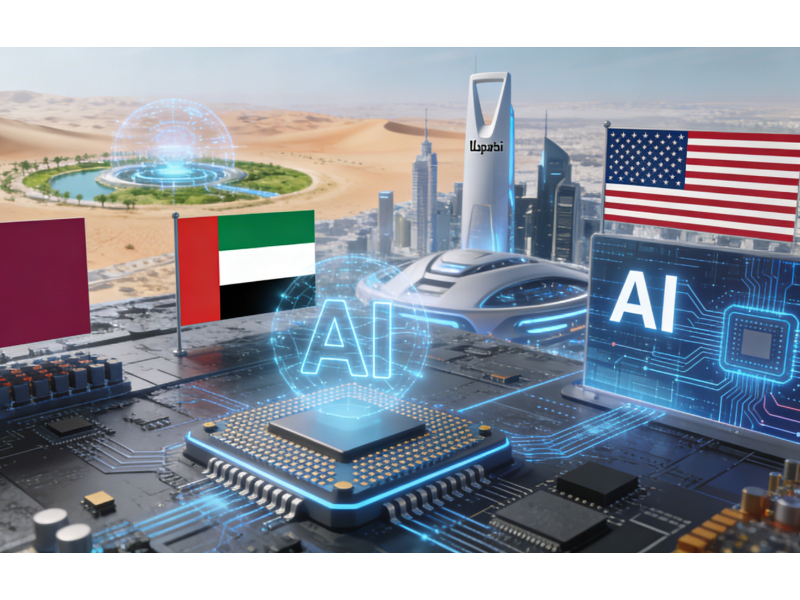
- Qatar and the United Arab Emirates are set to become new members of the U.S.-backed Pax Silica technology supply chain initiative.
- The coalition aims to strengthen AI- and semiconductor-related infrastructure and reduce dependence on strategic rivals, but analysts question its practical impact.
What happened: Gulf states sign up to U.S.-backed technology supply chain alliance
Qatar and the United Arab Emirates will formally join the United States-led Pax Silica initiative to bolster global technology supply chains covering artificial intelligence (AI), semiconductors and related infrastructure.
Undersecretary of State for Economic Affairs Jacob Helberg told Reuters that Doha is expected to sign the Pax Silica declaration on 12 January, with Abu Dhabi to join on 15 January at Saudi Arabia’s Future Minerals Forum. The group already includes nations such as Israel, Japan, South Korea, Singapore, Britain and Australia.
Rather than a traditional security pact, Pax Silica is described by U.S. officials as a “coalition of capabilities,” with membership based on each country’s industrial and technological strengths. The initiative spans critical minerals, chip production, advanced manufacturing, computing and data infrastructure — all seen as vital to secure and resilient supply chains.
The United States is also pushing forward strategic projects under the umbrella of the initiative. These include discussions on modernising trade and transport corridors such as the India-Middle East-Europe route, and a proposed industrial park in Israel called Fort Foundry One.
For Qatar and the UAE, participation marks an explicit policy shift from economies historically anchored in hydrocarbons toward technology-centric development.
Also Read: US faces political backlash over AI data centre electricity concerns
Also Read: US allows Nvidia H200 chips to be exported to China
Why it’s important
Securing supply chains for AI and semiconductors has become a central focus of U.S. economic and national security strategy, particularly amid competition with China and concerns about over-reliance on any single external source for key technologies. Bringing Gulf states like Qatar and the UAE into this framework symbolises an effort to integrate a broader range of economic partners into that strategy — spanning finance, critical minerals and compute infrastructure.
However, there are questions about how much tangible impact Pax Silica will have in practice. Analysts note that such coalitions often hinge on aligning diverse national interests, and Gulf states’ technology capabilities differ markedly from those of major semiconductor producers such as South Korea or Taiwan. Moreover, commitments to infrastructure and diversification — while politically significant — may take years to materialise into meaningful supply chain shifts.
Observers also ask whether this initiative will be resilient to broader geopolitical tensions in the Middle East and beyond, given ongoing diplomatic complexities between member states. Additionally, it remains to be seen how private sector actors will respond to or invest through this framework.
The inclusion of major Gulf financial resources — such as sovereign wealth funds — could provide capital for emerging technology projects, but that too depends on clear implementation plans and private-sector engagement.
