
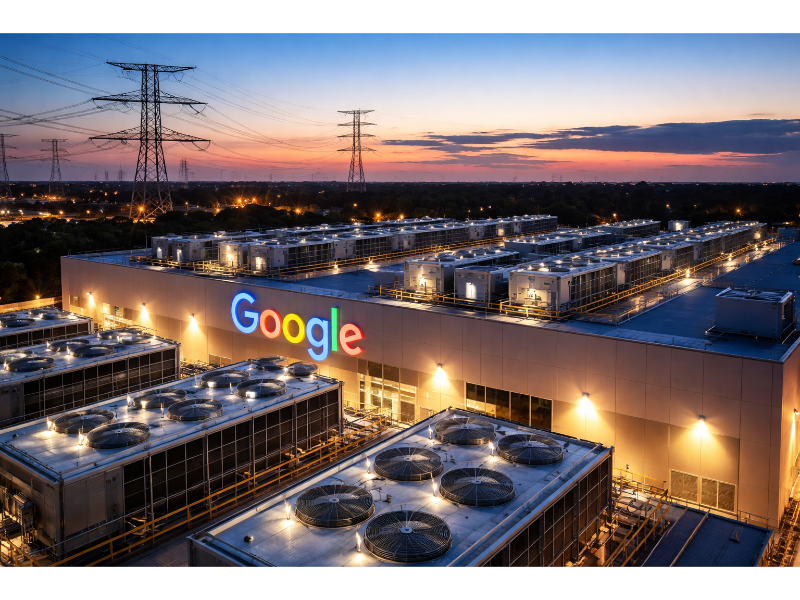
- Google signs expanded utility agreements to curb datacentre power use at peak times
- Move reflects growing pressure from AI-driven energy demand on electricity grids
What happened: Google deepens grid flexibility strategy
Google has expanded agreements with electricity providers to reduce datacentre power consumption during periods of peak demand, as detailed in this Reuters report. The initiative allows the company to temporarily scale back energy use when grids are under stress.
The programme builds on existing “demand response” arrangements, where large energy users adjust consumption in exchange for financial incentives. Google’s datacentres, which support cloud computing and artificial intelligence workloads, are among the most energy-intensive facilities globally. A single large datacentre can consume as much electricity as a small town, with AI training workloads requiring significantly more power than traditional computing tasks. Google operates more than 20 datacentres worldwide, each housing thousands of servers running 24/7.
The company has been working with utilities across several regions to automate these reductions without disrupting core services. This includes shifting computing tasks or briefly lowering non-essential operations.
The expansion comes as electricity demand rises sharply, driven in part by the rapid growth of AI systems and cloud infrastructure. Grid operators are increasingly seeking cooperation from major industrial users to maintain stability during peak periods.
Also read: Google boosts AI investment to challenge OpenAI
Also read: Google opens energy‑efficient AI data centre in Winschoten
Why this is important
The move highlights a critical tension in the digital economy: surging demand for computing power versus limited energy capacity. Datacentres already account for a significant share of global electricity consumption, and that figure is expected to climb as AI adoption accelerates.
Google’s approach signals a shift towards more flexible energy management rather than simply expanding supply. By adjusting demand in real time, companies can help avoid blackouts and reduce reliance on fossil fuel-based peaking plants. This aligns with broader industry efforts to decarbonise operations while maintaining growth.
Other technology firms, including Microsoft and Amazon, are also exploring similar strategies, alongside investments in renewable energy and battery storage. Microsoft has committed to carbon-negative operations by 2030, while Amazon recently announced $10 billion in clean energy investments. These commitments reflect growing industry recognition that sustainability must accompany AI expansion. However, demand response offers a faster and often cheaper solution than building new infrastructure.
For energy providers, partnerships with hyperscale tech firms offer a way to balance grids without major upgrades. For consumers, such measures may help limit price spikes during periods of high demand.
As AI continues to scale, the ability to manage when and how electricity is used could become as important as how it is generated.
