
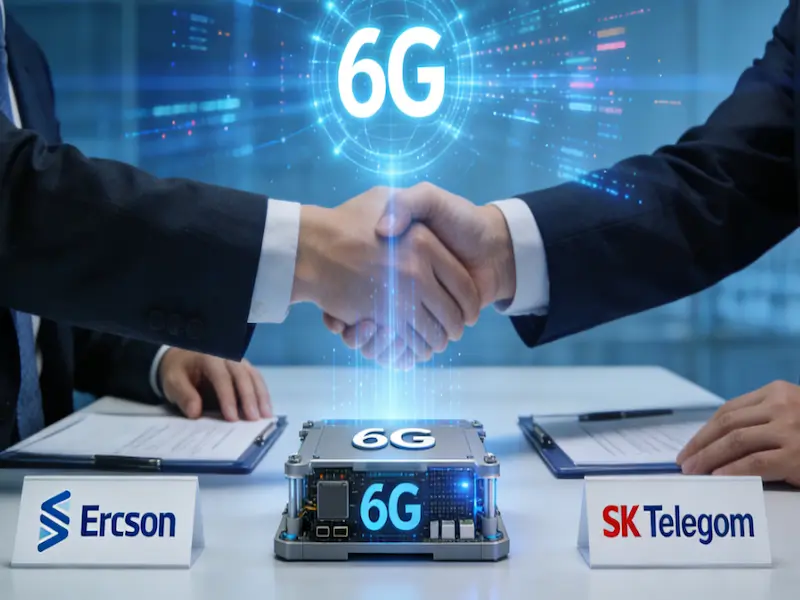
- Ericsson and SK Telecom have signed a memorandum of understanding to collaborate on 6G technologies.
- The agreement focuses on research into future network architecture, services and spectrum use.
What happened: Early steps towards 6G networks
Ericsson and SK Telecom have signed a memorandum of understanding (MoU) to jointly develop technologies for future 6G networks.
According to the companies’ announcement, the collaboration will focus on advancing next-generation mobile communication systems, including innovations in network architecture, radio technologies and potential use cases for 6G services. The collaboration will also examine AI-native air interfaces, terahertz spectrum bands, and energy-efficient network designs. Industry analysts predict 6G could deliver speeds up to 100 times faster than 5G, with latency below 0.1 milliseconds.
The agreement builds on a long-standing partnership between Ericsson and SK Telecom, both of which have been active in developing and deploying 5G networks. As the telecom industry begins to look beyond 5G, research into 6G is gathering pace globally.
The companies said they will explore how emerging technologies such as artificial intelligence and advanced spectrum utilisation can be integrated into future networks. 6G is expected to deliver significantly higher data speeds, lower latency and new capabilities compared with current 5G systems.
The announcement reflects early-stage efforts to define standards and technical frameworks that could shape commercial 6G deployments later in the next decade.
Also read: Ericsson and Qualcomm push 6G towards commercialization
Also read: BT and Ericsson strengthen UK 5G partnership
Why it’s important
The MoU highlights how telecom operators and equipment vendors are already preparing for the next generation of mobile networks, even as 5G rollout continues worldwide.
6G is widely expected to build on the foundations of 5G while introducing new capabilities such as integrated sensing, enhanced AI-driven network management and support for advanced applications including immersive communications and autonomous systems. Potential 6G applications include holographic communications, digital twins for industrial automation, and seamless integration of satellite and terrestrial networks. These capabilities could transform industries from healthcare to manufacturing.
For companies like Ericsson, early involvement in 6G research is critical to maintaining a competitive position in future network infrastructure markets.
For operators such as SK Telecom, participation in shaping standards can help ensure that future networks align with their business and technological requirements.
From a financial perspective, early investment in 6G research represents a long-term bet on future revenue streams tied to advanced connectivity services.
The collaboration also reflects broader industry dynamics, where partnerships between operators and vendors are essential for developing complex network technologies.
As global competition intensifies, countries and companies are seeking to establish leadership in next-generation communications infrastructure.
The Ericsson–SK Telecom agreement therefore illustrates how the groundwork for 6G is already being laid, even though widespread commercial deployment remains years away.
In this context, early research collaborations may play a decisive role in shaping the future of global connectivity.
