
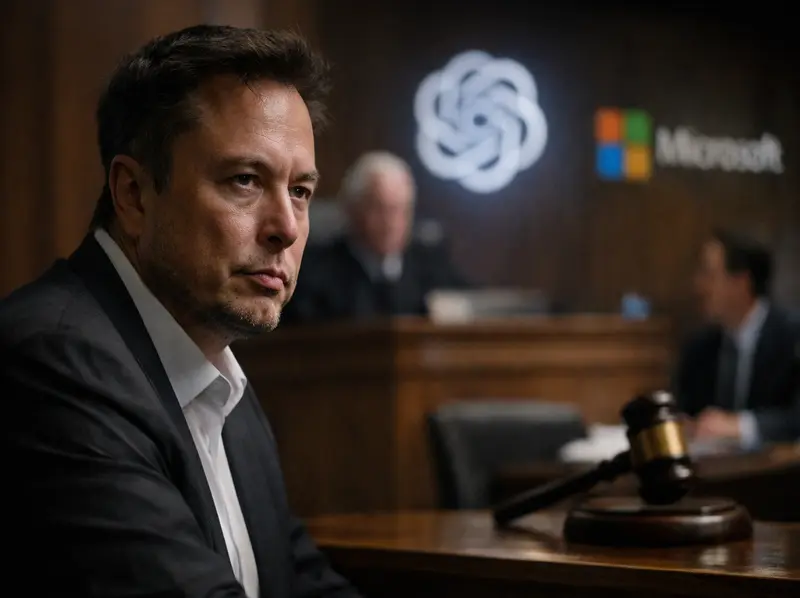
- Elon Musk has filed a lawsuit seeking up to $134 billion in damages from OpenAI and Microsoft, alleging they profited unjustly from his early support of the AI firm.
- The dispute, rooted in claims that OpenAI abandoned its non-profit mission and formed a close commercial partnership with Microsoft, is headed for a jury trial in April in Oakland, California.
What happened: Musk demand triggers AI industry legal showdown
Elon Musk, the billionaire technology entrepreneur and a co-founder of OpenAI, has taken the rare step of suing both OpenAI and Microsoft, seeking as much as $134 billion in damages. The lawsuit, filed in January 2026, alleges that the generative AI firm and its main commercial partner improperly profited from Musk’s early financial and strategic support, when OpenAI was founded as a non-profit organisation in 2015, according to CNBC.
Court filings show that Musk contributed about $38 million in seed funding, representing roughly 60 per cent of OpenAI’s initial capital, and now claims entitlement to a share of the substantial value generated since. An expert witness retained by Musk estimated so-called “wrongful gains” of between $65.5 billion and $109.4 billion for OpenAI, and $13.3 billion to $25.1 billion for Microsoft, based on that early involvement, according to the filing.
Both defendants have rejected the claims. OpenAI described the lawsuit as “unserious” and part of what it called a broader “harassment campaign”, while Microsoft has declined to comment in detail on the damages sought. A federal judge has allowed the case to proceed after rejecting efforts to avoid a jury trial, with proceedings scheduled to begin in April 2026 in Oakland, California.
Also Read: UK, Canadian watchdogs press on with probes into Elon Musk’s Grok chatbot
Also Read: UK regulator investigates Elon Musk’s Grok AI over deepfake and sexualised images
Why it’s important
This lawsuit is significant not just for its jaw-dropping financial stakes but also for what it could reveal about the governance, mission and funding structures of AI research organisations. OpenAI’s transition from a non-profit entity to a hybrid for-profit model — largely facilitated through a deep partnership with Microsoft — lies at the heart of the dispute and raises questions about contractual expectations and founders’ rights in rapidly scaling technology ventures
The case may also influence how future collaborations between mission-driven research bodies and major commercial partners are structured, particularly in emerging technologies like generative AI. With Musk also leading xAI, a competitor in the AI space, and public exchanges intensifying on social platforms, the dispute has garnered global attention and underscored tensions in a sector grappling with balancing innovation, funding and ethical commitments.
