
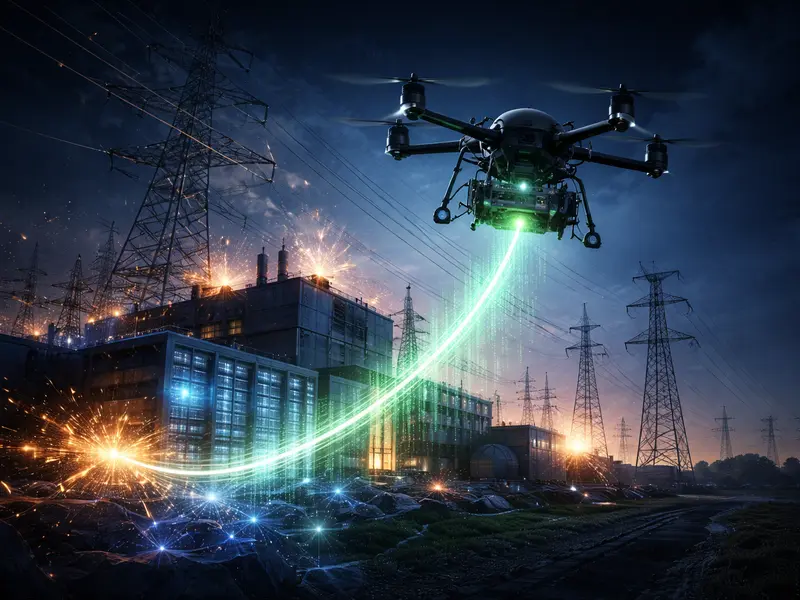
- New analysis highlights how drones could be used to support cyber-enabled attacks on critical infrastructure such as utilities and data centres.
- The study finds limited detection capabilities and weak guidance leave operators exposed as drone technology becomes more advanced and ubiquitous.
What happened: Sky-borne cyber threat emerging
Researchers found that drones could become vectors for cyber-attacks against critical infrastructure, including energy, water, telecommunications and data centre networks. That is according to an independent report from the University of Canberra’s Innovation Central Canberra (ICC) and Australian counter-drone technology company DroneShield published in mid-January 2026. The analysis, based on interviews with operators and technical assessment of current threat environments, found that while there have been no recorded domestic incidents yet, the rapid proliferation of drone capability and weak detection systems create a widening gap in defensive readiness.
Professor Frank den Hartog, Cisco Research Chair in Critical Infrastructure at the University, said that drones are no longer just kinetic tools for physical disruption but may increasingly serve as cyber threat vectors against networked systems, a shift that traditional cyber defence strategies are not yet structured to address. The report emphasises the need for improved education, industry collaboration and integration of counter-drone considerations into existing security and resilience frameworks.
Also Read: Nokia to head EU project on autonomous drones and robotics
Also Read: Antwork drones take medical delivery to new heights in China
Why it’s important
This research highlights a growing security challenge at the intersection of physical devices and networked systems: as drones become more affordable, autonomous and capable, they could be exploited to bypass perimeter defences and launch or facilitate cyber intrusion campaigns. In essence, the physical approach used in many critical infrastructure security strategies may be insufficient without corresponding advances in cyber-physical situational awareness.
According to recent U.S. guidance, authorities like the Cybersecurity and Infrastructure Security Agency (CISA) have released counter-UAS detection guides precisely because traditional perimeter and airspace defences struggle to detect and mitigate drone threats, including those that could be tied into cyber incidents.
From a financial perspective, the potential for drones to enable or augment cyber-attacks could compound losses from already rising cyber threats; insurers, utilities and cloud operators are increasingly factoring such convergence risks into resilience planning. Industry analysts note that integrated risk management—linking airspace surveillance with network security monitoring—will likely become a key competitive differentiator for critical infrastructure operators.
Former UK cyber chief Professor Ciaran Martin has argued that while catastrophic cyber scenarios have not yet materialised, emerging technologies such as autonomous drones further blur the boundaries between physical and digital systems, necessitating a re-evaluation of national security postures.
