
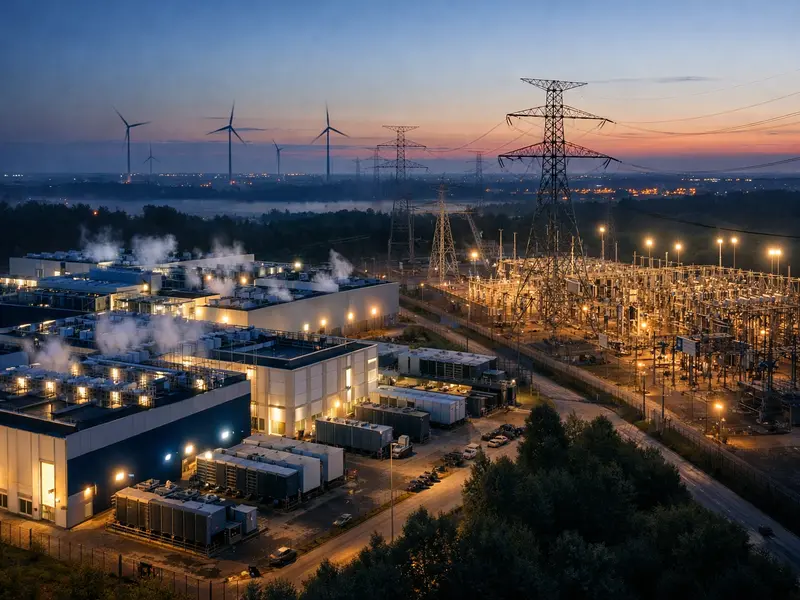
- Grid connection delays are becoming a decisive factor for where hyperscalers invest
- Investors warn that infrastructure friction could slow Europe’s AI ambitions
What happened: Permits, not processors
Europe’s ageing and congested power grids are increasingly slowing the expansion of large data centres, according to a Reuters report published on 3 February 2026. The issue has become visible as Amazon ramps up investment in European cloud infrastructure to support fast-growing demand for cloud computing and artificial intelligence workloads.
Amazon Web Services (AWS), the cloud arm of Amazon, relies on energy-intensive data centres that must be connected to national electricity grids. In several European countries, securing those connections can take years. Grid operators, already under pressure from electrification, renewable integration and cross-border power flows, face backlogs of applications from data centres, factories and green-energy projects.
According to Reuters, these delays are not primarily about Amazon’s willingness to invest, but about regulatory approvals, planning processes and physical grid constraints. In some locations, the company has been told that sufficient capacity will not be available until the end of the decade. That has forced AWS to rethink timelines and, in some cases, consider alternative sites.
The problem is not unique to Amazon. Other cloud providers and colocation operators are facing similar hurdles as demand for AI training and inference pushes up power consumption per site. Data centres that once drew tens of megawatts now routinely plan for hundreds.
Also Read: Amazon eyes $50B OpenAI investment
Also Read: Amazon and OpenAI in talks over potential $10bn investment
Why it’s important
The timing matters. Europe is trying to position itself as a credible hub for cloud and AI infrastructure, reducing dependence on the United States while supporting domestic innovation. Grid delays risk undermining that ambition at the moment when global investment in AI infrastructure is accelerating.
From a financial perspective, uncertainty over grid access raises capital risk. Data centres are long-term assets with high upfront costs. Delays can dent returns, complicate financing and tilt investment decisions towards regions with faster permitting, such as parts of North America or Asia.
More broadly, the bottleneck exposes a structural weakness. Europe’s energy transition, digital strategy and industrial policy are converging on the same physical networks. Without faster grid expansion and approval processes, the region may struggle to scale the cloud and AI infrastructure needed to stay competitive.
