
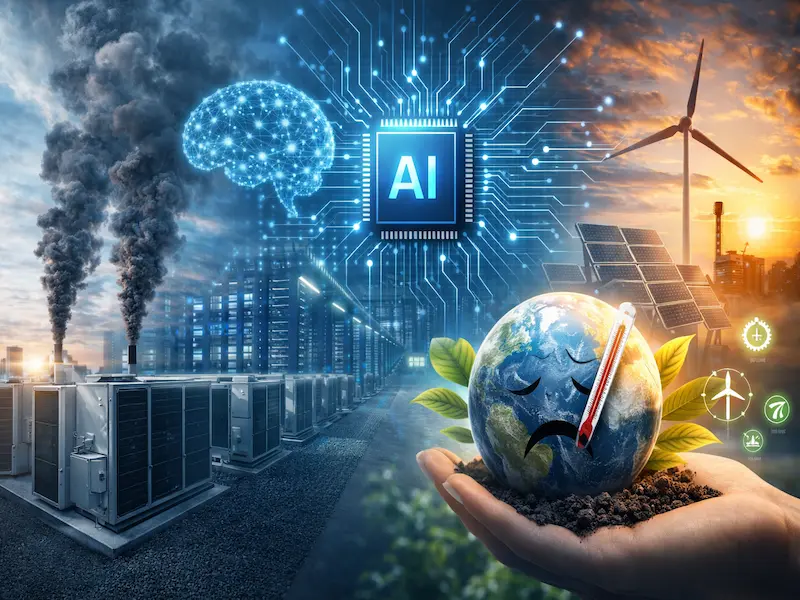
- Dame Dawn Childs highlights sustainability challenges as AI drives rapid data centre expansion.
- The industry must balance rising compute demand with energy efficiency and environmental constraints.
What happened: AI demand meets sustainability limits
Dame Dawn Childs has warned that the rapid growth of artificial intelligence is placing unprecedented pressure on data centre sustainability, according to an interview with Capacity Media.
Speaking at Datacloud, Childs said the scale and speed of AI-driven demand are testing existing infrastructure models, particularly in areas such as power consumption, cooling and site development.
Pure Data Centres, which builds and operates large-scale facilities, is seeing increased demand from customers deploying AI workloads that require significantly higher compute density than traditional applications.
According to the report, Childs emphasised that the industry must rethink how data centres are designed and operated, as AI workloads can dramatically increase energy usage.
She pointed to the need for innovation in areas such as cooling technologies, energy sourcing and infrastructure planning, as well as closer collaboration between operators, governments and energy providers.
The discussion comes as data centre operators across Europe and beyond face growing scrutiny over environmental impact and resource consumption.
Also Read: OpenAI Drops Sora Video Platform
Also Read: Nanya shares jump after $2.5bn fundraising
Why it’s important
The comments reflect a broader structural challenge facing the digital infrastructure sector.
Artificial intelligence is driving a surge in demand for computing capacity, but this growth is closely tied to energy consumption. Data centres already account for a significant share of global electricity usage, and AI workloads are expected to increase that demand further.
For operators, the challenge lies in scaling infrastructure while maintaining sustainability targets and managing costs.
From a financial perspective, energy efficiency is becoming a critical factor in the viability of data centre projects, influencing both operational expenses and investment decisions.
The issue is particularly acute in regions such as Europe, where regulatory requirements and environmental targets are shaping infrastructure development.
Childs’ remarks also highlight the need for systemic change. Rather than incremental improvements, the industry may need to adopt new approaches to energy management, facility design and site selection.
The intersection of AI growth and sustainability is therefore emerging as one of the defining issues for the data centre sector.
As demand for digital services continues to expand, the ability to deliver computing capacity in an energy-efficient and environmentally responsible way may determine the long-term trajectory of the industry.
In this context, sustainability is no longer a secondary concern but a central constraint shaping the future of AI infrastructure.
