
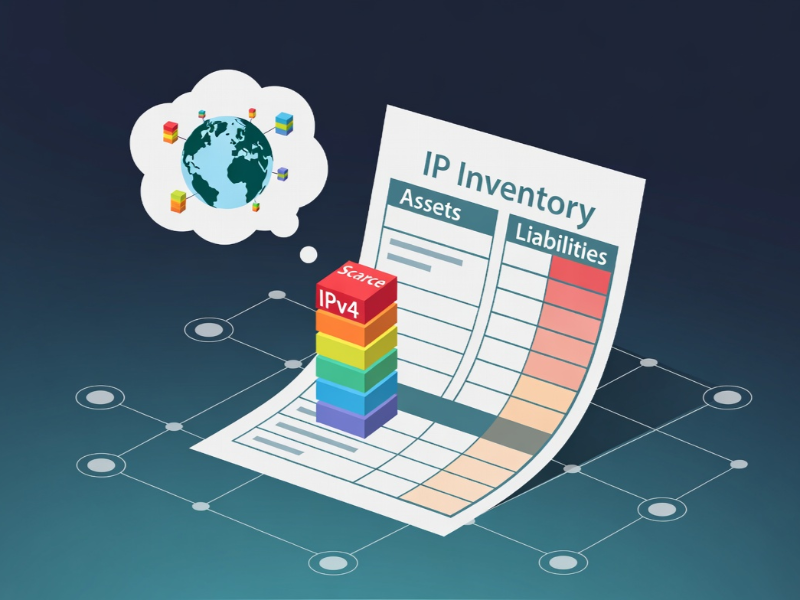
- IPv4 addresses have become scarce, quantifiable assets that can affect a company’s balance sheet and cash flow.
- Financial leaders must weigh owning versus leasing IPv4 address space, with significant impacts on revenue recognition, asset valuation and long-term strategic positioning.
IPv4 scarcity turns network inventory into financial risk
For most of Internet history, IPv4 addresses were a technical concern confined to networking teams. Free IPv4 address allocations ended years ago, and today every new block must be acquired through transfer or lease. This scarcity has given rise to a market in which IPv4 address blocks trade, lease or transfer for significant sums — turning them into de-facto financial assets.
Until recently, many organisations did not record IPv4 address space on their balance sheets. That oversight obscures a reality CFOs must confront: unused or under-utilised address blocks represent latent asset value and opportunity cost. A 2024 analysis found that IPv4 addresses are often “hidden assets with significant monetisation potential,” yet remain overlooked in corporate financial planning.
Paulius Judickas, head of sales at IP broker IPXO, notes that leasing can increase revenue beyond outright selling because companies retain ownership while generating recurring income. In one market example, leasing produced an estimated 43 per cent more revenue over a year than selling, because of yield growth on retained asset value.
Also Read: IPv4 as an investment asset: upper potential
Balance sheet impact: Owning vs leasing IP addresses
From an accounting standpoint, IPv4 addresses can be treated as intangible assets. Their valuation influences asset base, return on assets (ROA) and liquidity planning. When a company owns IPv4 addresses outright, the asset sits on the balance sheet and may appreciate as scarcity persists. Income from leasing those addresses subsequently contributes operational revenue without depleting the underlying asset.
By contrast, leasing IPv4 space represents ongoing operating expense and does not build asset value. Over short horizons leasing can be more cost-efficient for operational growth, but long-term leasing may erode cost efficiency compared to owning scarce addresses outright — a dynamic CFOs must model alongside cash-flow forecasts.
Also Read: Debate over decentralising global IP address registration
Case study: How an ISP’s IP portfolio shifted financial strategy
A regional ISP with a legacy IPv4 block found that owning substantial address space was tying up capital that could otherwise be deployed in network expansion. After auditing their IPv4 inventory, the company decided to lease part of its address needs rather than purchase new blocks on the transfer market, significantly reducing short-term CapEx. At the same time, it listed a smaller unused inventory for lease, creating a predictable revenue stream.
- Financial impact: Balanced leasing reduced capital deployment and improved short-term cash flow.
- Asset management: Retaining ownership of core blocks preserved long-term asset value and potential future sale proceeds.
- Operational flexibility: Leasing allowed rapid scaling without long commitment.
This dual strategy highlighted to the CFO that IP inventory decisions are capital allocation choices, not mere technical ones — with direct implications for balance sheets and risk profiles.
