
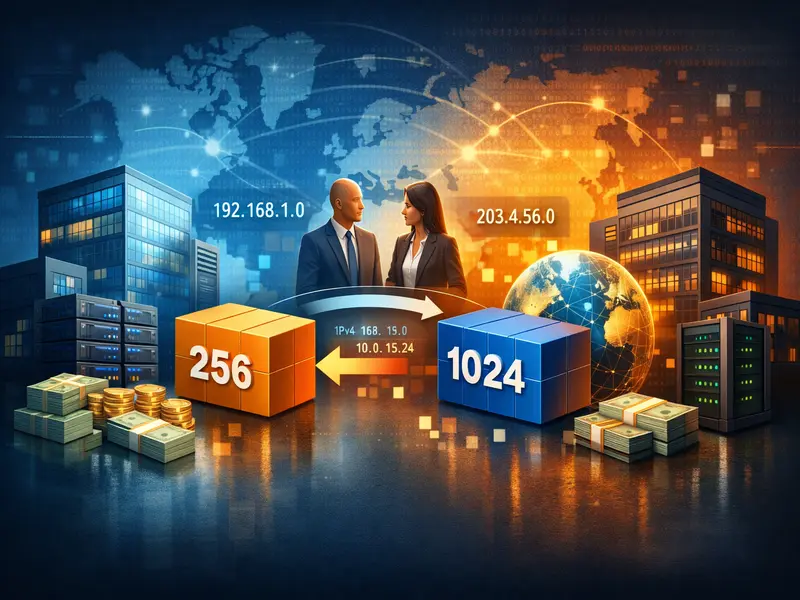
- How brokers of the IP market turned “obsolete” IPv4 addresses into the resilient backbone of the modern internet.
- Thanks to the invisible architects of the IP market, legacy systems, small ISPs and startups will survive digital scarcity with even lower costs.
In the quiet corners of server rooms and the bustling digital exchanges of the internet’s infrastructure, a silent drama unfolds. It is not a story of code or algorithms, but of human ambition, scarcity, and the unseen hands that guide the flow of one of the most critical resources of the digital age: IPv4 addresses. While the world was told for decades that IPv6 would render IPv4 obsolete, the reality has been far more complex—and far more human. At the heart of this enduring ecosystem are the brokers: the intermediaries who have transformed a technical protocol into a thriving, albeit controversial, marketplace.
The Myth of Obsolescence
For over twenty years, the narrative was clear: IPv4, with its limited 4.3 billion addresses, was doomed. IPv6, with its near-infinite address space, was the future. Yet, as of early 2026, nearly half of all global internet traffic still relies on IPv4. Why? Because migration is not just a technical challenge—it is an economic and operational one. Legacy systems, industrial controls, and enterprise networks are deeply entrenched in IPv4, creating an inertia that no mandate can easily overcome.
Geoff Huston, Chief Scientist at APNIC, captured this divergence poignantly in January 2026: “My personal opinion lies in a future of highly fragmented networks.” He wasn’t just describing a technical shift; he was hinting at a human one. The internet is no longer moving toward a unified future but settling into a dual-protocol equilibrium where IPv4 remains essential. And in this equilibrium, brokers have become the invisible architects shaping the market。
The Rise of the Broker Class
When the Internet Assigned Numbers Authority (IANA) allocated its final IPv4 blocks in 2011, scarcity became real. Regional Internet Registries (RIRs) began exhausting their pools, and a secondary market emerged. But this market was not organic—it was cultivated. Brokers stepped in to fill the void between supply and demand, becoming the matchmakers of the IP address world.
By late 2025, the price per IPv4 address had corrected to around $22, down from peaks of $50+ in 2021-2022. This correction was not a sign of collapse but of maturation. The hyperscalers—Amazon, Microsoft, Google—had secured their inventories and exited the market. What remained was a more diverse pool of buyers: smaller ISPs, AI infrastructure operators, and enterprises needing flexible solutions. Brokers facilitated these transactions, ensuring liquidity and trust in a market fraught with complexity.
One broker, speaking anonymously due to the sensitive nature of the trade, described their role as “part diplomat, part economist.” They navigate not just prices but policies, helping clients understand the nuances of RIR regulations across regions. In Europe, RIPE NCC’s permissive environment encourages consolidation. In Asia-Pacific, APNIC’s strict compliance rules create hurdles. In Latin America, LACNIC’s outright prohibition of leasing forces creative workarounds. Brokers don’t just sell addresses—they sell certainty.
The Human Cost of Scarcity
Behind every transaction is a story. Consider the small ISP in rural India that needed IPv4 addresses to expand broadband access but couldn’t afford the upfront cost of purchasing a block. Through a broker, they leased addresses at $0.45 per month, enabling them to serve thousands of new customers without crippling capital expenditure. Or the AI startup in Silicon Valley that needed dynamic IP rotation for reputation management, finding flexibility through a leasing arrangement orchestrated by a broker.
These stories highlight the human touch in a market often perceived as cold and technical. Brokers are not merely facilitators; they are enablers of innovation and access. They democratize a resource that was once hoarded by giants, allowing smaller players to compete. As Huston noted, “If you were hanging onto some idle IPv4 address hoping for the price to rise, then you may have missed out.” The market has shifted from speculation to utility, and brokers are at the forefront of this transformation.
The Ethics of Intermediation
Yet, the role of brokers is not without controversy. Critics argue that they profiteer from scarcity, inflating prices and complicating an already fragmented governance landscape. The patchwork of RIR policies creates compliance risks, and brokers sometimes operate in the gray areas between regions. A lease valid in Amsterdam might violate policy in Singapore, and brokers must navigate these minefields carefully.
Moreover, the financialization of IPv4 addresses raises ethical questions. Should a fundamental internet resource be treated as a tradable commodity? The U.S. Securities and Exchange Commission’s 2023 cybersecurity disclosure rules, while not explicitly naming IPv4, underscore the material risk associated with digital infrastructure. Brokers, in this light, are not just market participants but stewards of a resource that underpins global connectivity.
The Future of Brokerage
Looking ahead, the role of brokers will only grow. As IPv4 persists beyond 2030 in enterprise systems and leasing captures increasing market share, the need for intermediaries who understand both the technical and human dimensions of the market will intensify. Prices have likely found a floor, but demand from AI, IoT, and broadband expansion remains robust. Brokers will continue to shape this market, ensuring that IPv4 remains a viable, if niche, resource.
The story of IPv4 is not one of obsolescence but of resilience. And at its core are the brokers—the invisible architects who have turned scarcity into opportunity, complexity into clarity, and a technical protocol into a human endeavor. In their hands, the IPv4 market is not just a reflection of supply and demand but a testament to the adaptability and ingenuity of those who keep the internet running.
As we move forward, the question is not whether IPv4 will survive but how we choose to manage its legacy. Brokers, with their unique blend of expertise and empathy, will remain central to this story. They are the human touch in a digital world, ensuring that even as the internet evolves, no one is left behind.
