
Close Menu
  • Home
  • Leadership Alliance
  • Exclusives
  • History of the Internet
  • AFRINIC News
  • Internet Governance
    • Regulations
    • Governance Bodies
    • Emerging Tech
  • Others
    • IT Infrastructure
      • Networking
      • Cloud
      • Data Centres
    • Company Stories
      • Profile
      • Startups
      • Tech Titans
      • Partner Content
    • Fintech
      • Blockchain
      • Payments
      • Regulations
    • Tech Trends
      • AI
      • AR / VR
      • IoT
    • Video / Podcast
  • Country News
    • Africa
    • Asia Pacific
    • North America
    • Lat Am/Caribbean
    • Europe/Middle East
Facebook LinkedIn YouTube Instagram X (Twitter)
Blue Tech Wave Media
Facebook LinkedIn YouTube Instagram X (Twitter)
  • Home
  • Leadership Alliance
  • Exclusives
  • History of the Internet
  • AFRINIC News
  • Internet Governance
    • Regulation
    • Governance Bodies
    • Emerging Tech
  • Others
    • IT Infrastructure
      • Networking
      • Cloud
      • Data Centres
    • Company Stories
      • Profiles
      • Startups
      • Tech Titans
      • Partner Content
    • Fintech
      • Blockchain
      • Payments
      • Regulation
    • Tech Trends
      • AI
      • AR/VR
      • IoT
    • Video / Podcast
  • Africa
  • Asia-Pacific
  • North America
  • Lat Am/Caribbean
  • Europe/Middle East
Blue Tech Wave Media
Home » Regulatory unity or political capture? The real agenda behind CAIGA
regulatory-unity-or-political-capture-the-real-agenda-behind-caiga
Africa

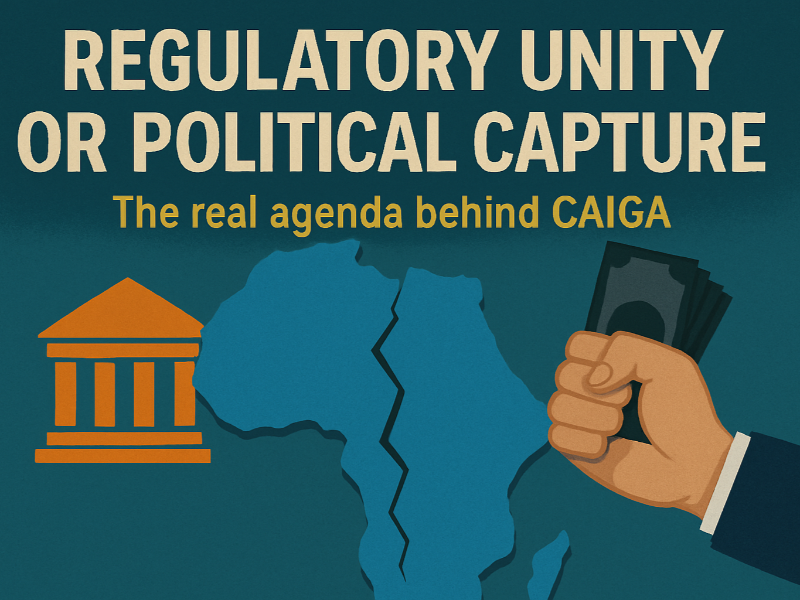
Regulatory unity or political capture? The real agenda behind CAIGA

By Jessi WuDecember 15, 2025No Comments3 Mins Read
Share
Facebook Twitter LinkedIn Pinterest Email
  • Claims that CAIGA could harmonise Africa’s fragmented digital regulatory landscape are increasingly being challenged, as critics warn the initiative risks entrenching political control rather than repairing broken governance systems.
  • There is growing concern that Smart Africa, with ICANN’s backing, is advancing a governance model that prioritises top-down authority while marginalising the technical communities responsible for operating and sustaining Africa’s internet.

A harmonisation narrative built on weak foundations

Africa’s digital regulatory environment is indeed uneven, shaped by divergent national approaches to data protection, cybersecurity and digital services. But critics argue that invoking regulatory fragmentation has become a convenient justification for expanding political oversight, rather than a serious attempt to address governance failures at their source.

The Continental Africa Internet Governance Architecture (CAIGA) is presented as a continental framework capable of unifying disparate rules. Yet the proposal lacks clarity on how policies would be developed, who would hold decision-making authority, and what safeguards would prevent political interference. There is little evidence that technical operators, civil society or regional internet communities would play a decisive role under this structure.

Rather than emerging from consensus, CAIGA risks enforcing standards designed by a narrow political circle, detached from operational realities and local conditions. In this context, “harmonisation” appears less a technical objective than a mechanism for consolidating authority.

Also Read: What role will regional internet communities play in CAIGA

Centralisation over diversity

CAIGA’s architecture places governments at the centre of regulatory alignment, displacing the multistakeholder model that has underpinned global internet governance for decades. Regional operators warn that technical requirements could be subordinated to political agendas, producing regulations that restrict innovation, slow deployment and limit digital freedoms.

Africa’s regulatory diversity reflects real differences in infrastructure maturity, legal systems and social priorities. Imposing uniform rules through a centralised, politically driven framework risks erasing necessary flexibility and creating standards ill-suited to local ecosystems.

Rather than reducing fragmentation, CAIGA may introduce new conflicts—particularly if continental authority begins to override national or community-led processes.

Also Read: Understanding CAIGA’s proposed policy framework

ICANN’s involvement deepens the credibility gap

ICANN’s funding and participation in Smart Africa’s governance blueprint has intensified scepticism. An organisation that publicly defends bottom-up governance is now associated with a framework that enables state-led oversight. Stakeholders question why Africa is being exposed to a governance experiment that would be unacceptable in other regions.

Without transparency, accountability and genuine community authority, CAIGA risks becoming a vehicle for political consolidation—not a solution to Africa’s regulatory challenges.

Afrinic CAIGA Smart Africa
Jessi Wu

Jessi is an intern reporter at BTW Media, having studied fintech at the University of New South Wales. She specialises in blockchain and cryptocurrency. Contact her at j.wu@btw.media.

Related Posts

CAIGA is not reform, it is a rewrite of who controls Africa’s internet

December 15, 2025

Why CAIGA’s governance efforts struggle with enforcement

December 15, 2025

LINX Accra goes live at Digital Realty’s ACR2 data centre

December 15, 2025
Add A Comment
Leave A Reply Cancel Reply

CATEGORIES
Archives
  • December 2025
  • November 2025
  • October 2025
  • September 2025
  • August 2025
  • July 2025
  • June 2025
  • May 2025
  • April 2025
  • March 2025
  • February 2025
  • January 2025
  • December 2024
  • November 2024
  • October 2024
  • September 2024
  • August 2024
  • July 2024
  • June 2024
  • May 2024
  • April 2024
  • March 2024
  • February 2024
  • January 2024
  • December 2023
  • November 2023
  • October 2023
  • September 2023
  • August 2023
  • July 2023

Blue Tech Wave (BTW.Media) is a future-facing tech media brand delivering sharp insights, trendspotting, and bold storytelling across digital, social, and video. We translate complexity into clarity—so you’re always ahead of the curve.

BTW
  • About BTW
  • Contact Us
  • Join Our Team
  • About AFRINIC
  • History of the Internet
TERMS
  • Privacy Policy
  • Cookie Policy
  • Terms of Use
Facebook X (Twitter) Instagram YouTube LinkedIn
BTW.MEDIA is proudly owned by LARUS Ltd.

Type above and press Enter to search. Press Esc to cancel.