
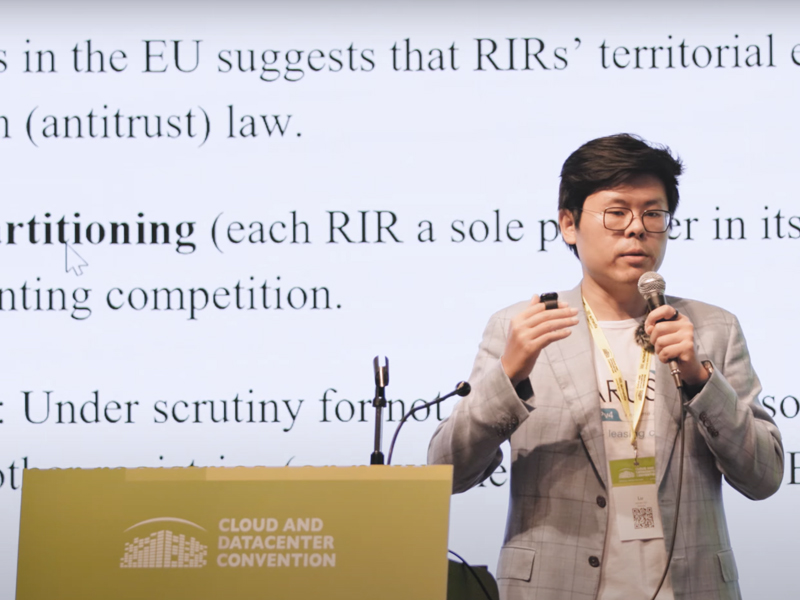
- Lu Heng, CEO at Cloud Innovation, argues that Smart Africa’s attempt to force a single centralised Internet policy on a continent as diverse and fractious as Africa is dangerous and ultimately impossible.
The Internet’s address book, and why ‘digital sovereignty’ is a dangerous fantasy
Imagine a city where every house needs an address to receive visitors, mail, or deliveries.
On the Internet, the houses are computers and networks, and the addresses are IP addresses.
As the city grows, someone must maintain a simple, neutral address book — just to note who is using which number so everything stays connected.
That is what the five Regional Internet Registries (RIRs) do.
And for Africa, that registry is called AFRINIC.
Here is what everyone must understand:
The person holding the address book does not own the houses.
He does not control the streets.
He does not control the residents.
He simply records numbers.
That is exactly what AFRINIC is.
An Internet number librarian — nothing more.
It does not run the Internet.
It does not control any country.
It does not command any network.
Once you understand this, the idea of “digital sovereignty” becomes obviously ridiculous.
Believing you can control the African Internet through AFRINIC is the same as saying:
“If I steal the address book, I own the whole city.”
It’s childish.
It’s wrong.
And it shows a complete misunderstanding of how the Internet works.
Also read: Special report: Smart Africa leaked email list was obtained without consent

What actually happened
Cloud Innovation acted for two main reasons:
1. To protect end users,
2. To defend the rule of law.
We serve hundreds of millions of users worldwide.
When AFRINIC’s former management tried to revoke our IP addresses without any legal basis, innocent people would have lost Internet connectivity. So we went to the Supreme Court of Mauritius to stop it. This was not political or strategic. It was simply protecting users.
When AFRINIC fell into crisis — no governance, no valid board — we asked the Court to appoint a Receiver. The Court ordered the Receiver to organize transparent, fair elections according to AFRINIC’s constitution.
The African community deserves a real, properly elected board.
When those elections were later disrupted by political pressure — with the Receiver publicly saying he was receiving instructions from the executive branch — we went back to court.
We defended the Mauritian Constitution, because separation of powers is the foundation of democracy. If AFRINIC loses neutrality, no African operator can trust it again.
Mauritius can still be a neutral and safe home for AFRINIC — if it chooses law over politics.
Also read: Is AFRINIC board working for Smart Africa? Fears of state-led capture
Why ‘digital sovereignty’ is a stupid and dangerous idea
Let’s speak clearly.
Smart Africa’s “digital sovereignty” project is not just wrong.
It is extremely stupid and dangerous.
Some politicians on the continent believe they can “control the African Internet” by grabbing the address book.
That will never happen and must never happen.
Africa has 54 countries with wildly different cultures, laws, politics, and interests. Many of them do not even agree on the most basic issues.
For example:
• Rwanda vs DR Congo
• Morocco vs Algeria
These countries agree on nothing — yet we’re supposed to believe they would accept a single “supreme digital authority”? Impossible.
Forcing a centralized Internet policy on an entire continent can only destroy the Internet — especially when the organization they want to control is nothing more than an address book that works only through voluntary cooperation.
You don’t build a digital empire by force.
You don’t rule the Internet by command.
And you don’t impose “continental sovereignty” on a system designed to be free and decentralized.
The Internet is decentralized by nature.
No one owns it, no one rules it.
AFRINIC is just a registry.
Trying to “dominate the Internet” through AFRINIC is as absurd as thinking controlling the phone book gives you power over every phone conversation.
Also read: Is ICANN dodging the AFRINIC community by supporting Smart Africa’s CAIGA?

Mauritius must stop chasing control
Mauritius is respected because it is neutral and peaceful.
It cannot compete with continental political pressure, and it should not try.
Mauritius wins by being a hub — not a ruler.
Supporting Smart Africa’s political games makes Mauritius look ridiculous and damages its reputation as a stable jurisdiction.
Mauritius must defend:
• Neutrality
• Rule of law
• An open Internet
• Decentralization
• Fairness
Not the fantasy of an “African digital empire.”
AFRINIC works best in Mauritius, where it can remain neutral and stable, while political games happen elsewhere.
That is exactly why we obtained an injunction preventing its relocation out of Mauritius.
Also read: AFRINIC community raises concern over Smart Africa data breach
Cloud Innovation’s position
Our position is simple and consistent:
• We defend the Internet.
• We defend users.
• We defend the rule of law in Mauritius.
• We defend decentralization.
• And we defend AFRINIC staying in Mauritius, neutral and protected.
The Internet grows through connection, not control.
Mauritius will become a real digital hub only if it pushes decentralization — not “digital sovereignty” propaganda.
Why centralized control would destroy the Internet
If the Internet begins following political borders, it is no longer the Internet.
Countries like Rwanda and DR Congo, or Morocco and Algeria, would never trust each other enough to interconnect freely.
Every country would need bilateral agreements for data packets to travel — like visa stamps for Internet traffic.
The Internet would devolve into fragmented “national networks,” barely usable.
Everyone suffered last year when the Internet was briefly shut down.
It was painful. Everything stopped.
We all want the freedom to connect with anyone, anywhere, anytime.
That freedom only exists if we ignore political divisions, not use them to fracture the network.
The Internet works because we choose to connect — not because we isolate ourselves.
The bottom line
The Internet is decentralized by nature.
Any attempt to impose “sovereignty” on it is stupid.
Trying to impose continental sovereignty is even more absurd — especially when some of the countries involved are literally in conflict.
That is not sovereignty.
It is an illusion of power — the impossible fantasy of a few leaders who believe that by controlling an address book, they will control the African Internet.
Even if they managed to seize it, they would only break the Internet.
Because the moment they try to govern it, everyone else will simply stop trusting the registry.
You don’t rule a territory by holding the map.
You rule only if people accept you.
And no one will accept something this absurd.
By Lu Heng, CEO at Cloud Innovation, CEO at LARUS Ltd, Founder of LARUS Foundation.
