
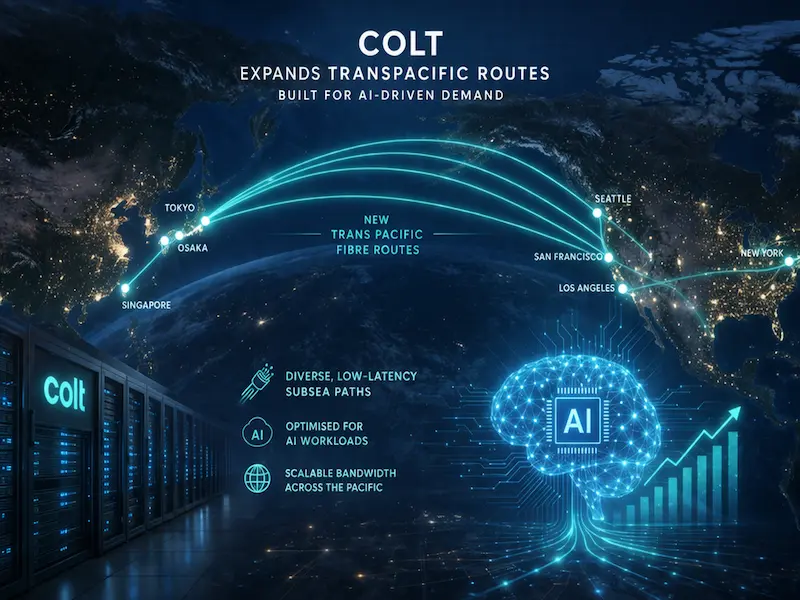
- Colt is launching new subsea and land-based routes between the US and Asia to support rising AI capacity demand.
- The expansion reflects growing pressure on global networks from data-intensive AI applications.
What happened: New routes for AI-era traffic
Colt Technology Services has announced new subsea and terrestrial network routes connecting the US West Coast with Asia, aimed at supporting the rapid growth of AI-driven data traffic.
According to the company’s announcement, the new routes are designed to provide increased capacity, lower latency and improved resilience for customers operating across transpacific markets. Read the announcement
The expansion links key digital hubs in North America and Asia, regions that are central to the development and deployment of artificial intelligence technologies. AI workloads often require the transfer of large datasets between geographically distributed data centres, placing significant strain on existing network infrastructure.
Colt said the new routes will enhance connectivity for enterprises and cloud providers, particularly those running high-performance computing applications.
The move reflects a broader shift in traffic patterns, as AI and cloud computing drive demand for high-capacity, low-latency international connections.
Also Read: Colt CEO urges telcos to think beyond connectivity for AI
Also Read: Colt tests agentic AI with Microsoft for enterprise pricing
Why it’s important
The development highlights how artificial intelligence is reshaping global network infrastructure.
Traditionally, international connectivity has been driven by general internet traffic and enterprise data flows. However, AI workloads introduce new requirements, including the need to move vast amounts of data quickly between data centres located in different regions.
For network providers, this creates both challenges and opportunities. Expanding capacity and improving performance are essential to supporting next-generation applications.
From a financial perspective, investment in subsea and terrestrial networks is increasingly tied to long-term demand from AI and cloud services, making connectivity infrastructure a strategic asset.
The focus on transpacific routes also reflects the importance of linking major technology markets, where much of the world’s AI development is concentrated.
At the same time, increasing reliance on international data flows raises questions about resilience and redundancy, particularly in the face of geopolitical risks.
Colt’s expansion therefore illustrates a broader trend: the global network is being reconfigured to support the requirements of AI-driven computing.
As artificial intelligence continues to scale, the ability to connect data centres efficiently across continents may become a defining factor in the performance of digital services.
In this context, fibre routes are not just infrastructure — they are critical enablers of the emerging AI economy.
