
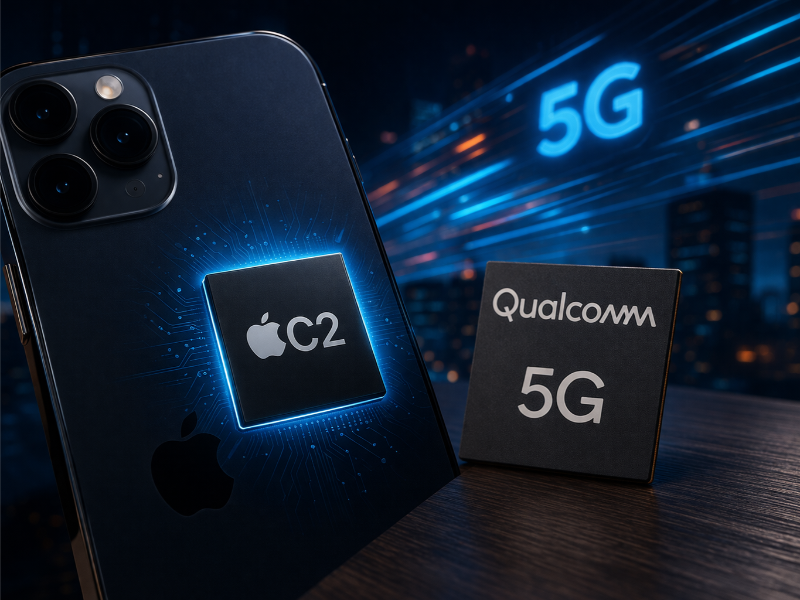
- Ookla testing shows Apple’s new C2 modem achieves speeds comparable to Qualcomm’s latest 5G chips.
- Apple’s in-house modem could reduce its dependence on Qualcomm, affecting global smartphone supply chains.
What happened: Apple’s modem catches up to Qualcomm
Recent tests by Ookla indicate Apple’s second-generation C2 modem is now competitive with Qualcomm’s top-tier 5G modems. The first-generation C1 chip launched last year had modest performance gains, but the C2 shows near parity in download and upload speeds, latency, and consistency across networks. Apple’s push to develop proprietary modems follows a long history of relying on Qualcomm, including past legal disputes over licensing. Analysts suggest this advancement could allow Apple to gradually reduce Qualcomm dependency in its iPhone line, improving supply chain control and potentially lowering costs. Tests covered multiple carriers in the US, with Apple’s modem performing particularly well in urban 5G environments.
Also read: Global smartphone market grows 4% in 4Q 2025 as Apple holds leading position for third year
Also read: Qualcomm acquires Alphawave for data centre expansion
Why this is important
Apple achieving parity with Qualcomm signals a major shift in the mobile chip industry. Historically, Qualcomm dominated 5G modem technology, licensing chips to multiple smartphone makers. Apple’s success demonstrates that vertically integrated companies can now rival specialised modem vendors, a move that may spur innovation and competition. For consumers, it promises faster updates and optimised device performance as Apple gains end-to-end control. Industry-wide, reduced reliance on Qualcomm could alter licensing revenues and reshape negotiations with network operators. Furthermore, as smartphones increasingly support advanced applications like AR and cloud gaming, modem performance becomes critical. Apple’s development also aligns with broader trends of tech giants investing in proprietary components, seen in its CPU transitions and satellite communication experiments. This progress may influence pricing, product differentiation, and even the global semiconductor supply landscape over the next few years.
