
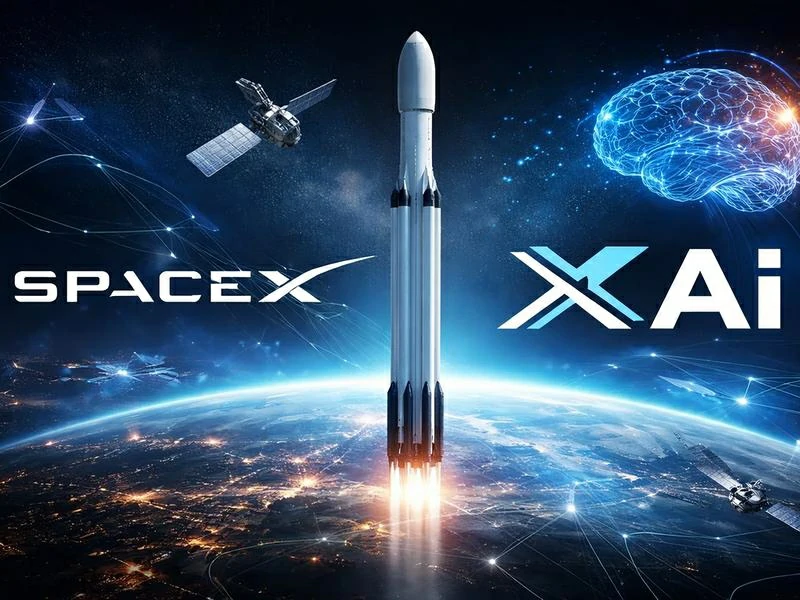
- SpaceX has acquired xAI, merging Musk’s aerospace and AI ventures into one private company valued at about $1.25 trillion.
- The unified company will pursue AI integration with space infrastructure and accelerate plans for space‑based compute.
What happened
SpaceX, the private spaceflight and satellite internet company led by Elon Musk, has formally acquired Musk’s artificial intelligence firm xAI in a deal that merges two of his most prominent technology ventures. The parties announced the merger on 2 February 2026, reporting that the combined entity is valued at about $1.25 trillion, surpassing the value of most private companies worldwide.
This integration brings xAI‘s AI research, including its Grok chatbot and related models, together with SpaceX’s launch capabilities and satellite infrastructure. SpaceX’s chief executive, Elon Musk, described the transaction as “not just the next chapter, but the next book” in the mission of connecting AI prowess with space operations.
Under the terms of the deal, xAI shareholders will receive SpaceX shares, with some executives having the option of cash instead. The merger also effectively folds xAI’s assets, such as the AI platform and associated technologies, into SpaceX’s broader infrastructure plans as the company continues to prepare for a potential initial public offering later this year.
Musk has previously woven parts of his ventures together, including the integration of the social media platform X into xAI’s operations, and this latest move represents a further consolidation of his technology ecosystem under SpaceX’s umbrella.
Also read: SpaceX proposes orbital AI data centres to reshape global compute
Also read: Türkiye blocks Grok AI chatbot in new crackdown
Why it’s important
This merger is a major milestone in how artificial intelligence and space technology are converging into a single strategic vision. The consolidation of SpaceX and xAI creates a privately held tech giant that brings together compute, communications, launch infrastructure and AI under one roof, potentially positioning it to challenge leading AI firms while also expanding beyond terrestrial compute models.
One of the most important implications is the potential expansion into space‑based data centres powered by solar energy, a concept that Musk and his teams have suggested could alleviate the energy and cooling constraints associated with Earth‑bound AI data facilities. Terrestrial data centres face rising costs and environmental challenges, and placing compute resources in orbit could provide scalable, sustainable support for the next generation of AI workloads.
From a competitive standpoint, the merger accelerates SpaceX’s strategic landscape, adding generative AI capabilities to Starlink’s satellite communications and future orbital compute aspirations. It also amplifies the company’s appeal to investors ahead of a planned IPO, where the broader technology portfolio could justify a premium valuation compared with a pure aerospace business.
However, this consolidation also raises questions about concentration of technological power and regulatory scrutiny, as a single company — particularly one led by a figure like Musk with multiple overlapping ventures — assumes influence over AI, communications infrastructure and space operations simultaneously.
Overall, by combining AI and space infrastructure ambitions, the merger illustrates a bold strategy to redefine computing’s physical and digital frontiers, while challenging competitors to rethink how and where future AI ecosystems are built and scaled globally.
