
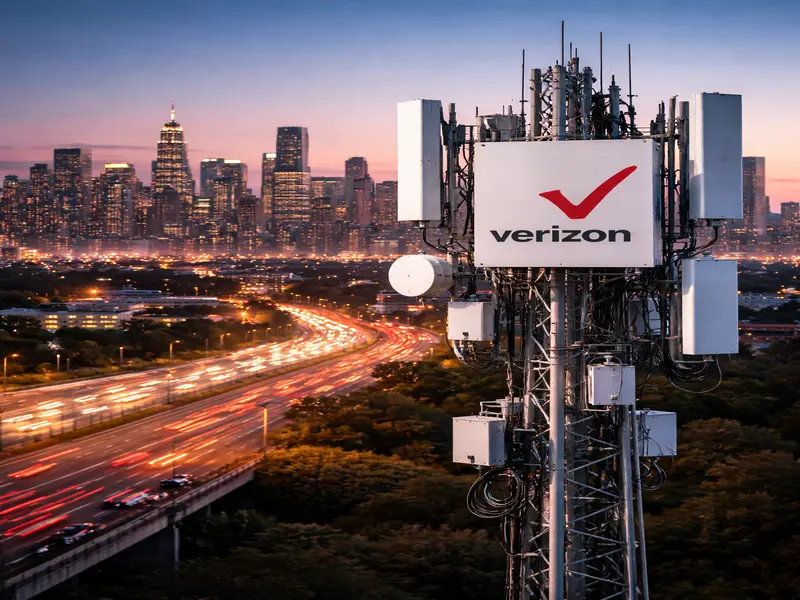
- Verizon has taken the top spot in a major US mobile network performance ranking, pulling ahead of close rivals AT&T and T-Mobile.
- The result underlines how long-term infrastructure investment remains decisive, even as US mobile markets approach saturation.
What happened: Consistency over hype
Verizon, the largest mobile network operator in the US, emerged as the overall leader in a nationwide mobile network assessment, according to independent testing firm RootMetrics, as reported by Telecoms.com. The benchmarking exercise measured real-world performance across metrics including speed, reliability and coverage, and found Verizon narrowly outperforming its main competitors.
According to the RootMetrics data cited by Telecoms.com, Verizon delivered the most consistent user experience across a broad range of locations, particularly outside dense urban cores, where performance gaps between operators are often more visible. The results follow years of heavy capital expenditure by Verizon on network densification, spectrum deployment and backhaul upgrades, spanning both LTE and 5G.
While rivals such as T-Mobile have drawn attention with aggressive 5G marketing and rapid mid-band rollout, Verizon’s approach has focused on incremental improvements and reliability. Executives have repeatedly argued that network quality, rather than headline speeds, is what ultimately sustains customer trust in a competitive and mature market.
Also Read: Verizon Expands US Fibre Footprint with Frontier Acquisition
Also Read: California clears Verizon Frontier deal
Why it’s important
The ranking reinforces a key reality of the US mobile sector: even in a market where subscriber growth is limited and 5G coverage is widespread, infrastructure investment remains a core competitive weapon. For Verizon, maintaining top-tier network performance supports its ability to defend premium pricing and reduce churn, particularly among enterprise and high-value consumer customers.
From a financial perspective, sustained capital spending places short-term pressure on margins, but strong network rankings help justify that investment to both customers and investors. In contrast, operators that slow infrastructure spending risk falling behind on quality, even if headline coverage claims remain strong.
More broadly, the results suggest that the US mobile race is entering a phase where differentiation is less about who launched 5G first and more about who can deliver stable, nationwide performance over time. In that context, Verizon’s lead serves as a reminder that, in telecoms, the returns on infrastructure often show up gradually rather than dramatically.
