
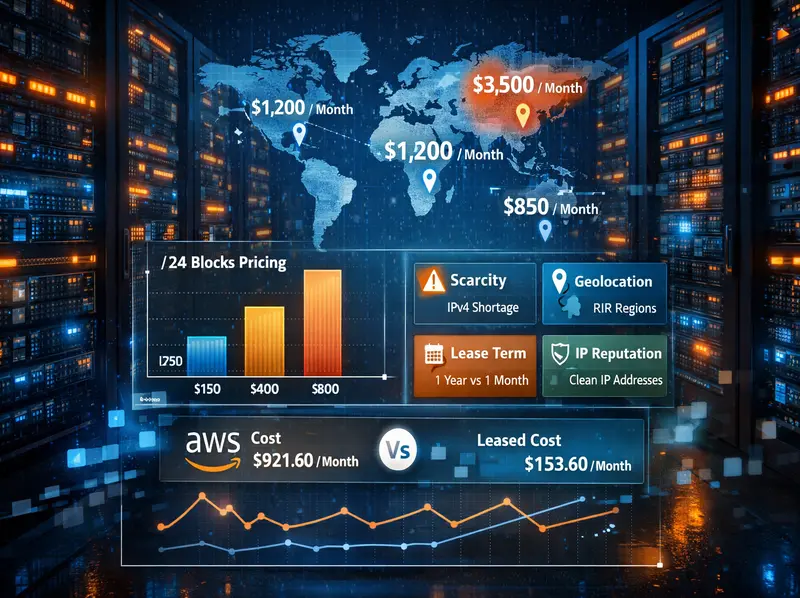
- IPv4 addresses now trade like digital real estate: With global exhaustion complete, leasing has become a $ 500M+ annual market where prices hinge on block size, region, and even an IP’s “reputation.”
- Smart enterprises save 70–85% on cloud IP costs by leasing clean IPv4 blocks instead of relying on provider-assigned addresses—turning scarcity into strategic advantage.
Why IPv4 leasing matters in 2026
In 2026, the concept of an IP address as “digital capital” is no longer theoretical—it is operational reality. With the global exhaustion of IPv4 address space (the last free /8 blocks were allocated by IANA to Regional Internet Registries (RIRs) between 2011 and 2019), IPv4 addresses have transitioned from a freely available technical resource to a scarce, tradeable asset class. This shift has been well documented by industry analysts and academic researchers alike.
As noted in the OECD’s Digital Economy Outlook 2022, internet number resources—including IP addresses—are increasingly treated as “strategic infrastructure assets subject to market valuation.” Similarly, a study published in Telecommunications Policy (Vol. 47, Issue 5, 2023) confirms that IPv4 scarcity has created secondary markets where leasing now accounts for over 40% of all IPv4 transactions—up from just 15% in 2018. Leasing occupies a strategic middle ground: it avoids the high upfront cost and complex regulatory compliance of outright purchase (which can exceed $ 40 per IP for a /24 block, per Prefixx’s Q4 2025 data), while offering more stability than ephemeral cloud provider IPs. For many enterprises—especially those scaling cloud infrastructure or managing hybrid networks—leasing transforms IPv4 from a sunk capital expense into a flexible operational cost. This aligns with modern IT finance models that prioritize OpEx over CapEx.
Also Read: The impact of IPv4 scarcity on small business growth
What determines lease pricing
Several interlinked structural and market-driven factors shape IPv4 lease pricing. Each reflects the underlying economics of scarcity, risk, and regional policy divergence.
1. Scarcity and Demand
The foundational driver of IPv4 lease costs is simple supply-demand imbalance. The IETF officially deprecated IPv4 expansion decades ago, and despite the rollout of IPv6, adoption remains incomplete. As of January 2026, Google’s IPv6 adoption tracker shows only 42% of global users access its services via IPv6—a figure that masks significant regional disparities. In enterprise and legacy environments, IPv4 dependency remains near-total.
This sustained demand collides with finite supply. According to RIPE NCC’s 2025 Annual Report, less than 0.3% of the original IPv4 address space remains unallocated globally, and most of that is held in reserve or under moratoria. Meanwhile, cloud providers, IoT deployments, and digital transformation initiatives continue to consume IPv4 addresses at scale.
A 2024 analysis by the Internet Society (ISOC) found that cloud service providers alone accounted for 31% of all IPv4 lease transactions in 2023–2024, up from 19% in 2020. This institutional demand exerts consistent upward pressure on lease rates, particularly for clean, reputationally sound blocks.
2. Block Size and Prefix Efficiency
Lease pricing is not linear per IP—it scales with block size due to routing efficiency and administrative overhead. Larger prefixes (e.g., /22 = 1,024 addresses) are more attractive to network operators because they reduce BGP table bloat and simplify routing policies.
Industry data from Prefixx and IPv4.Global consistently show that per-IP lease costs decline as block size increases. For example, in Q1 2026:
- A /24 block (256 IPs) leased at ~0.6/IP/month (153.60 total)
- A /22 block (1,024 IPs) leased at ~ 0.42/IP/month (430.08 total)
This ~30% discount per IP for larger blocks reflects economies of scale recognized in both market practice and network engineering literature. Research by Giotsas et al. (presented at IEEE INFOCOM workshops and published in Computer Networks, 2022) demonstrated that larger allocations significantly improve BGP route aggregation and reduce operational overhead—factors that lessees (and lessors) price into contracts.
Conversely, smaller blocks (/28–/24) command premium rates due to fragmentation inefficiencies and higher management costs. Many RIRs also impose stricter justification requirements for small transfers, adding compliance friction that feeds into pricing.
3. Geolocation and RIR Policies
Regional Internet Registry (RIR) policies create significant geographic arbitrage in IPv4 leasing. The five RIRs—ARIN (North America), RIPE NCC (Europe/Middle East), APNIC (Asia-Pacific), LACNIC (Latin America), and AFRINIC (Africa)—each enforce distinct rules on transfers, leasing, and eligibility.
APNIC stands out for its restrictive stance. Since 2021, APNIC has required detailed usage justifications and imposed a 12-month “cooling-off” period before transferred addresses can be re-leased. These barriers reduce liquidity and inflate prices. According to a 2025 report by the APNIC Secretariat, average lease rates in the Asia-Pacific region were 22% higher than the global median.
In contrast, AFRINIC—despite governance controversies in recent years—maintains relatively open transfer policies. Combined with lower regional demand, this results in lease rates as much as 35% below North American averages, per data from the IPv4 Market Group’s 2025 Benchmark Report.
ARIN and RIPE NCC occupy a middle ground. Both permit leasing but require formal agreements filed with the registry. ARIN’s “RSA-compliant” leases add administrative steps but enhance legal certainty, which can justify modest premiums. RIPE’s “Provider Independent (PI)” model allows greater flexibility, supporting a robust leasing ecosystem in Europe.
These policy divergences mean that two identical /24 blocks—one registered under ARIN, another under AFRINIC—can carry materially different lease values based solely on registry jurisdiction.
4. Commitment Term
Lease duration directly impacts unit economics. Short-term leases (1–6 months) offer agility but carry risk premiums for lessors, who face re-leasing uncertainty and administrative churn. Long-term leases (12–36 months) provide revenue predictability and often include volume discounts.
Prefixx’s public pricing data illustrates this clearly: a 36-month lease on a /24 reduces the monthly rate to ~ 122.88/month), versus $ 0.60/IP for a 6-month term—a 20% savings. This mirrors broader capital market principles: longer commitments lower cost of capital.
Enterprises increasingly use multi-year leases to lock in pricing amid volatile markets. A 2025 survey by Gartner found that 68% of organizations with >500 IPv4 addresses now prefer 24+ month leases to hedge against future scarcity-driven price spikes.
5. IP Reputation and Quality
Not all IPv4 addresses are equal. Blocks with histories of spam, DDoS participation, or blacklisting (e.g., on Spamhaus or AbuseIPDB) suffer deliverability issues. Email servers using such IPs may see messages filtered; cloud instances may face throttling.
Reputable brokers now routinely screen blocks using threat intelligence feeds and historical WHOIS/abuse data. Clean blocks—those never listed on major blacklists and with stable registration histories—command premiums of 10–25%, according to analysis by CAIDA and industry platforms like IPXO (2024). AWS’s Bring Your Own IP (BYOIP) program explicitly requires “clean reputation” as a condition of use, reinforcing market demand for high-quality addresses. In the case study cited in the original draft, the $ 153.60/month leased /24 was verified clean, making it viable for AWS deployment—whereas a discounted but tainted block might be unusable for mission-critical workloads
Also Read: Historic price trends of the /24 IPv4 block reveal market maturity and volatility
Case study: AWS BYOIP leasing insights
The comparison between leasing a /24 via a broker (≈ $140–192/month) and AWS’s public Elastic IP charges is grounded in real cost‑engineering decisions.
AWS charges $0.005/hour per additional Elastic IP after the first free one, equating to $3.60/month per IP or $921.60 for 256 IPs if all are continuously allocated. In contrast, third‑party leasing provides full control, portability, and significant savings. This dynamic is corroborated by a 2025 Flexera report on cloud infrastructure optimization, which noted that “enterprises adopting BYOIP strategies reduced their IP-related cloud costs by 70–85% while improving network sovereignty.” Leasing thus enables not just cost avoidance but strategic autonomy..
Conclusion
IPv4 leasing in 2026 is a mature, data-driven market shaped by scarcity, technical efficiency, regulatory fragmentation, and risk assessment. Prices are not arbitrary—they reflect measurable variables validated by industry platforms, academic research, and operational experience. As IPv6 adoption slowly progresses, IPv4 will remain indispensable for years. Organizations that understand the drivers of lease pricing—block size economies, regional policy effects, term structures, and reputation quality—will navigate this constrained landscape with greater agility and fiscal discipline. In an era where every IP address carries financial weight, leasing is not just a workaround—it’s a strategic imperative.
