
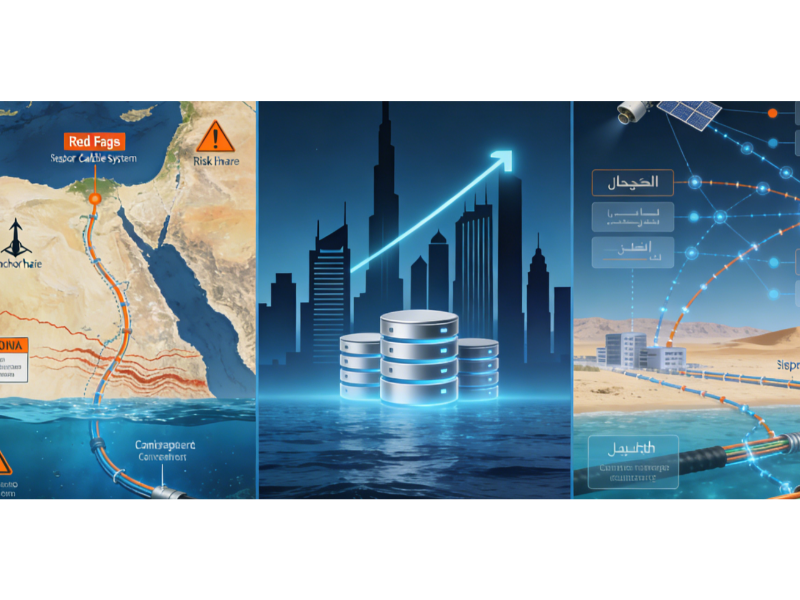
• Industry experts warn that heightened geopolitical tension and repeated undersea cable damage in the Red Sea are straining Middle East digital infrastructure and underlining the vulnerability of current subsea routes.
• Calls grow for diversified subsea capacity and alternative paths as data demand rises sharply due to cloud services, AI and international traffic needs.
What happened: subsea vulnerabilities in the Red Sea
The strategic importance of the Red Sea as a critical junction for global subsea data cables has been thrust into the spotlight again following a series of disruptions that highlighted the fragility of the region’s digital connectivity. Recent reporting by CapacityGlobal details how rising capacity demand, coupled with legacy subsea systems that lack redundancy, has underscored an “urgent need for diversification” of subsea infrastructure linking the Middle East to other regions. These warnings come amid broader concerns about regional connectivity stability that were central to industry conferences.
Cables traversing the Red Sea and Bab el-Mandeb strait carry a significant share of internet traffic between Europe, Asia and Africa. Independent analyses show that at times more than 90 % of communications between Europe and Asia route through this narrow corridor, making it an unavoidable chokepoint with little physical path diversity.
Over recent years, several subsea systems — including the South East Asia–Middle East–Western Europe 4 (SMW4), IMEWE and FALCON GCX — have suffered cuts or damage in the Red Sea, leading to rerouted traffic, increased latency and degraded performance for networks spanning the Middle East, South Asia and Africa. Operators have rerouted traffic around Africa, but this adds delay and complexity to global traffic flows.
CapacityGlobal’s report echoes industry concerns that new demand from cloud providers, hyperscale data centres and increasing adoption of artificial intelligence services is rapidly exhausting existing subsea capacity, while the physical structure of many current routes lacks alternative paths should one corridor fail.
Also Read: Boldyn Networks expands Transport for London 4G and 5G connectivity rollout across the capital
Also Read: Altice explores sale of OXG Glasfaser stake despite Vodafone’s confidence in fibre network
Why it’s important
The repeated incidents of subsea cable disruption in the Red Sea illustrate the broader structural risk to regional and global connectivity. Events such as simultaneous cuts to major undersea systems can cause slowdowns and degraded service even when full outages are avoided, underscoring how reliance on a narrow set of paths can heighten vulnerability.
The Middle East’s digital ambitions — including development of data centres, cloud services and AI infrastructure — depend on reliable, high-capacity communication links to Europe, Asia and beyond. Growth forecasts in these sectors imply that traffic volumes will expand sharply, increasing the potential impact of subsea failures on service quality and commercial operations.
Moreover, geopolitical risks add another layer of complexity. The Red Sea has been the focus of security concerns for over a year, with maritime attacks on commercial vessels and elevated insurance costs for shipping in the region. These broader tensions also reverberate in the subsea cable context because hostile activity and challenging operating conditions make both maintenance and new deployments more difficult.
As networks become more central to economic development, inconsistent connectivity can undermine confidence among investors and enterprises considering major digital investments. Markets such as Saudi Arabia and the United Arab Emirates are positioning themselves as digital and cloud hubs, but persistent subsea chokepoints could slow progress unless operators and governments prioritise path diversity and resilience.
Industry voices are increasingly calling for not only more subsea capacity but also alternative routes — such as terrestrial links around the Arabian Peninsula, satellite systems to complement undersea traffic, and new cable systems that avoid the most exposed stretches of the Red Sea — to mitigate risk.
Ultimately, the risks documented in the Red Sea highlight a disconnect between infrastructure demand and supply, where capacity growth continues but redundancy and route diversity lag behind. Stakeholders must balance speed of deployment with strategic planning to ensure that connectivity supports, rather than hinders, the Middle East’s digital future.
