
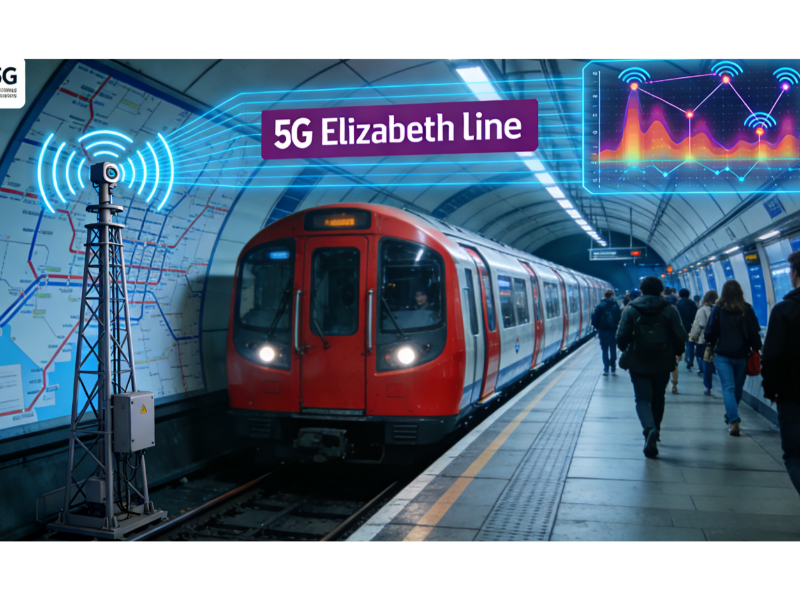
• Boldyn Networks, under a 20-year concession with Transport for London (TfL), is deploying extensive 4G and 5G infrastructure across London’s transport network to deliver mobile coverage in stations, tunnels and urban areas.
• The project leverages TfL’s ducts and street assets to accelerate small cell deployment, but infrastructure challenges, rollout pacing and operator uptake raise broader questions about actual user benefits.
What happened: connectivity project advances
Boldyn Networks, a neutral host connectivity provider, has been progressing a major initiative with Transport for London (TfL) to bring consistent 4G and 5G mobile coverage across London’s transport network, including the London Underground and parts of the Elizabeth line.
Under the concession agreed in June 2021, Boldyn is making use of existing TfL infrastructure — such as ducting, streetlamps and other assets — to install a high-capacity fibre backbone and radio equipment aimed at delivering mobile coverage in high-footfall locations as well as below ground. The company has reportedly installed over 200 small cells around the capital, including in areas such as King’s Cross, Waterloo, London Bridge, Old Street, The Shard and Hyde Park Corner, as part of efforts to densify 5G and 4G mobile signals at street level.
Transport for London and Boldyn recently announced that high-speed mobile coverage is now active at 62 of the 121 underground Tube stations in ticket halls, platforms and corridors, with more stations — including King’s Cross St Pancras, Gloucester Road and Vauxhall — expected to go live in the coming months. Work in the tunnels is also ongoing, and TfL says it expects to bring the vast majority of the network’s below-ground areas online by the end of 2026.
The rollout includes support for all four major UK mobile network operators — Three UK, EE, Vodafone and Virgin Media O2 — which connect their equipment to Boldyn’s infrastructure. A key objective of the initiative is to improve passenger experience by enabling data use, voice services and other connectivity-dependent tasks while travelling underground or waiting on platforms — activities that have historically been difficult in deep tunnel environments.
Also Read: Altice explores sale of OXG Glasfaser stake despite Vodafone’s confidence in fibre network
Also Read: Vodafone Idea launches 5G services in Bengaluru
Why it’s important
The expansion of 4G and 5G coverage across London’s transport network marks a significant infrastructure undertaking with the potential to change how commuters and visitors interact with mobile services underground and across the city. Continuous connectivity can improve passenger safety by enabling timely communication during emergencies, support work-related and leisure data use during journeys, and provide more reliable access to transportation information.
Boldyn’s approach, which reuses TfL’s existing ducts and street assets, aims to accelerate deployment while minimising street-level disruption and environmental impact. Its reported ability to connect small cells in approximately three months rather than the more typical longer timelines represents a strategic advantage in dense urban environments where planning and approval delays often hamper rollout.
Nevertheless, this public–private partnership raises questions about the broader efficacy and equitability of such projects. Despite progress, the rollout — with coverage at just over half of underground stations so far — highlights the complexity and extended timeframe of achieving full network integration. Uncertainties about operator uptake, the actual quality of coverage in deep tunnel sections and the cost implications for mobile network operators and passengers remain. Observers note that while the infrastructure capability might be present, not all carriers activate services at the same pace, which can temper the user experience.
There are also wider inquiries about digital inclusion: whether the rollout uniformly benefits all London boroughs and communities, or if areas outside central London and high-footfall zones lag behind as priorities focus on major stations and tourist hubs. Strategic planning documents for London’s digital infrastructure have emphasised gigabit-capable connectivity to public centres and CCTV sites as part of a citywide strategy, but ensuring that gains are equitable across socioeconomic groups will be important to realise long-term value.
Finally, technological advancements in mobile data and transport communications must be balanced against broader urban planning considerations, including safety, cost, and infrastructure resilience. Delivering robust mobile coverage in below-ground environments remains an engineering challenge, one that requires careful project management, clear metrics for success and ongoing evaluation to measure benefits against investment. As the project continues towards its 2026 target, stakeholders and Londoners alike will be watching whether the connectivity promise translates into substantial, reliable and equitable service across the capital.
