
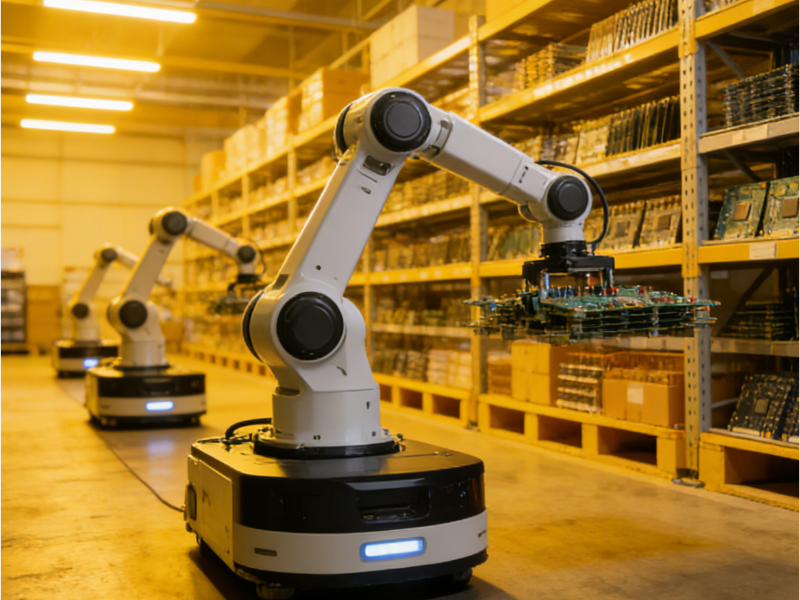
• The Indian government approved projects worth $4.6 billion to boost domestic manufacture of electronic components across mobile, telecoms, consumer and automotive segments.
• The initiative aims to strengthen local supply chains and reduce import dependence, though questions remain about execution and long-term competitiveness.
What happened: ECMS project approvals surge
India’s Ministry of Electronics and Information Technology (MeitY) has approved 418.64 billion rupees (US$4.6 billion) of projects under its Electronics Component Manufacturing Scheme (ECMS), backing efforts to grow indigenous production of key electronic parts and assemblies. The tranche represents 22 newly cleared proposals, bringing the total number of approved applications under the ECMS to 46 across eight Indian states.
The ECMS, which was launched in March 2025 and will run for six years, offers financial incentives to both domestic and global companies to manufacture components that currently have heavy import dependence. Approved projects span 11 product segments, including mobile components, telecoms parts, consumer electronics, automotive electronics and IT hardware goods.
Among the companies benefiting from the most recent approvals are global names such as Samsung Electronics, Foxconn and Tata Electronics, which are expected to use the incentives to produce enclosures, camera sub-assemblies, connectors and other components. The investments are forecast to generate 33,791 direct jobs and create output valued at about 2.58 trillion rupees ($28.6 billion) over time.
Manufacturing activity is scheduled to be spread across states including Andhra Pradesh, Haryana, Karnataka, Madhya Pradesh, Maharashtra, Tamil Nadu, Uttar Pradesh and Rajasthan, bolstering regional industrial diversification.
MeitY officials have said the ECMS approvals are part of a broader push to integrate India into global value chains and reduce reliance on imported parts. Minister for Electronics and Information Technology Ashwini Vaishnaw said the scheme is geared to support both global and local suppliers, though precise details on the split of government versus private funding for the new approvals have not been fully clarified.
Why it’s important
India’s electronics manufacturing sector has grown rapidly in recent years, producing goods worth roughly $125 billion in the year to March 2025. However, the country remains heavily dependent on imported components, particularly from China and other Asian supply hubs, which account for a significant portion of key parts such as chips, PCBs and connectors.
The ECMS initiative aims to strengthen domestic production capabilities and reduce this dependency by attracting investment in component manufacturing. By encouraging local assembly of complex parts, the policy could support wider goals of self-reliance in technology sectors that have wide applications, from smartphones to telecom equipment and electric vehicles.
Despite the ambitious investment figures, there are questions about how quickly India can build competitive advantages in component production. Analysts note that while subsidies and incentives can attract initial capital, long-term competitiveness requires sustained improvements in supply chain quality, scale and cost efficiency. For example, certain critical parts such as advanced semiconductors still rely heavily on supplies from established global hubs, and creating equivalent capacity domestically remains a longer-term challenge.
The split between state support and private investment in the newly approved projects has not been fully publicised, raising questions about the overall financial commitment from the government. Without clear visibility on funding proportions, it is difficult to predict how much of the $4.6 billion will directly stimulate new production facilities versus subsidise existing operations.
The plan also intersects with other policy initiatives aimed at boosting India’s electronics ecosystem, such as production-linked incentive schemes and export promotion measures. Whether the ECMS will significantly reduce import dependence and drive export growth remains to be seen, particularly as geopolitical tensions and global supply chain shifts continue to affect sourcing strategies and manufacturing priorities in key markets.
Also Read: India’s broadband subscriber base surpasses 1B, Marking decade of digital expansion
Also Read: Softcell Technologies builds enterprise IT for a cloud-first India
