
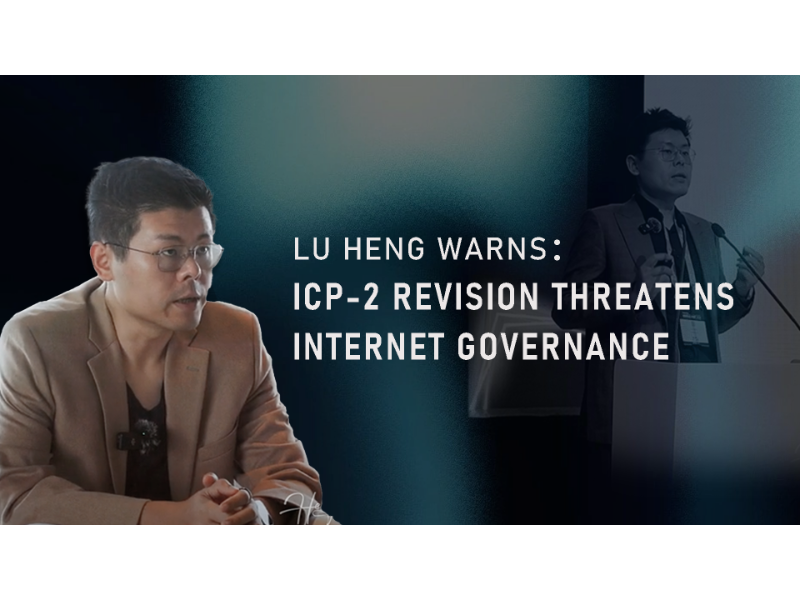
- Lu Heng argues that the latest ICP-2 revision draft effectively centralises authority over Regional Internet Registries (RIRs), restricting competition and exit.
- He explains that because the RIR system is based on voluntary cooperation, concentrating power undermines consent and risks systemic fragility.
“Every system eventually reaches a moment when it must either adapt to reality or attempt to freeze itself in place. That moment is not decided by debate. It is decided by scale. The ICP-2 Revision Draft is presented as protection, stewardship, and order. In reality, it is an attempt to preserve a structure that no longer fits the scale or nature of the system it claims to govern.”
——Lu Heng, CEO at Cloud Innovation, CEO at LARUS Ltd, Founder of LARUS Foundation.
Centralisation masquerading as stability
In his 29 December 2025 essay, Lu Heng, CEO of LARUS Limited and founder of the LARUS Foundation, critiques the draft proposal to revise the Internet Coordination Policy-2 (ICP-2) — the foundational document that sets criteria for recognising, maintaining and potentially derecognising Regional Internet Registries (RIRs). Heng asserts that the draft, while framed in terms of stewardship and protection, actually entrenches authority in a way that resists necessary adaptation.
Heng explains that the ICP-2 revision draft limits the ability of organisations to enter or exit the RIR system, making existing RIRs almost irreplaceable and new ones practically impossible. Such restrictions, he says, convert coordination into permission, and permission into power. This approach consolidates decision-making in the hands of a few unelected entities, particularly ICANN and the Numbers Resource Organization, instead of preserving the bottom-up, community-driven ethos that has long sustained the RIR system.
Also Read: Why IPv4 could be worth $60 trillion: Evaluating the debate over digital asset value
The voluntary nature of the RIR system
A core point in Heng’s analysis is the voluntary nature of the RIR governance model. Because no sovereign power enforces ICP-2 requirements, compliance depends entirely on the willingness of community members to participate. Heng warns that once exit is restricted and competition blocked, the legitimacy that underpins the system evaporates, and members may simply withdraw cooperation. Such voluntary withdrawal, he suggests, would quietly erode the system’s relevance without dramatic collapse.
Heng contends that structural resilience is not strengthened by centralising authority, but by enabling adaptive, decentralised governance processes that reflect the distributed and cooperative character of global Internet infrastructure.
Also Read: IPv4 as an investment asset: upper potential
A call for adaptation, not entrenchment
Heng’s critique frames the ICP-2 revision as symptomatic of broader tendencies to defend legacy structures instead of embracing evolution. For him, a governance framework that resists change and consolidates power risks undermining the very cooperation and consent on which the global Internet depends.
