
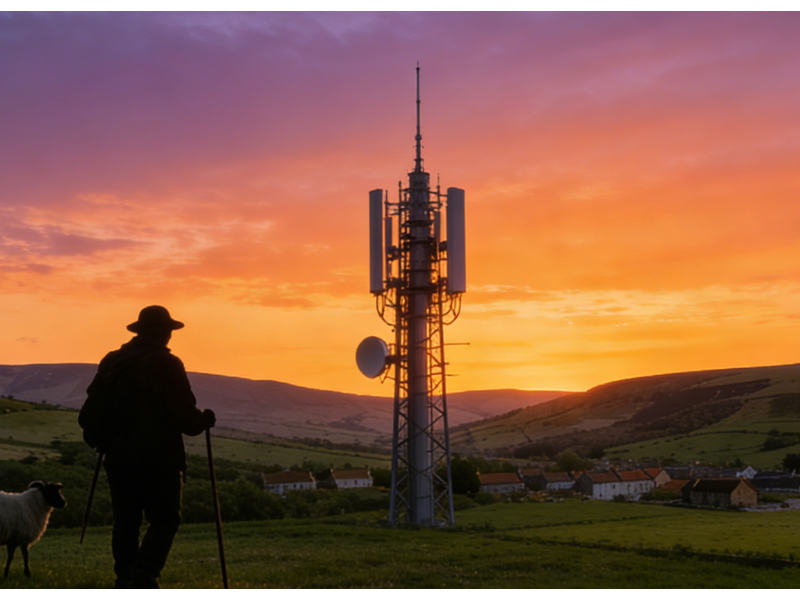
- The UK’s Shared Rural Network has delivered 4G upgrades to 100 additional rural mobile masts, extending coverage in hard-to-reach areas.
- While the rollout improves basic connectivity, questions remain about long-term funding, performance and the gap between rural and urban services.
What happened: Expanding rural coverage under the SRN
The Shared Rural Network (SRN) has completed upgrades to a further 100 mobile masts across rural parts of the UK, significantly extending 4G coverage in areas that have long suffered from poor mobile connectivity. According to the report by Telecoms.com, the new sites are located in some of the country’s most remote communities, including national parks and sparsely populated regions, where commercial investment has historically been limited.
The SRN is a joint initiative between the UK government and the country’s four mobile network operators: EE, Three UK, Virgin Media O2 and Vodafone. Its aim is to tackle so-called “partial not-spots”, areas where only one operator provides coverage, and “total not-spots”, where there is no signal at all. By sharing infrastructure and coordinating upgrades, the programme seeks to improve geographic coverage without requiring each operator to build parallel networks.
The latest batch of upgraded masts is part of the SRN’s publicly funded element, which focuses on areas unlikely to attract private investment. The operators have also committed to additional privately funded upgrades elsewhere. Together, these efforts are intended to push 4G geographic coverage to 95 per cent of the UK by the middle of the decade, though progress has varied by region.
While the announcement highlights improved access to mobile voice and data services, the upgrades largely focus on extending existing 4G capability rather than introducing new technologies such as 5G. For many rural users, however, reliable 4G remains a significant improvement over previous patchy or non-existent service.
Also Read: auDA: Administrator of Australia’s .au Domain
Also Read: 1-TO-ALL: Thailand telecom and solutions distributor
Why it’s important
Improved rural mobile coverage has clear economic and social implications. Better connectivity can support local businesses, emergency services, tourism and remote working, helping to reduce the digital divide between urban and rural communities. In this sense, the SRN addresses a long-standing policy challenge that market forces alone have struggled to solve.
However, the programme also raises questions about sustainability and ambition. While adding 100 upgraded masts is a measurable step forward, it represents incremental progress rather than a transformative leap. Many rural areas still experience slower speeds and less reliable service compared with urban centres, and the focus on 4G may limit future-proofing as digital services increasingly assume higher bandwidth and lower latency.
There is also the issue of accountability. Public funding underpins a significant portion of the SRN, making transparency over performance, coverage quality and timelines essential. Simply declaring areas “covered” does not necessarily reflect real-world user experience, particularly indoors or in challenging terrain.
As the UK looks ahead to wider 5G adoption and longer-term discussions around 6G, the SRN highlights a broader tension in telecoms policy: how to balance cutting-edge innovation with the unglamorous but essential task of ensuring universal basic connectivity.
The latest rollout shows tangible progress, but it also underlines how much work remains to ensure rural users are not left permanently one generation behind.
